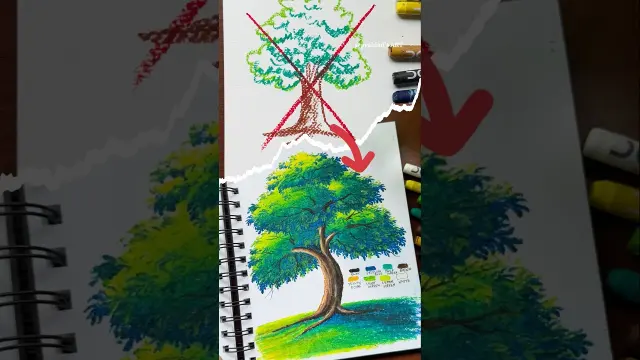
 Realistic Tree Drawing and Foliage Tutorial with Oil Pastels
#Tree Drawing
1 ideas
Realistic Tree Drawing and Foliage Tutorial with Oil Pastels
Get new #Tree Drawing ideas by email
Every Thursday: the week's best ideas, with the newest from #Tree Drawing.
Related tags
Tree Drawing Guide
What tree drawing is
Tree drawing is the study and practice of capturing the form of a tree with line, shape, and shading. It can be as simple as a quick sketch of a trunk and canopy, or as detailed as a realistic study of bark, branches, leaves, and light. Trees are a classic subject because they teach you how to observe structure in nature: thick forms branching into smaller ones, dense masses broken by open space, and irregular shapes that still feel balanced.
Why it matters
Drawing trees helps you understand proportion, texture, and rhythm. A tree is never just a round top on a stick. Its trunk shifts, branches divide unevenly, and foliage grows in clusters rather than a single smooth outline. Learning to draw trees well also improves landscape drawing, since trees often anchor gardens, forests, parks, and countryside scenes.
Read more
Main types and styles
You can draw trees in many ways, depending on the effect you want.
- Realistic tree drawing focuses on accurate structure, light, and texture.
- Loose sketching captures the gesture and overall shape with fewer details.
- Decorative or stylized trees simplify leaves and branches into patterns.
- Botanical studies pay close attention to species form, bark, and leaf arrangement.
- Silhouette drawings show the outer shape clearly and can be very effective in simple compositions.
Each style has value. If you are a beginner, it helps to start with simple shapes and gradually add detail.
How to begin
Start by looking at the tree as three main parts: trunk, branches, and foliage. Block in the largest shapes first. The trunk usually gets narrower as it rises, while branches divide into smaller and smaller forms. The outline of the canopy is often uneven and broken, not perfectly rounded.
A useful approach is to sketch lightly and build in layers:
- draw the main trunk shape
- place the largest branch directions
- map the general mass of leaves or needles
- refine the edges and add smaller branch structure
- shade to show depth and volume
If you are drawing from life, choose a tree with clear light and a simple background at first. This makes it easier to see the major forms.
Helpful techniques
To make a tree feel natural, avoid repeating the same branch length or leaf shape over and over. Nature is varied. Leave small gaps in the foliage so the drawing breathes. Vary your line weight, too: darker lines can suggest shadow or closer edges, while lighter lines keep the drawing open.
For texture, use short strokes for bark, clustered marks for leaves, and layered shading for dense areas. Think in masses rather than single leaves unless you want a highly detailed botanical study. In many cases, suggesting the foliage is more effective than drawing every leaf.
A few practical tips
- Keep the trunk and branches connected logically; branches should seem to grow from the structure, not float beside it.
- Compare sizes often so the tree does not become too symmetrical.
- Use shadows to show which side of the tree turns away from the light.
- If the drawing feels flat, simplify the outer contour and strengthen the volume inside it.
- Practice different tree species so you learn how pines, bare deciduous trees, and full leafy trees differ in shape.
With regular practice, tree drawing becomes easier to control and more expressive. The more you observe real trees, the more convincing your sketches will feel.
#Tree Drawing: frequently asked questions
How do I start drawing a tree if I'm a complete beginner?
Begin by breaking the tree into its trunk, branches and foliage rather than trying to render every leaf. Block in the largest shapes lightly first, then layer in branch directions and the general mass of the canopy before refining edges. Choosing a tree with clear light and a plain background makes those big forms much easier to see.
What do I need to draw trees, and does it have to be expensive to start?
A pencil, some paper and an eraser are genuinely enough to begin, since the early work is about observing shape and proportion rather than materials. As you get comfortable you can add softer pencils for shading, a blending tool, or colour media like oil pastels for richer foliage. Start with what you already own and let the supplies follow the skills you want to build.
Which style of tree drawing should I choose?
It depends on what you want the drawing to do: realistic studies develop observation and shading, loose sketching captures character quickly, and stylised or silhouette approaches suit decoration and simple compositions. Beginners often progress fastest by starting with a simplified outline and adding detail gradually. Try a couple of styles on the same tree to see which one you enjoy working in.
How do I keep foliage from looking flat or repetitive?
Think in clusters and masses rather than individual leaves, and let small gaps break up the canopy so the drawing breathes. Vary branch lengths, leaf marks and line weight so nothing repeats too evenly, because repetition is what makes foliage look mechanical. Strengthening volume with shading inside a simplified outer contour usually fixes a drawing that feels flat.
What are the most common mistakes people make when drawing trees?
The usual culprits are drawing a perfectly rounded canopy, giving the tree too much symmetry, and letting branches float beside the trunk instead of growing out of it. Comparing sizes as you go and keeping the trunk narrowing sensibly as it rises prevents most of these issues. It also helps not to outline every leaf, since suggestion often reads better than exhaustive detail.
What kinds of projects can I use a tree drawing for?
Tree sketches work well in nature journals, handmade cards, seasonal decorations and as studies for larger landscape pieces. Silhouette versions are especially handy for simple compositions where a strong shape matters more than detail. Practising a few different species also gives you a small library of shapes to reuse across projects.
Videos come from YouTube and posts from Instagram; titles and summaries are our own. All rights belong to their creators.