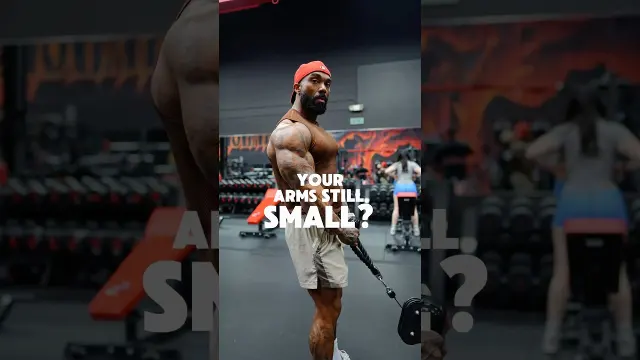
 Thirty-Minute Arm Workout for Biceps, Triceps and Forearms
#Triceps
1 ideas
Thirty-Minute Arm Workout for Biceps, Triceps and Forearms
Get new #Triceps ideas by email
Every Thursday: the week's best ideas, with the newest from #Triceps.
Related tags
Triceps: A Guide to Arm Strength and Training
The triceps brachii is the large muscle running along the back of the upper arm. Its name says most of what it does: tri-ceps, three heads. It attaches to the shoulder blade and the upper arm bone above, and to a single point on the elbow below, and it exists mainly to straighten the arm at the elbow. Every time you push a door open, lower yourself from a step, or press something away from your chest, the triceps is doing the work.
What it is and where it comes from
The three heads are usually described as long, lateral and medial. The long head crosses the shoulder joint as well as the elbow, so it also assists with bringing the arm down toward the body and reaching backward. The other two stay purely at the elbow. Because the long head works across two joints, the position of your upper arm changes how much it is involved — which is why overhead movements and movements with the arm at your side feel different from one another.
Culturally, the muscle is often treated as a purely aesthetic concern, the back of the arm people want to "tone." In practice it matters more for ordinary function than for appearance: it is a major contributor to every pushing action, and it stabilises the elbow under load.
Read more
The main kinds of training
Triceps work falls into a few broad families, each with a slightly different emphasis.
- Isolation movements: cable push-downs, overhead extensions, kickbacks. These keep the elbow doing most of the work and are easy to control.
- Compound pushing: close-grip pressing, dips, push-up variations. Here the triceps shares the load with the chest and shoulders.
- Overhead versus arms-down positions: overhead extensions place the long head under stretch; push-downs emphasise the arms-down position. Training both is a simple way to cover the whole muscle.
What beginners should know
Start lighter than you think you need. The triceps responds to the same principle as any other muscle — progressive overload, adding a little difficulty over time — and form is what makes that overload land in the right place. Keep your elbows from flaring wide during push-downs, and keep the upper arm still rather than swinging it. Full range of motion, with a controlled return, is worth more than extra weight.
If a movement causes pain in the elbow rather than a working sensation in the muscle, stop, reduce the load, and check your setup. Sharp or persistent pain is a reason to see a qualified professional rather than to push through.
Practical habits
Give the muscle time to recover between hard sessions, and remember that pushing movements elsewhere in your training already work it. Warm up with a light set or two. A few focused exercises added consistently to an existing routine will do more than a large programme attempted for a week.
#Triceps: frequently asked questions
How do I start training my triceps if I have never worked them directly?
Begin with a simple isolation movement such as a cable push-down or an overhead extension, using a lighter load than feels necessary so you can control the whole path. Keep the upper arm still and let only the elbow bend and straighten, then add a little difficulty over later sessions once the movement feels steady. A couple of focused exercises added to whatever you already do is plenty at the start.
Do I need equipment to work the triceps at home?
No — pushing movements like push-up variations and close-grip pressing use your own bodyweight and load the triceps alongside the chest and shoulders. A sturdy bench, step or low surface lets you do dips safely, and a resistance band or a single weight covers the extension and push-down style movements. What matters far more than the gear is controlling the return of each repetition.
Which triceps exercise should I choose: overhead or arms-down?
They emphasise different parts of the muscle, so the useful answer is both rather than one. Overhead extensions put the long head under stretch because that head crosses the shoulder as well as the elbow, while push-downs and kickbacks work the arms-down position. Rotating between the two across your sessions covers the muscle more evenly than sticking to a favourite.
What are the most common mistakes people make with triceps work?
Flaring the elbows wide and swinging the upper arm to move the weight are the usual ones, and both shift the effort away from the muscle. Using more load than you can lower under control, or cutting the range short at the top, are close behind. Slowing the return and keeping the elbow as the working joint fixes most of it.
How often should I train triceps, and do other exercises already count?
Any pressing you already do — chest presses, push-ups, dips — works the triceps too, so a couple of dedicated exercises is usually enough rather than a whole separate session. Leave time between hard efforts so the muscle can recover, and treat the pushing in the rest of your routine as part of the total. Warming up with a light set makes the focused work feel far better.
Videos come from YouTube and posts from Instagram; titles and summaries are our own. All rights belong to their creators.