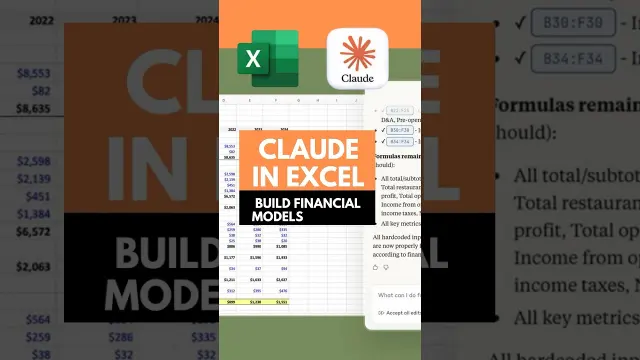
 Building Financial Models and DCF Valuations in Claude for Excel
#Valuation
1 ideas
Building Financial Models and DCF Valuations in Claude for Excel
Get new #Valuation ideas by email
Every Thursday: the week's best ideas, with the newest from #Valuation.
Related tags
Understanding Valuation
What valuation means
Valuation is the process of estimating how much something is worth. In finance, it is most often used for businesses, shares, property, projects, or other assets. A valuation is not a fixed truth; it is an informed estimate based on available information, assumptions, and the purpose of the assessment.
You may need a valuation when buying or selling a company, raising money, negotiating a partnership, planning taxes, settling an estate, or comparing investments. The same asset can have different values depending on the method used and the reason for the valuation.
Where valuation comes from
Read more
Valuation grew out of accounting, economics, and investment analysis. Over time, several approaches became standard because no single number can capture every aspect of worth. Some methods focus on current financial performance, some on future income, and some on what similar assets have recently sold for.
The right approach depends on the type of asset and how much reliable information you have. A mature business with steady cash flow is often valued differently from a startup, a property, or a piece of art.
Main valuation methods
The most common methods are:
- Income-based valuation: This looks at the future cash or earnings an asset may produce. A discounted cash flow approach is one of the best-known examples.
- Market-based valuation: This compares the asset with similar ones that have been sold or traded. It is useful when there are enough comparable examples.
- Asset-based valuation: This estimates value from the net worth of the assets after subtracting liabilities. It is often used for holding companies or businesses with significant tangible assets.
Each method has strengths and limitations. Income-based methods can be powerful but depend heavily on assumptions. Market comparisons are intuitive, but true comparables are not always available. Asset-based methods can be useful for a floor value, but they may miss the value of a strong brand, customer base, or growth potential.
What beginners should know
If you are new to valuation, start by understanding the purpose of the exercise. A value for investment decisions may differ from a value for accounting or tax purposes. Also remember that small changes in assumptions can make a large difference in the final number.
Pay attention to these basics:
- Use consistent assumptions throughout the analysis.
- Separate facts from estimates.
- Be cautious with overly optimistic forecasts.
- Compare several methods instead of relying on only one.
- Think about risk, liquidity, and the time it may take to realize value.
Practical tips
A good valuation is usually clear about what it includes and what it leaves out. It should explain the assumptions, the data source, and the method used. If you are valuing a business, make sure you understand earnings quality, debt, working capital, and any unusual one-time items. If you are valuing an asset, consider how easy it is to sell and whether demand is broad or limited.
Valuation is part analysis and part judgment. The goal is not to find a perfect number, but to reach a thoughtful, defensible estimate that helps you make better decisions.
#Valuation: frequently asked questions
What is valuation, and why would someone need one?
Valuation is an estimate of what an asset — a business, a property, a project, or a share — is worth, built from available information rather than a single fixed truth. People reach for it when buying or selling, raising money, negotiating a partnership, planning taxes, or comparing investment options. The purpose behind the exercise matters, because the same asset can fairly be valued differently depending on why it's being assessed.
How do I choose the right valuation method?
It depends on the asset and on how much dependable information you have. Income-based methods suit assets with predictable future cash flow, market comparisons work when genuine comparables exist, and asset-based methods give a useful floor for holding companies or businesses heavy in tangible assets. Rather than picking one, run more than one and see where they agree — the gaps tell you as much as the numbers.
What do I need before I start a valuation?
Start with a clear statement of purpose, then gather consistent financial information: earnings quality, debt, working capital, and any one-time items that distort the picture. Separate what you know from what you're assuming, and write the assumptions down as you go. A valuation is only as defensible as the reasoning behind it, so documenting sources and logic early saves trouble later.
Why do two valuations of the same thing come out differently?
Because a valuation is an informed estimate shaped by method, assumptions, and purpose, not a measurement. Small changes in growth expectations, discount rates, or which comparables are chosen can shift the result considerably, and a value for investment decisions may legitimately differ from one prepared for accounting or tax. Treat the difference as information about uncertainty rather than as an error.
What are the most common mistakes beginners make?
The usual ones are relying on a single method, mixing assumptions that contradict each other, and letting forecasts drift optimistic because the story is appealing. People also tend to ignore risk, liquidity, and how long it might actually take to realize value. Being clear about what the valuation excludes is just as important as being clear about what it includes.
What should a good valuation actually contain?
It should state the method used, the data behind it, and the assumptions that drive the result, in language someone else could follow and challenge. It should also say plainly what was left out and where the estimate is weakest. The aim isn't a perfect number — it's a thoughtful estimate you can defend and use to make a better decision.
Videos come from YouTube and posts from Instagram; titles and summaries are our own. All rights belong to their creators.