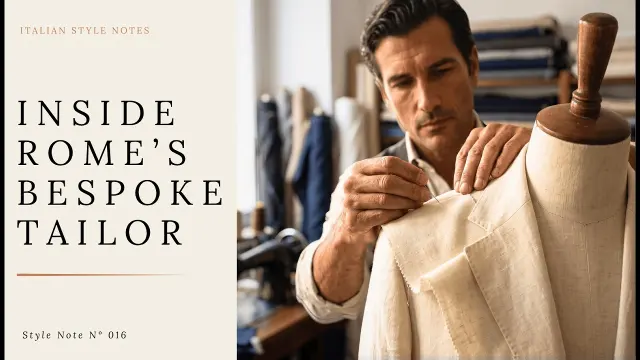
 Inside a Private Roman Atelier with Sartoria Ripense
#Atelier
2 ideas
Inside a Private Roman Atelier with Sartoria Ripense
 A Day Exploring Neapolitan Tailoring in Naples
Get new #Atelier ideas by email
Every Thursday: the week's best ideas, with the newest from #Atelier.
Related tags
Atelier: The Workshop Behind Handmade Craft
An atelier is a workshop, but the word carries more weight than that. It comes from the French for a carpenter's shop, and over centuries it came to mean the private studio where an artist, a couturier, a milliner or a tailor works with a small team of assistants. The defining characteristic is not the trade but the scale: an atelier is a place where things are made individually, by hand, under the eye of the person whose name is on them. It sits between the artist's studio and the factory floor, and it has never quite been either.
Where the word comes from
In eighteenth- and nineteenth-century Europe, workshops were organised as hierarchies. A master took on apprentices, who learned by doing the least skilled tasks first and gradually worked up to cutting, fitting and finishing. Many of the ateliers still operating today descend from that system, and some retain its vocabulary — première d'atelier, petit main, apprentice, journeyman. The French terms survive because Paris became the centre of couture, but the model existed everywhere cloth was made into clothing.
What an atelier actually contains
Read more
Walk into one and you notice the tools before anything else. Long wooden tables, shears kept sharpened, paper patterns hanging from hooks, dress forms padded to a client's measurements, drawers of buttons and offcuts. You may also notice the quiet. Much of the work is done seated, by hand, and conversation tends to be practical.
The rhythm of an atelier follows the object. A garment moves through cutting, basting, fitting, adjusting and finishing, and each stage may pass to a different pair of hands. Nothing is finished until it has been tried on a real body. That is the essential difference from ready-made production: the fitting is not a formality, it is the point.
Kinds of atelier
The word is used across many crafts. Couture and tailoring ateliers make clothing to measure. Milliners, glovers, shoemakers and embroiderers keep ateliers of their own, often supplying the bigger houses. Artists' ateliers serve painting and sculpture; ceramic, glass and jewellery ateliers work with kilns and flame. Some ateliers are attached to a single designer; others are independent workshops that take commissions from several.
If you are starting out
Learn the hand skills first and the shortcuts later — basting, pressing, hand-finishing and seam allowances are not old-fashioned, they are what hold a garment together. Be prepared to unpick. Keep a notebook of measurements and corrections, since fit is largely memory. Ask about the order of operations before you cut anything, and buy the best shears and iron you can afford, because they do more for your results than expensive fabric.
To visit an atelier, look for open studio days, craft fairs and small tailoring houses that accept appointments. Go with questions rather than a shopping list; most people working this way are glad to explain what they do, and the explanation is usually the best part.
#Atelier: frequently asked questions
How do I start learning to work in an atelier?
Begin with hand skills rather than machines: basting, pressing, hand-finishing and understanding seam allowances are what a garment actually rests on. Expect to unpick and redo a great deal, and keep a notebook of measurements and corrections because good fit depends on remembering what you have already adjusted. Before cutting anything, ask about the order of operations, so each step leaves room for the next.
What tools and equipment do I actually need?
The essentials are plain: a long flat surface to cut on, sharpened shears, paper for patterns, a padded form or dummy set to real measurements, and a good iron. Spend your money on the shears and the iron before anything else, since they influence the result more than costly cloth does. Buttons, offcuts and a drawer of small notions accumulate naturally as you work.
Which kind of atelier should I look for?
Ateliers are defined less by trade than by scale: they are places where things are made individually, by hand, under the eye of the person whose name is on them. Couture and tailoring workshops make clothing to measure, while milliners, glovers, shoemakers and embroiderers keep ateliers of their own handling a single element of dress. Decide whether you need a garment built around your body or a particular piece finished or restored, and choose accordingly.
How should I care for a handmade or made-to-measure piece?
Treat it as an object with a structure rather than as fabric alone: brush and air it after wearing, hang it on a shaped hanger, and give it rest between uses so the cloth can recover. Pressing should be done gently and from the inside wherever possible, since seams and allowances are the first thing to show damage. When something needs altering, take it back to the hands that made it, because they know how it was put together.
Can an atelier make something for a wedding or another special occasion?
Yes, and this is where made-to-measure work makes most sense, since the fitting is not a formality but the point of the process. Expect several stages — cutting, basting, fitting, adjusting, finishing — and allow real time between them rather than asking for everything at the end. Bring references and a clear sense of the occasion, but let the workshop guide the construction.
What mistakes do people make when approaching an atelier?
The commonest is arriving with a shopping list instead of questions, which skips the part of the conversation that tells you what is genuinely possible by hand. Another is chasing shortcuts before the fundamentals are solid — basting, pressing and hand-finishing are not old-fashioned, they are what holds the work together. Finally, people underestimate time and fitting: nothing is finished until it has been tried on a real body.
Videos come from YouTube and posts from Instagram; titles and summaries are our own. All rights belong to their creators.