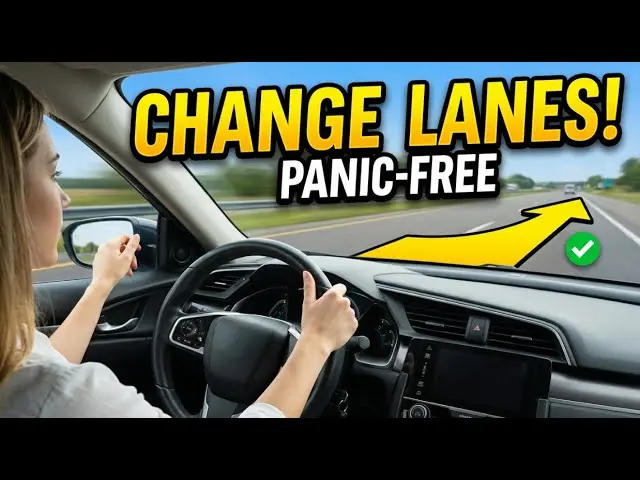
 How to Change Lanes Safely: A Step-by-Step Guide for New Drivers
#Blind Spots
1 ideas
How to Change Lanes Safely: A Step-by-Step Guide for New Drivers
Get new #Blind Spots ideas by email
Every Thursday: the week's best ideas, with the newest from #Blind Spots.
Related tags
Blind Spots: What They Are and How to Check Them
A blind spot is any area around a vehicle that you cannot see from the driver's seat, either directly or through the mirrors. Every car, van, lorry, bus and bicycle has them, and they do not disappear with experience: they shrink a little with good mirror settings and disappear almost entirely if you turn your head. Understanding them is one of the quiet fundamentals of driving, the kind of thing that never makes a lesson exciting but keeps a lot of people out of trouble.
Where blind spots sit
In a car, the largest blind spots are on both sides, just behind the driver's shoulders, in the gap between what the side mirrors show and what the corner of your eye catches. There is also a smaller one directly behind the vehicle, which is why reversing needs more than a glance in the mirror, and a patch low and close in front of the bonnet where a child or a small animal can be hidden. The exact shape depends on the car, the height of the seat and how the mirrors are set, so the only reliable map is the one you build yourself in your own vehicle.
Setting mirrors and the shoulder check
Read more
A common way to set side mirrors is to angle them outward until the side of your own car is barely visible, so that a vehicle leaving the rear-view mirror appears in the side mirror and then beside you, with as little overlap as possible. Even then, a gap remains. That gap is what the shoulder check is for: a quick turn of the head over the shoulder in the direction you intend to move, done after signalling and before committing to the manoeuvre. It takes about a second, and it is the single most useful habit a driver can build.
Bigger vehicles, bigger problems
Lorries, buses and vans have far larger blind spots, and drivers sit high up with limited views close to the vehicle. A useful rule for cyclists and pedestrians is simple: if you cannot see the driver's face in the mirror, the driver probably cannot see you. Pass behind a large vehicle with room to spare, avoid lingering alongside it, and never assume a signal means the driver has noticed you.
Practical habits
- Move your head, not just your eyes, when you scan the road.
- Check blind spots before changing lanes, merging, opening a door into traffic and pulling away from the kerb.
- Do not rely on mirrors alone in car parks or when reversing; walk around the car if you can.
- Give cyclists and motorcyclists extra room, since they are small enough to vanish into a blind spot.
- Remember that blind spots exist for pedestrians too: a parked car can hide you from a driver who is already moving.
None of this is complicated, and none of it becomes unnecessary. A blind spot is simply a place where your view ends, and the whole skill is remembering to look there anyway.
#Blind Spots: frequently asked questions
What exactly is a blind spot, and does every vehicle have one?
A blind spot is any patch of road around a vehicle that the driver cannot see directly from the seat or through the mirrors. Every car, van, lorry, bus and bicycle has them, and they do not vanish with experience — good mirror settings shrink them, and turning your head clears almost all of the rest.
How do I work out where the blind spots are in my own car?
The shape changes with the vehicle, the seat height and how the mirrors are angled, so there is no universal diagram worth memorising. The reliable way is to sit in your normal driving position and note where a car disappears from your rear-view mirror, where it reappears in the side mirror, and where it vanishes into the gap beside you until you turn your head. That personal map is worth building once in any car you drive regularly.
What is the best way to set my side mirrors, and is that enough?
A common approach is to angle each side mirror outward until barely a sliver of your own car shows, so a vehicle moves from the rear-view mirror to the side mirror to your peripheral vision with little overlap. Even then a gap remains, which is why mirror settings support the shoulder check rather than replacing it.
What is a shoulder check and when should I do one?
It is a quick turn of the head over the shoulder in the direction you intend to move, performed after signalling and before you commit to the manoeuvre. It costs a brief moment and covers the gap the mirrors cannot, so it belongs before lane changes, merging, pulling away from the kerb and opening a door into traffic.
How should cyclists and pedestrians handle the blind spots of lorries and buses?
Large vehicles have much bigger blind areas and the driver sits high with poor views close in, so the safest assumption is that you have not been seen. If you cannot see the driver's face in the mirror, the driver probably cannot see you — so pass well behind rather than lingering alongside, and never treat a signal as proof the driver has noticed you. A parked car can hide a pedestrian from a moving driver in the same way.
What mistakes do drivers most often make with blind spots?
The usual ones are trusting the mirrors alone, especially when reversing or in car parks, and moving the eyes across the glass without turning the head. Another is crowding cyclists and motorcyclists, who are small enough to sit entirely inside the blind area. Walking around the car before reversing, where you can, removes the guesswork altogether.
Videos come from YouTube and posts from Instagram; titles and summaries are our own. All rights belong to their creators.