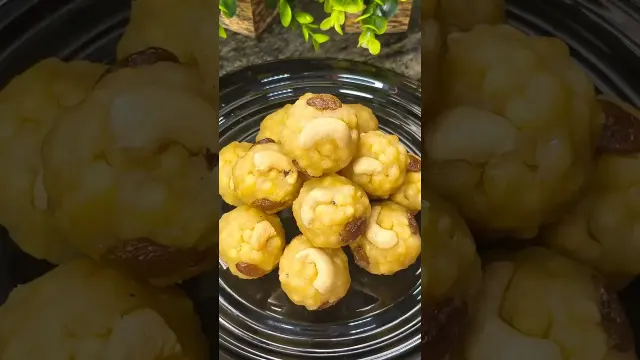
 Perfect Boondi Laddu recipe for Diwali celebrations
#Boondi Laddu
1 ideas
Perfect Boondi Laddu recipe for Diwali celebrations
Get new #Boondi Laddu ideas by email
Every Thursday: the week's best ideas, with the newest from #Boondi Laddu.
Related tags
Boondi Laddu: A Guide to the Classic Indian Sweet
Boondi laddu is one of those sweets that seems to appear whenever something good happens — a wedding, a festival, a temple visit, an exam passed, a relative arriving unannounced. Round, golden and slightly sticky to the touch, it is a fixture of Indian celebration sweets, and it is also one of the few that many families still make at home.
What it is
The name tells you most of it. Boond translates roughly as "droplet", and boondi are just that: tiny round pearls of batter made from besan, gram flour, dropped into hot ghee or oil and fried until they set. Those pearls are then soaked briefly in a sugar syrup, drained, mixed with flavourings and nuts, and pressed into firm balls while still warm and pliable. Once cool, a laddu holds its shape and can be stored for days.
Where it comes from
Read more
Boondi has a long history in the Indian subcontinent, appearing in temple offerings and regional cooking across the north and west in particular. It exists in two quite different lives: soft boondi, soaked in syrup and used for sweets, and crisp salted boondi, which becomes a snack or a topping for yoghurt dishes. The laddu form grew out of the sweet version, and it remains closely associated with religious offerings — many temples distribute it as prasad — as well as with festival tables and wedding trays.
The main kinds
The base is almost always the same, but the variations matter:
- Plain boondi laddu, lightly flavoured with cardamom and studded with almonds, cashews or raisins.
- Saffron or yellow-tinted versions, where the syrup is perfumed and coloured.
- Motichoor laddu, made from a much finer, softer boondi that gives a denser, melt-in-the-mouth texture.
- Regional variations that add coconut, poppy seeds, or a hint of edible camphor for fragrance.
What beginners should know
Making boondi at home is forgiving once you understand three things. First, the batter: besan and water whisked to a smooth, pourable consistency with no lumps — thick enough to fall in droplets, thin enough not to clog the ladle. Second, the dropping: a perforated ladle held just above the hot fat, tapped gently, so the batter falls as small even pearls rather than streams. Third, the syrup: cook sugar and water until it is sticky between your fingers but not stringy, then soak the fried boondi only briefly, so the laddus stay soft without becoming soggy.
A few practical tips help. Fry on a steady medium heat, because fat that is too hot browns the outside while the centre stays raw. Drain the boondi well before adding it to the syrup. Grease your palms with ghee before shaping, and work quickly while the mixture is warm. If it cools too much, a few seconds back over gentle heat loosens it again.
Serve them at room temperature, and store in an airtight container away from moisture. Made with care, a batch will keep for several days — long enough to carry to whoever you are celebrating with.
#Boondi Laddu: frequently asked questions
How do I get started making boondi laddu at home if I've never made sweets before?
Start by getting comfortable with the batter and the dropping, since those two steps decide how the laddus turn out. Whisk gram flour with water until it is completely smooth and pourable, then practice dropping it through a perforated ladle into hot fat so it falls as small pearls instead of streams. Once the boondi fry evenly and drain well, shaping them in warm syrup is the easy part.
What ingredients and equipment do I need for boondi laddu?
You need gram flour, water, sugar, ghee or oil for frying, and something to flavour and finish with such as cardamom, nuts or raisins. The one piece of equipment worth having is a perforated ladle or skimmer with small holes, because it controls the size of the boondi. A heavy pan for the syrup and a wide slotted spoon for draining make the whole process calmer.
Should I make plain boondi laddu or motichoor laddu?
Plain boondi laddu has a bit more texture, with visible pearls and a light cardamom flavour, and it is the more forgiving one to attempt first. Motichoor uses a much finer, softer boondi, which gives a denser sweet that seems to dissolve as you eat it, but it demands more care in the dropping. If you are new to it, start plain and move to motichoor once the batter and frying feel familiar.
How should I store boondi laddu so they stay fresh?
Keep them at room temperature in an airtight container, away from any moisture, and they will hold up well for several days. Avoid putting them in the refrigerator, since the sugar syrup can turn grainy and the texture suffers. If you are carrying them somewhere, pack them in a single layer or with parchment between so they do not press into each other.
What occasions suit boondi laddu best?
They are a natural fit for festivals, weddings, temple visits and any celebration where something traditional is expected. Because they travel and keep well, they also work as a gift to bring when visiting family or marking good news. Many households treat them as the default sweet to make when guests arrive without warning.
What are the most common mistakes when making boondi laddu?
The usual culprits are fat that is too hot, which browns the boondi outside while the middle stays raw, and boondi that go into the syrup wet with oil. Another frequent slip is soaking them too long, which leaves the finished laddu soggy rather than soft. Greasing your hands and shaping while the mixture is still warm fixes a lot of the frustration at the end.
Videos come from YouTube and posts from Instagram; titles and summaries are our own. All rights belong to their creators.