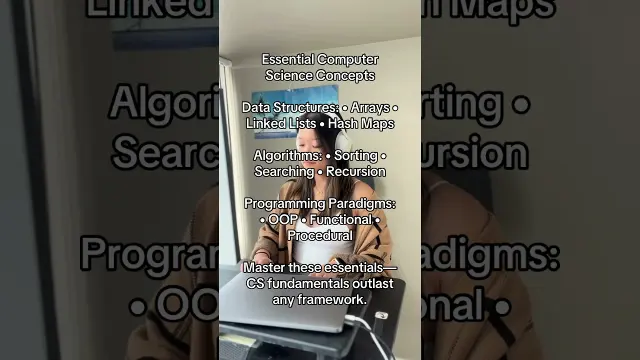
 Core Computer Science Fundamentals That Outlast Any Framework
#Computer Science Basics
1 ideas
Core Computer Science Fundamentals That Outlast Any Framework
Get new #Computer Science Basics ideas by email
Every Thursday: the week's best ideas, with the newest from #Computer Science Basics.
Related tags
Computer Science Basics: A Beginner's Guide
Computer science is the study of how information is represented, stored, processed and communicated, and of how problems can be solved with precise, step-by-step methods. It is not the same as simply using computers. Someone who writes a letter in a word processor is using a computer; someone who works out why that program runs slowly on large files is starting to think like a computer scientist.
The field grew out of mathematics and logic in the twentieth century, when researchers began asking what can be computed at all and how machines could carry out those computations. Today its ideas show up almost everywhere, from the apps on a phone to the way online shops keep track of orders, from the design of games to the tools that help doctors read scans.
The core ideas
Most introductory courses and books return to a handful of foundations:
Read more
- Algorithms: a clear sequence of steps that solves a problem, such as sorting a list of names or finding the fastest route between two points.
- Data structures: ways of organising information, such as lists, stacks, queues, trees and tables, each suited to different tasks.
- Binary and representation: computers store everything, including text, images and sound, as patterns of zeros and ones.
- Abstraction: hiding complicated details behind a simpler interface, so that you can use a tool without rebuilding it from scratch.
- Logic: the rules of true and false that underlie conditions, decisions and error checking.
- Complexity: how the time and memory an algorithm needs grow as the input grows, which helps you choose between approaches.
Where to begin
If you are new to the subject, start small and be patient with yourself. Choose one language to learn first, such as Python, which has a readable syntax and is widely taught. Write short programs that do something you care about, like a tool that counts words in a text or a simple quiz. Reading other people's code is just as useful as writing your own.
Draw things out on paper before you type. Working through a problem step by step, with a pencil and a few examples, often reveals the logic faster than staring at a screen. When something breaks, read the error message carefully, change one thing at a time, and try to predict what will happen before you run the code.
Do not worry if the maths feels intimidating at first. Many people discover that the logical thinking matters more than advanced formulas for everyday programming, and the more complex topics can be approached gradually.
Keeping it useful over time
Tools and frameworks change, but the fundamentals are remarkably stable. Learning how data is organised, how algorithms are compared and how systems communicate will serve you whatever technology you use later. Free online courses, library books and introductory university materials are good places to build that foundation at your own pace.
Above all, enjoy the process. Computer science rewards curiosity: every program you understand a little better is a small step toward seeing the digital world in a new way.
#Computer Science Basics: frequently asked questions
How do I start learning computer science with no background at all?
Begin with one language and stay with it long enough to get comfortable, rather than sampling several at once. Pick small projects you actually care about, like a word counter or a simple quiz, so each lesson has a purpose. Reading other people's code counts as practice too, and it often teaches you faster than writing alone.
What do I actually need to get going?
A computer, a free code editor or text editor, and the patience to work through problems slowly are really all it takes. Paper is more useful than people expect: sketching the steps of a problem by hand often makes the logic clear before you write a line of code. Free courses, library books and introductory university materials will carry you a long way if you go at your own pace.
Should I choose a language first, or start with the theory?
Start with a language, because it gives you something concrete to practise on, and let the theory arrive as you need it. Choose one with readable syntax that beginners are commonly taught, since clear code helps you focus on the thinking rather than the punctuation. The underlying ideas stay the same across languages, so the specific choice matters far less than finishing small projects in whichever one you pick.
Do I need to be good at maths to study computer science?
Advanced formulas matter less than many beginners fear, especially for everyday programming. What does most of the work is logical thinking: breaking a problem into steps, checking conditions, and reasoning about what happens in each case. Harder mathematical topics can be approached gradually, once the basics feel familiar.
How do I keep my skills relevant when tools change so quickly?
Concentrate on the fundamentals, which are remarkably stable: how data is organised, how algorithms are compared, and how systems communicate. Frameworks come and go, but that foundation transfers to whatever technology you meet next. Treating each new tool as an application of ideas you already know makes the churn far less exhausting.
What mistakes do beginners most often make?
Changing several things at once when something breaks is the classic one, because then you cannot tell what fixed it. Ignoring error messages, or typing before thinking the problem through on paper, wastes a lot of time. Try predicting what your code will do before you run it, then compare that with what actually happened.
Videos come from YouTube and posts from Instagram; titles and summaries are our own. All rights belong to their creators.