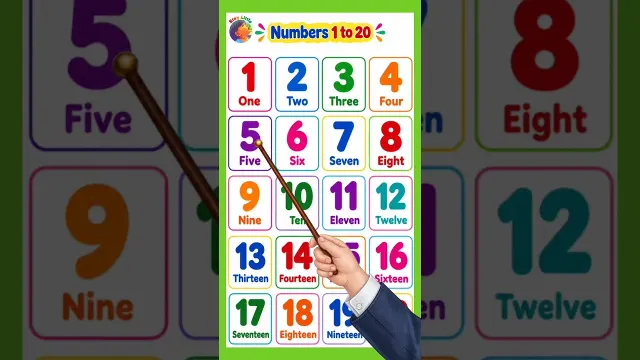
 Fast Counting From One to Twenty for Children
#Counting Practice
1 ideas
Fast Counting From One to Twenty for Children
Get new #Counting Practice ideas by email
Every Thursday: the week's best ideas, with the newest from #Counting Practice.
Related tags
Counting Practice for Children
Counting practice is one of the earliest and most important steps in learning mathematics. It helps children connect spoken number words with objects, actions, and quantities. Before a child can add, compare, or solve simple number problems, they usually need repeated experience with counting in many different ways.
Counting has been part of early learning for a very long time. Families, teachers, and caregivers have always used songs, finger games, picture books, and everyday objects to help children understand numbers. At its heart, counting practice is not only about saying numbers in order. It is also about learning what each number means, how quantities grow, and how numbers relate to one another.
What counting practice includes
Counting practice can take several forms. A child may count aloud from one upward, count objects one by one, count backward, or count by groups in simple ways. They may also match numbers to items, such as one toy, two apples, or three steps. These activities build number sense, which is the basic understanding of how numbers work.
Read more
For young children, the most useful kinds of counting practice are often concrete and visual. Touching, moving, pointing to, or grouping objects helps make numbers easier to understand. That is why counting everyday things such as buttons, stairs, blocks, fingers, or fruit can be so effective.
Common ways children learn to count
There are several familiar approaches to counting practice:
- Counting objects: children point to each item once as they say the number words.
- Counting aloud: children recite numbers in order to become familiar with the sequence.
- Counting with actions: claps, jumps, steps, or taps make counting active and memorable.
- Counting in everyday life: setting the table, sorting toys, or sharing snacks gives numbers real meaning.
- Counting pictures or patterns: rows of dots, animals, or shapes help children recognize amounts.
What beginners should know
At first, children may repeat numbers without matching them correctly to objects. That is normal. Counting takes time, and young learners often need many chances to practice. It helps to keep activities short, calm, and playful. A child usually learns best when counting feels like part of a game rather than a test.
It is also important to go slowly. Start with small groups of objects and use the same routine often. For example, you can ask a child to touch each block while saying the numbers. If they lose track, begin again without pressure. Repetition is useful because it strengthens memory and confidence.
Practical tips for counting practice
- Use real objects whenever possible.
- Encourage the child to point, move, or line up items while counting.
- Mix counting into ordinary routines, such as snack time or tidying up.
- Count in both directions once forward counting feels easy.
- Keep the mood light and encouraging.
- Repeat familiar number songs and rhymes.
Counting practice lays the groundwork for later math skills, but it is also useful in everyday life. When children count regularly, they begin to notice patterns, compare amounts, and understand that numbers describe the world around them.
#Counting Practice: frequently asked questions
How do I start counting practice with a young child?
Begin with a handful of familiar objects and count them together slowly, touching each one as you say a number word. Keep the session short and playful so it feels like a game rather than a lesson, and stop while the child is still enjoying it.
What do I need to get started?
Nothing special beyond everyday things — buttons, blocks, fruit, stairs, or fingers all work well. Real objects that can be picked up and moved are more useful than worksheets at this stage, because they let a child see and feel the quantity.
Which type of counting practice should I choose?
Pick the form that fits the moment: counting objects builds one-to-one matching, counting aloud builds familiarity with the number sequence, and counting with claps or steps adds movement and memory. Mixing several kinds across the day tends to work better than sticking to just one.
How do I keep counting practice going as my child improves?
Once counting forward feels easy, try counting backward, counting small groups, or counting things around the house during ordinary routines like tidying up or setting the table. Repeating the same familiar activity often builds confidence more than introducing something new each time.
What are common mistakes to avoid?
A frequent mistake is going too fast or turning practice into a test, which can make a child anxious about numbers. Another is correcting every slip — if a child loses track, it is usually better to simply start again without pressure, since repetition is what strengthens the skill.
Are there simple ideas for making counting fun?
Sing number songs and rhymes, count jumps or claps, and let the child point to and line up items while counting. Bringing counting into snack time, shopping, or bedtime routines shows that numbers describe real things rather than existing only on a page.
Videos come from YouTube and posts from Instagram; titles and summaries are our own. All rights belong to their creators.