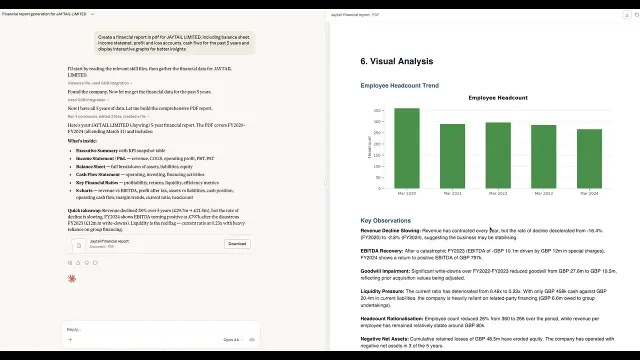
 Pulling Company Financial Data Directly Inside Claude AI
#Data Research
1 ideas
Pulling Company Financial Data Directly Inside Claude AI
Get new #Data Research ideas by email
Every Thursday: the week's best ideas, with the newest from #Data Research.
Related tags
Data Research Basics and Best Practices
Understanding data research
Data research is the process of finding, collecting, checking, and interpreting information so you can answer a question or make a better decision. It is used in many fields, from business and education to journalism, science, design, and everyday planning. At its core, data research is about turning raw information into something meaningful.
Where data research comes from
Data can come from many places. Some sources are created for research, such as surveys, interviews, experiments, and observations. Other sources are collected for practical use and later reused for analysis, such as records, reports, databases, website activity, and administrative files. You can also work with published data from books, articles, public institutions, and open datasets.
Read more
The best source depends on what you are trying to learn. If you want personal opinions or experiences, a survey or interview may help. If you want patterns over time, existing records or datasets may be more useful. If you want to understand behavior, observation or usage data can be helpful.
Main kinds of data research
There are two broad approaches: qualitative and quantitative.
- Qualitative research focuses on words, meanings, and experiences. It often uses interviews, open-ended responses, notes, and documents.
- Quantitative research focuses on numbers and measurable patterns. It often uses counts, ratings, percentages, and comparisons.
Many projects combine both. For example, you might use numbers to spot a pattern and then use interviews to understand why it happens.
Common steps in the process
Good data research usually follows a simple path:
- Define the question clearly.
- Choose data that fits the question.
- Collect information carefully.
- Clean and organize the data.
- Look for patterns, differences, and gaps.
- Check whether the findings make sense.
- Present the results in a clear way.
A clear question matters more than a large amount of data. If the question is vague, the results are likely to be vague too.
What beginners should keep in mind
When you are new to data research, start small. Choose one question, one type of source, and one simple way to organize the material. Keep notes on where each piece of data came from. That makes it easier to check your work later.
It is also important to think about quality. Not all data is equally reliable. Look for missing values, unclear definitions, duplicate records, and biased sampling. If data comes from people, remember that context matters. A number without background can be misleading.
Practical tips for better research
- Use sources that are relevant and trustworthy.
- Keep your data organized from the start.
- Compare more than one source when possible.
- Be careful not to confuse correlation with cause.
- Separate facts from interpretation.
- Make your conclusions match the strength of your evidence.
A useful habit
The best data research is patient and precise. Ask good questions, check your sources, and stay open to what the data actually shows. When you handle information carefully, it becomes easier to trust your conclusions and explain them clearly to others.
#Data Research: frequently asked questions
How do I get started with data research if I've never done it before?
Begin with one narrow question you actually want answered, then pick a single type of source that suits it. Keep the scope small enough that you can collect and organize everything yourself, and write down where each piece of information came from as you go. Once that first round feels manageable, you can widen the question or add another source.
What do I need before I start collecting data?
A clearly worded question and a simple plan for where the information will come from are the essentials; expensive tools are not required. Decide in advance how you will store and label what you gather so the material stays consistent. Thinking about definitions early saves a lot of cleanup later.
Should I choose qualitative or quantitative research?
Pick qualitative approaches when you care about opinions, meaning, and the reasons behind behavior, and quantitative ones when you want to measure patterns and compare groups. Many projects work best as a mix, using numbers to reveal a pattern and interviews or open responses to explain it. Let the question decide the method rather than the other way around.
How can I tell whether my sources are reliable?
Check who produced the information and whether they had a reason to skew it, then look for missing values, vague definitions, and duplicate entries. Comparing more than one independent source is one of the simplest ways to catch problems. A figure without any background about how it was gathered should be treated with caution.
What mistakes do beginners most often make?
The most common ones are starting with a vague question, letting data pile up without organizing it, and treating a correlation as if it proved a cause. Another frequent slip is presenting interpretation as though it were the data itself. Keeping facts and conclusions in separate places helps you avoid all of these.
How do I present my findings clearly at the end?
Match the strength of your conclusions to the strength of the evidence behind them, and say plainly where the gaps are. Lead with the answer to your original question, then show the support in a simple chart, table, or short summary that a reader can follow without your help. Explaining how you checked your work makes the result far easier to trust.
Videos come from YouTube and posts from Instagram; titles and summaries are our own. All rights belong to their creators.