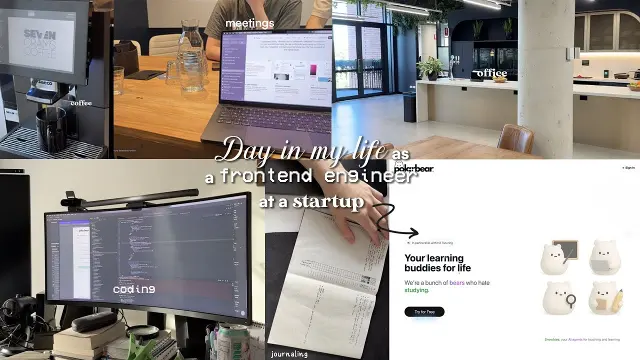
 A Day in the Life of a Frontend Developer at a Startup
#Developer Career
2 ideas
A Day in the Life of a Frontend Developer at a Startup
 Day in the Life and Responsibilities of a Software Engineer
Get new #Developer Career ideas by email
Every Thursday: the week's best ideas, with the newest from #Developer Career.
Related tags
Developer Career: A Guide to Growing as a Software Engineer
A developer career is the long arc of work that begins when someone learns to write software and continues through the roles, projects and decisions that follow. It is not a single job but a family of them — frontend, backend, mobile, data, infrastructure, embedded — each with its own tools and temperament, all sharing the same core: turning a problem into instructions a computer can carry out reliably, and doing it in a way other people can maintain.
Where it comes from
Software development grew out of mathematics, engineering and a certain amount of improvisation. The early programmers were often scientists writing instructions by hand; over time the field split into specialities as systems grew too large for one person to hold in their head. What has stayed constant is the apprenticeship shape of the work: you learn by reading other people's code, by shipping something small, and by fixing the things you broke.
The main paths
Read more
- Frontend: everything the user sees and touches in a browser or app — layout, state, accessibility, responsiveness.
- Backend: the servers, databases and business logic that hold a product together.
- Full stack: a working knowledge of both, common in smaller teams and startups.
- Mobile: building for phones and tablets, with platform conventions that differ from the web.
- Data and machine learning: pipelines, analysis and models, closer to statistics than to interface work.
- Infrastructure and platform: keeping systems running, deployable and observable.
Specialities overlap more than job titles suggest. Moving between them is normal and often useful.
What beginners should know
You do not need to learn everything before you apply for work. What employers and collaborators look for is evidence that you can finish things: a project you built, a bug you chased down, a piece of code you can explain line by line. Learn one language well rather than five badly, and learn to read code as deliberately as you write it. Version control, debugging and the ability to ask a clear question are skills that pay off in every role.
Growing over time
Early in a career, the goal is breadth and reliability: finishing tasks, writing code others can read, learning to estimate honestly. Later, the leverage shifts. Seniority is less about knowing more syntax and more about judgement — spotting which problems are worth solving, breaking large work into safe steps, reviewing other people's designs, and explaining technical trade-offs to people who do not write code.
Practical habits
- Keep a small record of what you build and what you learned; it becomes your portfolio and your memory.
- Read code more than you think you need to, especially in projects you admire.
- Ask for feedback on specific things — a naming choice, a design — rather than in general.
- Protect your attention. Deep work is where the difficult parts get solved.
- Learn to write plainly. Most of a developer's influence travels through written words.
- Treat burnout as a design problem, not a personal failing; sustainable pace outlasts heroic sprints.
Careers in this field rarely move in straight lines. People move between product companies and consultancies, from hands-on work into management and back again. What holds it together is curiosity and the willingness to keep learning tools that will eventually be replaced.
#Developer Career: frequently asked questions
How do I actually start a developer career with no technical background?
Start by picking one language and using it to build something small and finished, rather than reading about many languages at once. A working project you can explain line by line — even a modest one — is the evidence people look for, far more than a pile of half-finished tutorials. Read other people's code deliberately alongside writing your own, and get comfortable with version control and debugging early, because those habits carry across every role.
What do I need before applying for a first developer job?
You need proof that you can finish things: a project you built, a bug you tracked down and fixed, and code you can walk someone through without hesitating. You do not need to know everything in advance, since the job is largely learning on the move. Being able to ask a clear, specific question and write plainly will matter as much as syntax.
Which path should I choose — frontend, backend, mobile, data, or infrastructure?
Choose based on what kind of problem you enjoy holding in your head: what users see and touch, the logic and data underneath it, or the systems that keep everything running. The paths overlap more than job titles suggest, and switching between them later is normal rather than a setback. A reasonable approach is to start where your curiosity is strongest, since that is where you will keep practising without being pushed.
What does a developer actually do all day?
Most of the day is spent reading existing code, understanding a problem, and making small careful changes, punctuated by conversations about what to build and how. Writing new code is a smaller share of the work than beginners expect, and reviewing other people's work is a regular part of it. Expect a mix of solitary focus and explaining your thinking to teammates who may not write code themselves.
How does a developer career grow beyond just writing more code?
Early on, the goal is reliability — finishing tasks, writing code others can read, and estimating honestly. Later the leverage shifts toward judgement: spotting which problems are worth solving, breaking big work into safe steps, and explaining trade-offs to people outside the field. Seniority comes to mean knowing what not to build rather than knowing more syntax.
What mistakes do people new to this field commonly make?
Trying to learn many languages shallowly instead of one well, and avoiding reading code because writing feels more productive, are the usual ones. Another is treating exhaustion as a personal failing rather than a design problem, which leads to unsustainable sprinting and losing the attention deep work requires. Asking for vague feedback instead of feedback on a specific naming choice or design decision also slows people down.
Videos come from YouTube and posts from Instagram; titles and summaries are our own. All rights belong to their creators.