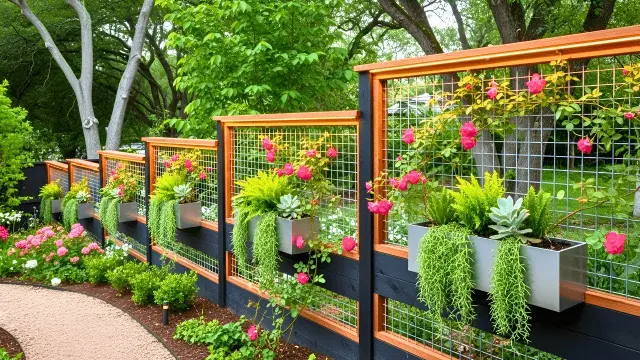
 Backyard Fence Garden Ideas For Privacy And Style
#Fence Garden
1 ideas
Backyard Fence Garden Ideas For Privacy And Style
Get new #Fence Garden ideas by email
Every Thursday: the week's best ideas, with the newest from #Fence Garden.
Related tags
Fence Garden Ideas and Planting Guide
A fence garden is a planting area designed around a fence so the boundary becomes part of the garden rather than just a divider. It can be used to soften a plain edge, add privacy, create a backdrop for flowers and foliage, or make the most of a small outdoor space. In many gardens, fences have long been used as supports for climbers and as a way to define paths, courtyards, and boundaries.
What a fence garden can be
A fence garden may be as simple as a line of climbers trained along timber, metal, or wire fencing. It can also include planting beds at the base of the fence, hanging containers, trellises, or a mix of all three. The style can be formal and tidy, with clipped plants and repeating shapes, or loose and romantic, with rambling vines and layered flowers.
Common uses include:
- Softening a hard boundary
- Adding privacy
- Creating a green screen
- Supporting vertical planting in a small space
- Giving structure to a garden border
Read more
Good plants for fence gardens
The best plants depend on your climate, light, and the amount of space you have. Climbing plants are often the main feature because they naturally use the fence for support. Some gardeners also mix in shrubs, perennials, herbs, and seasonal flowers at ground level to create layers.
When choosing plants, think about:
- Sun or shade
- How much room the roots have
- Whether the fence can support the plant’s weight
- How much maintenance you want
If you want a fuller look, combine upright plants with trailing or climbing ones. If the fence is in shade, choose plants that tolerate less light rather than forcing sun-loving species to struggle.
Styles and techniques
There are several ways to create a fence garden. A trellis fixed to the fence gives climbing plants something to grip. Training wires can help guide growth in a neat pattern. Containers attached to the fence are useful for herbs, small flowers, or compact foliage plants. Raised beds along the base of the fence make planting easier and can help create a layered effect.
You can shape the garden in different ways:
- Natural and informal, with mixed planting and relaxed growth
- Neat and structured, with repeated plants and clear lines
- Cottage-style, with abundant flowers and soft edges
- Minimal, with a few well-chosen plants and clean spacing
Practical tips for beginners
Start by checking the fence condition. A healthy, stable fence is important if you plan to grow climbers on it. Leave enough space between the fence and plants so air can move and maintenance stays manageable. Avoid overcrowding the base of the fence, since plants need room to grow and roots need space.
Watering is especially important for fence gardens in containers or narrow beds, because these areas can dry out quickly. Mulch can help hold moisture and keep weeds down. Pruning and training are also part of the process, especially for climbers that need guiding in the right direction.
A fence garden works best when it feels balanced: enough growth to soften the fence, but not so much that it becomes heavy or difficult to manage. With a little planning, your fence can become one of the most attractive parts of the garden.
Videos come from YouTube and posts from Instagram; titles and summaries are our own. All rights belong to their creators.