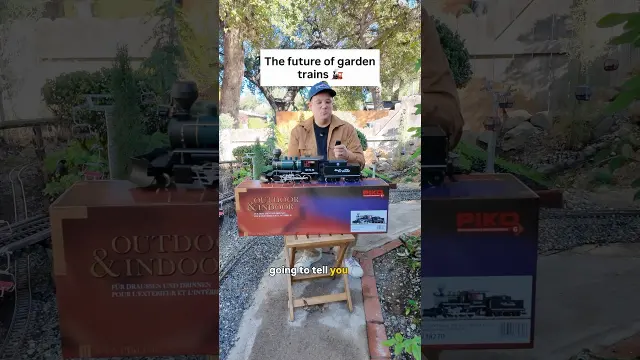
 Unboxing And Reviewing The New Piko Tri-Mode G Scale Locomotive
#G Scale
1 ideas
Unboxing And Reviewing The New Piko Tri-Mode G Scale Locomotive
Get new #G Scale ideas by email
Every Thursday: the week's best ideas, with the newest from #G Scale.
Related tags
G Scale Model Railways
What G scale means
G scale is a size of model railway used for larger-scale trains, often chosen for indoor display layouts and garden railways. The name is commonly linked with large models that are easy to handle and enjoyable to watch in motion. Because the trains are bigger than many other model scales, G scale is often popular with beginners, families, and anyone who likes a layout that feels clear, robust, and full of presence.
Why people choose it
One of the main appeals of G scale is visibility. The locomotives, carriages, and details are large enough to see easily, which makes the scale satisfying to build, operate, and decorate. It can suit simple oval tracks, detailed scenic layouts, or more ambitious outdoor railways. Many people also like that the larger size can make coupling, cleaning, and handling easier than with smaller model trains.
Read more
Common styles and uses
G scale is often associated with garden railways, where tracks run through planted borders, patios, or dedicated outdoor spaces. In that setting, the trains become part of the landscape and can be paired with buildings, bridges, figures, and trees.
It is also used indoors, especially for display layouts or larger rooms where there is enough space for broad curves and substantial scenery. Depending on your interests, you might focus on:
- Steam locomotives with classic passenger or freight stock
- Diesel or electric locomotives for a more modern look
- Narrow scenic lines with mountains, tunnels, and bridges
- Simple loop layouts for easy operation
- Detailed miniature worlds with stations, yards, and villages
What beginners should know
G scale looks simple at first, but it still benefits from planning. The larger size means you need more room than with smaller model railway scales, especially if you want realistic curves and scenery. Before buying trains, think about whether your layout will be indoors or outdoors, how much space you have, and how much maintenance you want to do.
A good beginner layout does not need to be complex. A clean track plan, a reliable locomotive, and a few well-chosen scenic elements are often enough to create something enjoyable. It is usually better to start small and expand gradually than to build too much at once.
Practical tips for building and running G scale
- Use solid, level track support so the trains run smoothly.
- Keep outdoor track clean and check it regularly for dirt, leaves, and weather effects.
- Choose weather-resistant materials if your layout will stay outside.
- Leave generous curves and clearances, because large models need more space.
- Add scenery slowly so you can test how trains move before fixing everything in place.
- Store rolling stock carefully when not in use, especially if it is exposed to damp or dust.
A scale with room to enjoy
G scale is especially rewarding if you like visible detail, steady operation, and a layout that feels substantial. It can be as simple or as elaborate as you want, from a small loop with a single locomotive to a full miniature landscape. If you are patient and plan with care, G scale can give you a railway that is both practical and charming for years to come.
#G Scale: frequently asked questions
What is G scale, and is it a good place to start in model railways?
G scale is one of the larger model railway sizes, which makes the locomotives, carriages and details easy to see, handle and enjoy in motion. That visibility is a big part of why beginners and families are drawn to it, along with the satisfying sense of presence a large layout has. The trade-off is that it asks for more room than the smaller scales do.
Do I need a garden to run G scale trains?
No — plenty of people run G scale indoors, either as a display layout or in a larger room with broad curves and substantial scenery. Outdoors is simply where the scale feels most at home, with track winding through borders, patios or a dedicated garden space. What really matters is deciding which setting suits you and how much weather exposure you want to deal with.
What should I think about before buying my first G scale train?
Start by deciding whether the layout will live indoors or outside, how much space you can genuinely give it, and how much cleaning and upkeep you're happy to take on. From there, choose a reliable locomotive and a clean, simple track plan rather than trying to assemble everything at once. Beginning small and expanding gradually usually works out better than building too much too soon.
How do I keep an outdoor G scale railway running well?
Clean track is the foundation, so check regularly for dirt, leaves and anything the weather has left behind. Choose materials that cope with damp and sun, and store rolling stock somewhere protected when it isn't in use. Leaving generous curves and clearances also helps, since large models need room to move without catching on scenery.
Which style of G scale layout should I choose?
It mostly comes down to what you enjoy watching: classic steam with passenger or freight stock, diesel and electric locomotives for a more modern feel, or a narrow scenic line running through mountains, tunnels and bridges. A simple loop is a perfectly respectable starting point and can develop into a detailed miniature world over time. Let your own interest in the trains themselves guide the scenery around them.
What common mistakes should a beginner avoid with G scale?
The usual one is trying to build an entire landscape at once — a small layout you can test and extend is far more rewarding than an ambitious one that never runs properly. Tight curves and cramped clearances cause trouble too, because large models need generous space. Fixing scenery permanently before checking how trains actually run can also trap problems in place.
Videos come from YouTube and posts from Instagram; titles and summaries are our own. All rights belong to their creators.