 Complete Reading and Language Arts Guide for the GED
#GED RLA
3 ideas
Complete Reading and Language Arts Guide for the GED
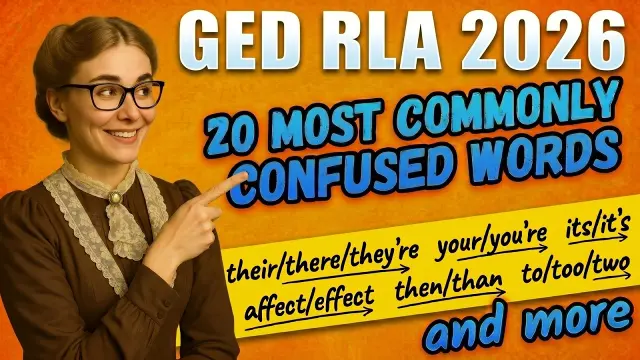 Top Twenty Commonly Confused Words on the GED RLA Test
 Challenging Language Arts Practice Questions for the GED
Get new #GED RLA ideas by email
Every Thursday: the week's best ideas, with the newest from #GED RLA.
Related tags
GED Reading and Language Arts Guide
What GED Reading and Language Arts covers
GED Reading and Language Arts, often shortened to GED RLA, is the part of the GED test that measures how well you can read, understand, analyze, and write in English. It brings together several important skills: reading closely, finding evidence in a text, understanding grammar and sentence structure, and writing clearly.
The test is designed to reflect real-life reading and writing tasks. You may read fiction or nonfiction passages, answer questions about what the author says and means, and respond to writing prompts that ask you to explain your ideas with evidence. For many test-takers, this section can feel broad, but it mostly rewards calm reading and careful attention.
What kinds of skills are tested
Read more
GED RLA usually includes three main areas:
- Reading comprehension: understanding the main idea, details, tone, purpose, and structure of a passage
- Language and grammar: correcting sentence errors, punctuation, word choice, and sentence clarity
- Writing with evidence: building a response based on what you read, using examples from the text
You may encounter literary passages, informational texts, and workplace-style writing. The exact wording can vary, but the basic challenge stays the same: read carefully, think critically, and answer directly.
What to focus on as a beginner
If you are just starting to prepare, do not try to memorize everything at once. A strong foundation matters more than speed at first. Start with the basics:
- Read a passage once for the main idea
- Read the question before choosing an answer
- Look for words in the text that support your choice
- Review common grammar rules, especially punctuation and sentence boundaries
- Practice writing short, clear responses with evidence
It also helps to build your vocabulary gradually. Many GED RLA questions use familiar words in unfamiliar ways, so understanding context is important. If a word seems unclear, read the full sentence and nearby sentences before guessing its meaning.
Useful reading and writing strategies
Good test takers often use simple habits that save time and reduce mistakes:
- Underline or mentally note names, dates, reasons, and important details
- Watch for words like however, because, although, and therefore, since they signal relationships between ideas
- Eliminate answer choices that are too broad, too narrow, or not supported by the text
- In writing, answer the question directly before adding explanation
- Use complete sentences and avoid repeating the same point in different words
For the writing portion, clarity is more important than fancy language. A strong response usually has a clear point, a few supporting details, and a logical order. If you can explain your thinking simply and support it with evidence, you are on the right track.
How to prepare well
Practice is most effective when it is focused. Read a variety of short texts, then ask yourself what the author is saying, how the text is organized, and what evidence supports the answer. Review common grammar mistakes such as run-on sentences, fragments, apostrophes, commas, and subject-verb agreement.
Most of all, take your time to understand the question. GED RLA is not about memorizing obscure rules. It is about reading carefully, writing clearly, and showing that you can use language in practical ways.
Videos come from YouTube and posts from Instagram; titles and summaries are our own. All rights belong to their creators.