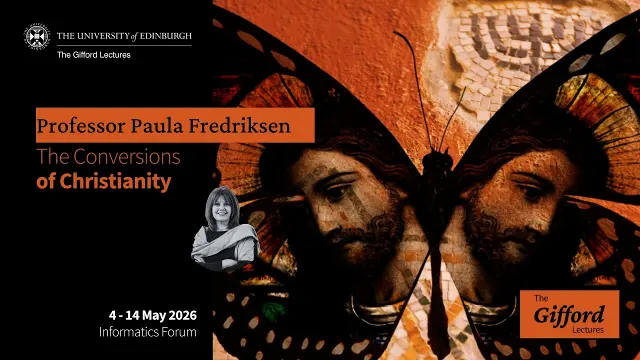
 Paula Fredriksen's Gifford Lecture: A World Full of Gods
#Gifford Lectures
1 ideas
Paula Fredriksen's Gifford Lecture: A World Full of Gods
Get new #Gifford Lectures ideas by email
Every Thursday: the week's best ideas, with the newest from #Gifford Lectures.
Related tags
Gifford Lectures: A Guide to Natural Theology
The Gifford Lectures are a series of public lectures on natural theology, given at Scotland's four ancient universities: Edinburgh, Glasgow, Aberdeen and St Andrews. They exist because of a bequest left by Lord Gifford, a Scottish judge, who set aside money for the promotion of the study of natural theology, as he put it, in the widest sense of the term. The conditions he attached shape everything about the series: the lectures are open to the public, taught as a university course, free of charge and free of examinations, and they may not promote any particular church or confession. A believer, an agnostic and an atheist are all equally welcome to give them.
What natural theology means
Natural theology is reasoning about God, or about ultimate questions, using nature, reason and ordinary human experience rather than scripture or church authority. Gifford's phrase "in the widest sense" opened the door to something broader than classical proofs for the existence of God: metaphysics, ethics, the philosophy of mind, the relation between science and religion, and the meaning of religious experience have all found a place. The series has hosted devout thinkers, sceptics and critics of religion itself, which is part of why it has remained intellectually alive.
What the lectures are like
Read more
Each series is usually the work of one scholar, developed over several lectures and later published as a book. That shapes how they read. They are not a survey or a neutral overview; they are an argument, built step by step, often drawing on a lifetime of work. Some series are historical, tracing how an idea developed. Some are systematic, laying out a whole account of reality. Some are essayistic and personal. Some are heavily technical; others were written for a general audience.
The best-known series have become classics in philosophy and theology, and many are still read long after the lectures were delivered. This is the central pleasure of the form: a single mind, given room and time, working through its deepest commitments in public.
How to approach them
- Choose one lecturer and read the whole series in order rather than dipping into fragments.
- Expect difficulty. These are serious academic arguments, and some presuppose familiarity with philosophy or theology.
- Keep a notebook. Watching an argument unfold over several lectures is easier when you record each step.
- Attend or listen when you can. The lectures are still public events, and hearing an argument spoken is different from reading it.
- Read generously but critically. The point is not to agree with every Gifford lecturer, but to follow a sustained case for something that matters.
Why they endure
The series rests on an unusual premise: that questions about God, meaning and the nature of things deserve a public hearing on university ground, funded without conditions and open to any sincere position. Whether you come as a believer, a doubter or someone simply curious, the lectures offer something rare — a long, unhurried argument about the largest questions, made in plain reach of an audience.
#Gifford Lectures: frequently asked questions
What are the Gifford Lectures, and who are they meant for?
They are a public lecture series on natural theology held at Scotland's ancient universities, founded on a bequest from a Scottish judge who wanted the subject explored in the broadest possible sense. Because the terms of that bequest forbid promoting any particular church or confession, the audience is genuinely open: believers, agnostics and atheists are all equally welcome, both to listen and to lecture. You can come purely out of curiosity about the large questions and still be in the intended audience.
What exactly does natural theology mean here?
It means reasoning about God and ultimate questions through nature, reason and ordinary experience rather than through scripture or church authority. The founder's deliberately wide wording let the series stretch well beyond classic proofs for God's existence into metaphysics, ethics, philosophy of mind and the relation between science and religion. That breadth is why the lectures have hosted sceptics and critics of religion as readily as devout thinkers.
Do I need a background in philosophy or theology to follow them?
Some series assume real familiarity with the field and are quite technical, while others were written for a general audience, so difficulty varies a great deal from one lecturer to the next. A reasonable approach is to accept that you will not understand everything and to keep a notebook so you can track the argument as it builds. If a particular series feels impenetrable, setting it aside for a more accessible one is not a failure.
Which series should I start with?
Rather than sampling fragments, pick one lecturer and read that whole series in order, since each is a single sustained argument developed across its lectures and later published as a book. Historical series that trace how an idea developed tend to be easier entry points than dense systematic ones that lay out an entire account of reality. Choosing a topic you already care about matters more than choosing the most famous series.
Can I still attend the lectures in person?
Yes — they remain public events on university ground, and hearing an argument spoken aloud is a noticeably different experience from reading it on the page. Check the hosting university's listings for what is currently being given, since the series rotates among the institutions. If attending isn't possible, the published book form of each series is the intended way to encounter it.
What is the most common mistake people make with them?
The biggest one is reading a series as though it were a neutral survey or a reference work to dip into, when it is actually one scholar's case built step by step. The second is reading only to agree or disagree rather than to follow the argument through. Read generously but critically, and let the lecturer finish the case before you judge it.
Videos come from YouTube and posts from Instagram; titles and summaries are our own. All rights belong to their creators.