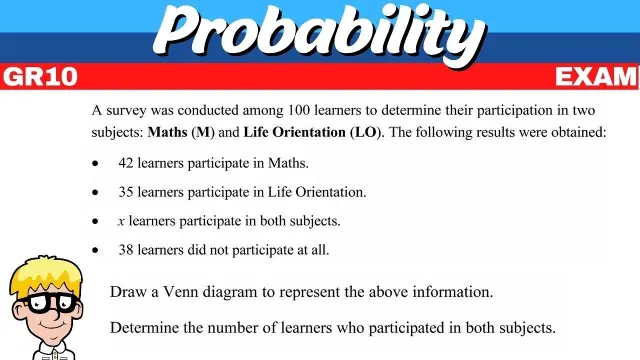
 Grade 10 probability exam question worked through step by step
#Grade 10 Maths
1 ideas
Grade 10 probability exam question worked through step by step
Get new #Grade 10 Maths ideas by email
Every Thursday: the week's best ideas, with the newest from #Grade 10 Maths.
Related tags
Grade 10 Maths: A Guide to the Year's Core Topics
Grade 10 is often the year maths changes character. Until now, much of the work involved learning procedures and repeating them accurately. Around this stage the subject starts asking for something else: connecting ideas, choosing a method, and explaining why it works. For many students this is the first year that feels genuinely demanding — and also the first year the subject becomes interesting in a new way.
What the year usually covers
Curricula differ between countries and exam boards, but the same broad topics appear almost everywhere. Algebra deepens: factorising, working with exponents and surds, solving linear equations and inequalities, and often an introduction to quadratic equations and functions. Geometry moves from naming shapes to reasoning about them — congruence, similarity, circle theorems and formal proof. Trigonometry typically begins here, with right-angled triangles, the sine, cosine and tangent ratios, and their applications to lengths and angles. Statistics and probability appear too: summarising data, interpreting graphs, and calculating the likelihood of simple and combined events.
Why it feels harder
Read more
The difficulty is rarely that the individual steps are complicated. It is that Grade 10 problems ask you to decide which steps apply. A probability question might need you to list outcomes systematically; a geometry question might need an auxiliary line you have to invent. This shift from following to choosing is what unsettles students, and it is also exactly what later maths depends on.
Habits that help
Work through examples with the book closed. Reading a worked solution creates a pleasant feeling of understanding that often disappears the moment the page is turned. Covering the solution and attempting the problem first is a far better test of whether the method has actually been absorbed.
Write the reasoning, not just the answer. In algebra, showing each step makes errors visible and easy to trace. In geometry, stating which property or theorem justifies a claim is part of the answer, not decoration.
Keep a list of your own mistakes. A page of errors — a sign dropped when expanding brackets, a forgotten unit, a misread question — is more useful than a page of correct answers, because it tells you what to watch for.
Practise in short, regular sessions rather than long, rare ones. Mathematics is cumulative; a topic missed in one week tends to resurface as confusion three weeks later.
For parents and helpers
Resist the urge to solve the problem yourself. Ask instead what the question is asking, what is known, and what method seems relevant. Being stuck and then unstuck is how the learning happens. And if a topic stays genuinely opaque after honest effort, that is worth raising early rather than hoping it resolves itself — foundations laid in Grade 10 carry into everything that follows.
#Grade 10 Maths: frequently asked questions
Why does Grade 10 maths suddenly feel so much harder than earlier years?
The individual steps usually aren't more complicated — what changes is that problems stop telling you which steps to use. You have to pick a method, connect ideas from different topics, and justify why your approach works. That shift from following to choosing is unsettling at first, but it's also the part that makes the subject more interesting and it's what later maths builds on.
How should I actually start studying for Grade 10 maths?
Begin by attempting problems with the worked solution covered, then check yourself afterwards. Reading an example gives a comfortable sense of understanding that often vanishes when the page is closed, so testing yourself first is the honest measure. Keep sessions short and frequent rather than long and rare, because the subject is cumulative and gaps come back to haunt you later.
What should I expect the year to cover, and does it vary?
Exact content depends on your country and exam board, but the broad shape is fairly consistent. Expect deeper algebra including factorising, exponents and quadratics, geometry that moves toward congruence, similarity and formal proof, a first look at trigonometry with right-angled triangles, and work on summarising data and calculating probability. Treat your own syllabus as the authority on the detail.
Should I memorise the formulas, or is understanding them enough?
You need the formulas available, but understanding where they come from is what lets you choose correctly under exam pressure. Write out your reasoning rather than only the final answer — in algebra this makes slips visible, and in geometry stating the property or theorem that justifies a claim is genuinely part of the answer. Explaining a method in your own words is a good test of whether you actually have it.
What mistakes do students most often make in Grade 10 maths?
The recurring ones are small and mechanical: a dropped sign when expanding brackets, a forgotten unit, or a question misread under time pressure. The most damaging habit, though, is passive study — reading solutions and nodding along instead of producing the work yourself. Keep a page of your own errors; it tells you what to watch for far better than a page of correct answers does.
How can a parent help without simply doing the problem for them?
Ask questions instead of giving the method: what is the question asking, what information do you already have, and which approach looks relevant. Being stuck and then working through it is where the learning happens, so resisting the urge to solve it yourself matters. If a topic stays genuinely opaque after real effort, raise it early rather than assuming it will sort itself out.
Videos come from YouTube and posts from Instagram; titles and summaries are our own. All rights belong to their creators.