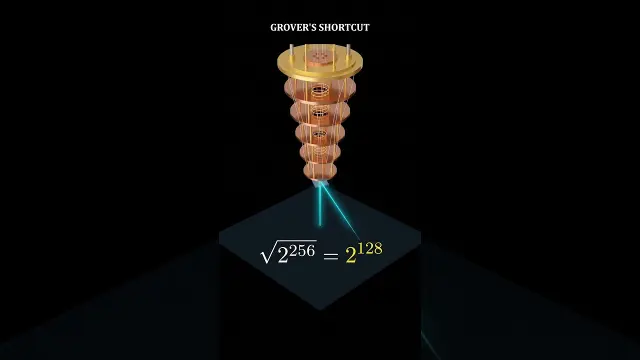
 Can Quantum Computers Break 256-Bit AES? Grover's Algorithm
#Grovers Algorithm
1 ideas
Can Quantum Computers Break 256-Bit AES? Grover's Algorithm
Get new #Grovers Algorithm ideas by email
Every Thursday: the week's best ideas, with the newest from #Grovers Algorithm.
Related tags
Grover's Algorithm: Quantum Search, Explained
Grover's algorithm is a quantum method for finding the item you want inside an unsorted set of possibilities. Classically, if you have a pile of options and only a test that answers yes or no, you have to check them one after another, so the work grows in proportion to the size of the pile. Grover's approach reaches the answer in a number of steps that grows with the square root of that size. It is one of the founding results of quantum computing, and it is the standard example used to explain what a quantum speedup actually looks like.
The idea in plain terms
The algorithm starts by spreading a quantum state evenly across every possible answer, so all candidates are present at once with the same small weight. Then it repeats a two-part step. First, a routine called an oracle marks the correct answer by flipping the sign of its amplitude. Second, a diffusion step, often described as inversion about the average, nudges the amplitude of the marked answer upward and pushes the others down.
Repeating this cycle a number of times proportional to the square root of the search space makes the correct answer's probability approach certainty. Measure at that point and you read out the right item with high confidence. The technique behind it is called amplitude amplification, and it is the reusable idea: any procedure that can recognise a good answer can be boosted this way.
Read more
Where it matters
The speedup is quadratic, not exponential, which is worth being clear about. It does not turn an impossible problem into an easy one; it makes a hard search noticeably shorter.
- Searching unstructured data or large lists of candidate solutions.
- Solving constraint and satisfiability problems by testing assignments.
- Cryptanalysis of symmetric ciphers, where a brute-force search is conceptually the target.
- Finding collisions and preimages in hash functions.
- Speeding up parts of larger quantum routines that rely on repeated checking.
What beginners should know
The oracle is where the real difficulty hides. Grover's algorithm assumes you can test a candidate cheaply and coherently, in superposition, without learning which candidate you tested. For many real problems that test is expensive to build, and its cost can erase the advantage.
The algorithm also needs a fault-tolerant quantum computer with enough reliable qubits, since long sequences of operations accumulate errors. This is why it is studied intensively while practical use remains limited.
Practical tips
- Count the cost of the oracle first; that, not the search step, usually decides whether the approach helps.
- Remember the square root: doubling the search space roughly multiplies the work by about 1.4, not by two.
- Do not run the amplification step longer than optimal; overshooting rotates probability away from the answer.
- Think of amplitude amplification as a general tool you can apply to other quantum procedures, not just to databases.
- Study it with small examples and a simulator before reasoning about cryptographic sizes, where intuition often slips.
#Grovers Algorithm: frequently asked questions
What is Grover's algorithm, in simple terms?
It is a quantum method for locating a desired item inside an unsorted set of possibilities when all you have is a yes-or-no test. Instead of checking candidates one after another, it spreads the quantum state across every option at once and then repeatedly boosts the weight of the correct one. When you finally measure, the right answer comes up with high confidence.
Does it make searching exponentially faster?
No — the gain is quadratic, not exponential. The work still grows with the size of the search space, just with its square root rather than its full size, so doubling the space multiplies the effort by roughly one and a half instead of by two. It shortens a hard search noticeably rather than turning an impossible problem into an easy one.
What do I actually need before it becomes useful?
You need a cheap, coherent test — the oracle — that can recognise a good answer in superposition without revealing which candidate was tested. You also need a fault-tolerant quantum machine with enough reliable qubits, because long operation sequences accumulate errors. Building the oracle is usually the real obstacle, and its cost can wipe out the speedup entirely.
What happens if I run the amplification step too many times?
Overshooting is a genuine mistake: repeating the cycle beyond the optimal point rotates probability back away from the answer you want. The repetitions should stop at the point where the marked item's amplitude peaks, which is why the count is tied to the square root of the search space. Stop short of that peak and you lose confidence; go past it and you lose it again.
Where does this approach actually get applied?
It suits unstructured searches and large piles of candidate solutions, constraint and satisfiability problems where assignments can be tested, and repeated checking inside bigger quantum routines. It is also the textbook target for brute-force style attacks on symmetric ciphers and for finding collisions or preimages in hash functions. The reusable idea behind it — amplitude amplification — can be bolted onto almost any procedure that can recognise a good answer.
How should a beginner go about learning it?
Work through small examples on a simulator first, watching how the amplitudes shift with each cycle, before reasoning about cryptographic sizes where intuition usually slips. Get comfortable with the two-part rhythm — marking the answer, then inverting about the average — because that pair is the whole mechanism. Treat the oracle's cost as the thing to examine first in any problem you consider applying it to.
Videos come from YouTube and posts from Instagram; titles and summaries are our own. All rights belong to their creators.