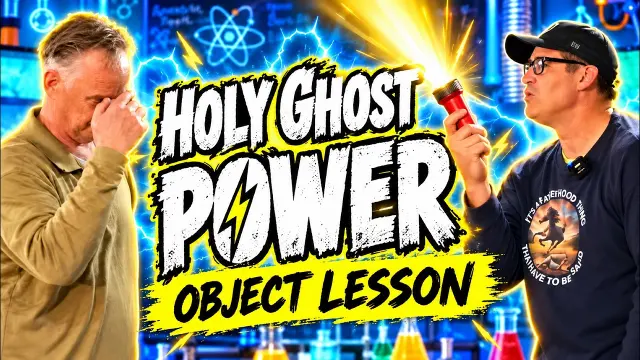
 Holy Ghost Power Flashlight Object Lesson
#Holy Ghost
1 ideas
Holy Ghost Power Flashlight Object Lesson
Get new #Holy Ghost ideas by email
Every Thursday: the week's best ideas, with the newest from #Holy Ghost.
Related tags
The Holy Ghost: Meaning, Teaching and Object Lessons
The Holy Ghost is the name many Christians use for the third person of the Trinity, alongside God the Father and Jesus Christ. In everyday language he is also called the Holy Spirit, and the two terms point to the same belief: a presence of God that is personal rather than abstract, able to comfort, guide, convict and empower. If you have heard the phrase mostly in older hymns or in Pentecostal preaching, you have met only part of a much wider idea.
Where the name comes from
The English word "ghost" once carried the older sense of "spirit" or "breath", which is why early Bible translations used "Holy Ghost" where later ones say "Holy Spirit". The underlying Greek word, pneuma, means wind or breath as much as spirit, and that picture of air you cannot see but can certainly feel runs through the whole subject. Translations differ, but the meaning does not.
How different traditions understand it
Read more
Most churches hold the same core belief and express it differently. Liturgical traditions, such as Catholic, Orthodox and Anglican churches, speak of the Spirit chiefly through sacraments, prayer and confirmed faith. Evangelical and Protestant congregations emphasise a personal relationship, Bible reading and a changed life. Pentecostal and charismatic churches look for visible gifts and experiences, such as speaking in tongues, healing prayer and prophetic encouragement. None of these differences make one group's faith more real than another's, and it helps to know which vocabulary you are hearing.
Teaching it to children
Because the Holy Ghost is invisible and intangible, children's ministers often reach for object lessons, and a torch or flashlight is a favourite. You switch it on in the dark and the room changes without anything appearing to move. The lesson is not that the Spirit is a battery; it is that light, wind, water and fire are all images the Bible itself uses for something real yet unseen. Good object lessons keep that gap honest. Use the prop to open a conversation, then say plainly that we are talking about what we trust, not what we can measure.
Practical tips if you are starting out
- Read the passages where the Spirit appears, rather than only hearing them quoted, so the language becomes familiar in context.
- Ask quietly what a church means by its own words before assuming you know; "baptism in the Spirit" and "the indwelling Spirit" are not interchangeable phrases.
- Keep explanations simple with children, and let them ask questions without needing a tidy answer for each one.
- Remember that the subject is meant to produce gentleness, patience and self-control, so any teaching that leaves you harsh or fearful has probably been misheard.
Whether you come to this as a curious reader or as someone preparing to teach, the heart of the matter is a belief in a companion presence rather than a puzzle to be solved.
#Holy Ghost: frequently asked questions
Is the Holy Ghost the same thing as the Holy Spirit?
Yes — the two names point to the same belief in the third person of the Trinity, alongside God the Father and Jesus Christ. "Ghost" simply carries the older English sense of "spirit" or "breath", which is why earlier Bible translations used it where newer ones say "Spirit". The wording differs; the meaning does not.
How do I start learning about the Holy Ghost if I'm new to it?
Begin with the passages where the Spirit actually appears and read them in context, rather than only meeting them as quoted lines in hymns or sermons. Then listen carefully to how a particular church uses its own vocabulary, since phrases like "baptism in the Spirit" and "the indwelling Spirit" are not interchangeable. Keeping a simple notebook of what you read and what you hear can help you sort out the different traditions.
Which tradition or church should I choose?
There is no single right answer, because most churches hold the same core belief while expressing it in different ways. Liturgical traditions tend to speak of the Spirit through sacraments and prayer, Protestant and evangelical congregations through personal relationship and Bible reading, and Pentecostal or charismatic churches through visible gifts and experiences. Visit a few, notice which vocabulary and practice feel honest to you, and remember that these differences do not make one group's faith more real than another's.
How can I explain the Holy Ghost to a child?
Because the subject is invisible, object lessons help — a flashlight switched on in a dark room is a favourite, since the room changes without anything visibly moving. The point is not that the Spirit is a battery, but that light, wind, water and fire are images the Bible itself uses for something real yet unseen. Use the prop to open a conversation, then say plainly that this is about what we trust rather than what we can measure, and let their questions stand without forcing a tidy answer for each one.
What mistakes should I watch out for when teaching or learning about it?
One common slip is assuming every church means the same thing by its terms, which leads to confusion and unnecessary argument. Another is treating the subject as a puzzle to be solved, or as something that should leave you fearful and harsh — the belief is meant to produce gentleness, patience and self-control, so teaching that does the opposite has probably been misheard. The heart of the matter is a companion presence, not a riddle.
Can I explore this topic with simple craft or object-lesson ideas?
Yes — light, wind, water and fire are all biblical images for the Spirit, so a flashlight, a fan or a bowl of water can carry a lesson well. The key is honesty about the gap: use the object to open the conversation, then say clearly that we are talking about something real that we trust rather than something we can measure.
Videos come from YouTube and posts from Instagram; titles and summaries are our own. All rights belong to their creators.