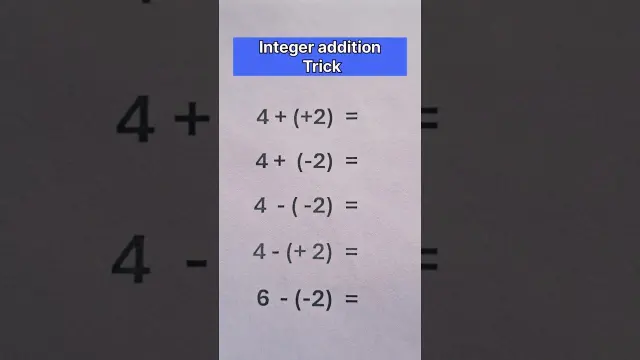
 Mastering Integer Addition and Subtraction with Simple Tricks
#Integer Math
1 ideas
Mastering Integer Addition and Subtraction with Simple Tricks
Get new #Integer Math ideas by email
Every Thursday: the week's best ideas, with the newest from #Integer Math.
Related tags
Integer Math: Working with Positive and Negative Numbers
Integer math is the branch of arithmetic that deals with whole numbers, including zero and negative numbers. These numbers are called integers, and they are used anywhere you need to count, compare, measure, or track values that can go above and below zero. You meet them in temperature, money, elevation, time differences, and many kinds of calculation.
What integers are
Integers include numbers like -3, -2, -1, 0, 1, 2, and 3. They do not include fractions or decimals. The main idea is that integers help you describe direction and change as well as quantity. For example, a gain and a loss, a rise and a drop, or moving forward and backward can all be shown with integers.
A good way to think about integers is as points on a number line. Numbers to the right of zero are positive, and numbers to the left are negative. The farther a number is from zero, the greater its absolute value, which is its distance from zero without considering sign.
Read more
The main operations
Integer addition and subtraction often feel easiest when you picture movement on the number line.
- Adding a positive number moves to the right.
- Adding a negative number moves to the left.
- Subtracting a positive number means moving left.
- Subtracting a negative number means moving right.
This is why signs matter so much. A common beginner mistake is to ignore them and focus only on the number itself. Taking time to notice the sign first makes calculations much more reliable.
Multiplication and division with integers follow sign rules as well:
- A positive times a positive is positive.
- A negative times a negative is positive.
- A positive times a negative is negative.
- A negative times a positive is negative.
The same rules apply to division. These patterns are worth learning early because they appear everywhere in algebra and more advanced math.
Useful techniques for beginners
When you are starting out, keep your work neat and slow. Write the numbers and signs clearly, and use a number line if you need a visual aid. If a problem has several steps, solve one step at a time instead of trying to do everything at once.
Some helpful habits include:
- Check whether the operation is addition, subtraction, multiplication, or division.
- Pay attention to the sign of each number.
- Use zero as a reference point.
- Estimate the answer first so you can notice if your final result seems unreasonable.
It also helps to practice with real-life examples. If you owe money, that can be shown as a negative amount. If the temperature drops, the change is negative. If you climb above sea level, the elevation is positive. These everyday examples make integer math easier to understand.
Why integer math matters
Integer math is a foundation for algebra, coordinate graphs, and many problem-solving tasks. Once you are comfortable with signs and number line thinking, more advanced topics become much easier. The key is to build confidence with small problems and steady practice. With time, the rules become natural, and integers stop feeling abstract.
Videos come from YouTube and posts from Instagram; titles and summaries are our own. All rights belong to their creators.