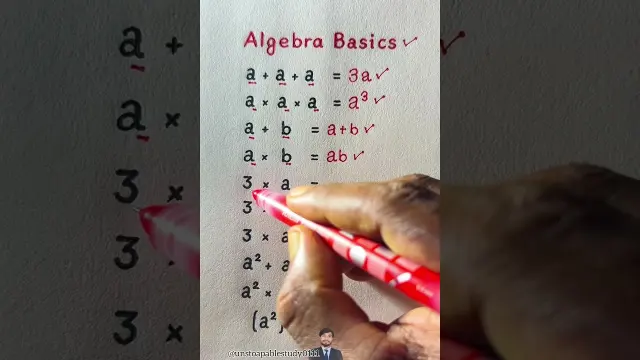
 Short Practice Session for Basic Algebra Revision
#Algebra Basics
15 ideas
Short Practice Session for Basic Algebra Revision
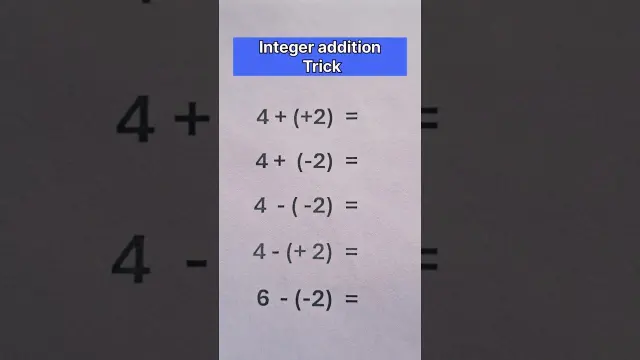 Mastering Integer Addition and Subtraction with Simple Tricks
 Essential Algebra Concepts Before Learning Precalculus
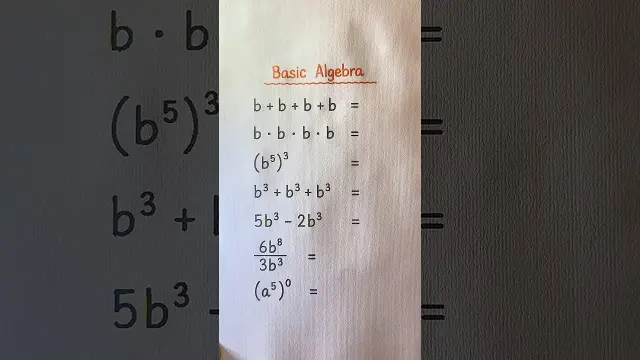 Quick Revision Guide for Basic Algebra Concepts
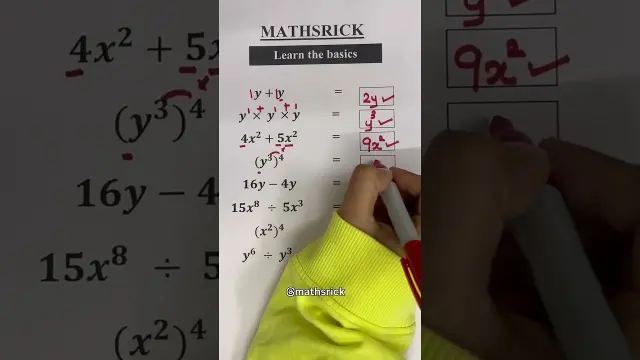 Quick Study Guide for Learning Basic Algebra
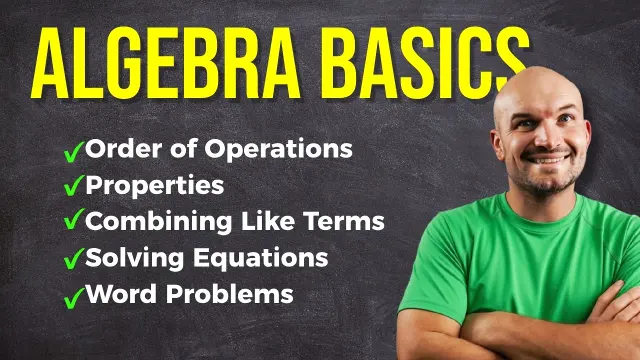 Comprehensive Algebra Basics Review for Beginners
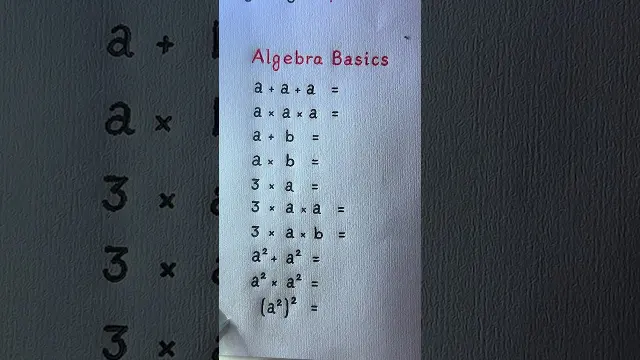 Helpful Shortcut and Trick for Basic Algebra
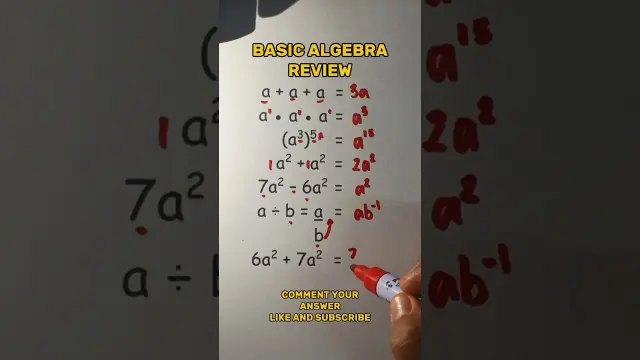 Fundamental Algebra Review with Practice Problems
 Interactive Basic Algebra Quiz with Twenty Questions
 Comprehensive Slow Explanation of Everything in Algebra
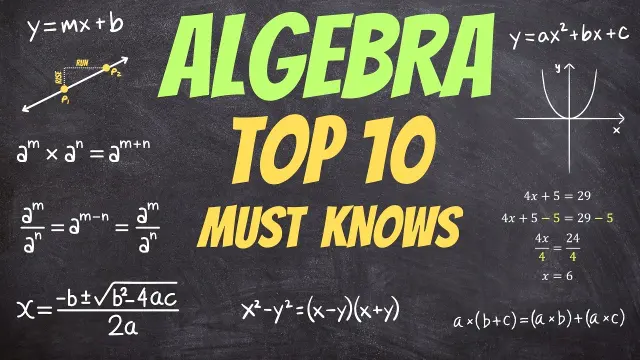 Complete Algebra Study Guide Covering Ten Essential Topics
 Five Essential Foundational Math Skills Before Starting Algebra
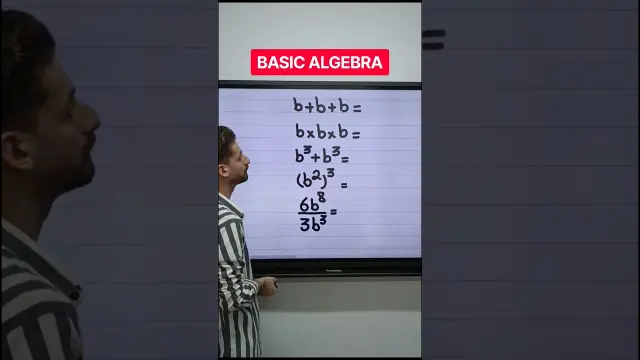 Basic Algebra Practice Challenge to Test Your Skills
 Algebra Basics Breakdown of the Language of Algebra
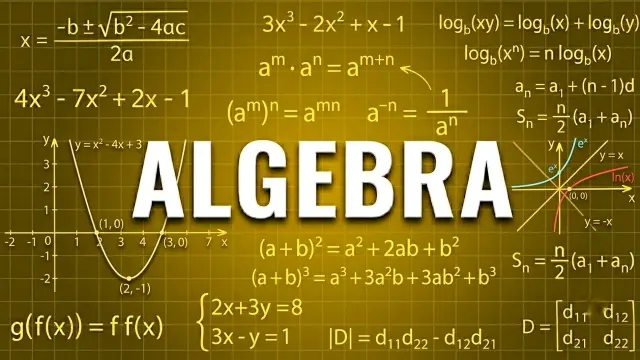 Complete Comprehensive Guide Explaining All of Algebra
Get new #Algebra Basics ideas by email
Every Thursday: the week's best ideas, with the newest from #Algebra Basics.
Related tags
Algebra Basics: The Language of Symbols
What algebra is
Algebra is a branch of mathematics that uses letters and symbols to represent numbers and relationships. Instead of working only with fixed values, you learn how to describe patterns, compare quantities, and solve for unknowns. At its heart, algebra is a way of thinking: it helps you turn a word problem, a pattern, or a missing number into a form you can work with.
You meet algebra in school, in everyday calculations, and anywhere a value is not yet known. It can be used to find costs, measure distances, compare shapes, or describe how one quantity changes with another. Once you understand the basics, many more advanced math topics become easier to approach.
The main building blocks
Read more
The first thing to understand is the variable. A variable is a letter, usually something like x or y, that stands for an unknown or changeable number. A constant is a number that stays the same. When you combine numbers, variables, and operation signs, you get an expression. For example, 3x + 2 is an expression.
An equation is different from an expression because it includes an equals sign. It says that two sides have the same value. Solving an equation means finding the number that makes it true. For instance, if x + 3 = 7, you want the value of x that balances both sides.
Algebra also uses terms, coefficients, and operations:
- A term is a part of an expression separated by + or -.
- A coefficient is the number multiplied by a variable.
- Common operations include addition, subtraction, multiplication, division, and powers.
What beginners should focus on
If you are new to algebra, start with simple ideas and build slowly. Make sure you are comfortable with basic arithmetic first, especially with negative numbers, fractions, and order of operations. These come up all the time in algebra.
A good habit is to treat an equation like a balance scale. Whatever you do to one side, you must do to the other. That idea helps you keep equations equal while you simplify them. Another useful skill is translating words into symbols. Phrases like "more than," "less than," and "twice as much" often turn into algebraic expressions.
Common kinds of algebra problems
Beginners usually meet these types of problems:
- Simplifying expressions by combining like terms
- Solving one-step and two-step equations
- Working with inequalities, which compare values
- Graphing simple relationships on a coordinate plane
- Recognizing patterns and formulas
Each of these uses the same basic tools, so do not rush. Understanding why a step works is more useful than memorizing it alone.
Practical tips for learning
Algebra becomes easier with steady practice. Write each step clearly, and avoid skipping too many steps at first. If you make a mistake, check whether you handled signs, fractions, or order of operations correctly. Reading the problem carefully is just as important as doing the calculations.
It also helps to check your answer by substituting it back into the original equation. If both sides match, you know your solution works. Over time, algebra starts to feel less like guesswork and more like a reliable method for finding answers.
Videos come from YouTube and posts from Instagram; titles and summaries are our own. All rights belong to their creators.