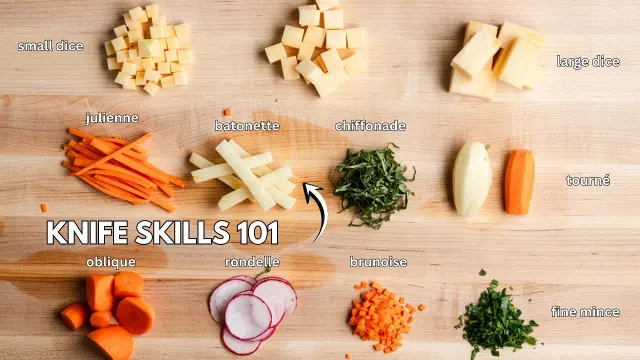
 Ten Professional Knife Cuts Taught in Culinary School
#Julienne
1 ideas
Ten Professional Knife Cuts Taught in Culinary School
Get new #Julienne ideas by email
Every Thursday: the week's best ideas, with the newest from #Julienne.
Related tags
Julienne: Cutting Food into Fine, Even Sticks
Julienne is the name cooks give to food cut into fine, even sticks, roughly the size and shape of a matchstick. You will meet it most often with vegetables — carrots, courgettes, peppers, leeks, celeriac — but the same cut works for fruit, cheese, cooked meats and firm tofu. The word describes a shape rather than an ingredient, which is why a julienned carrot and a julienned slice of ham belong to the same idea.
A French kitchen word
The term comes from French professional cooking, where cutting techniques carry names and are taught as part of a shared vocabulary. The exact origin of the word itself is debated, and it is safest to understand it simply as the French name for this stick cut. What matters more than etymology is the purpose: in a professional kitchen a named cut is a standard, a compact way of saying "this size", so that a dish cooks and looks the same whoever prepares it.
Why cut food this way
Read more
Fine sticks cook quickly and evenly, which makes julienne useful in stir-fries, quick sautés, soups and braises where you want a vegetable to soften in minutes rather than half an hour. The shape also gives texture and height: a small handful of julienned vegetables scattered over a finished dish adds crunch and colour, and the same sticks tossed with a dressing make a slaw or salad that feels light rather than chunky. Because the pieces are long and thin, they hold sauce well and sit neatly on a fork.
The family of stick cuts
Julienne belongs to a group of related cuts, and knowing the group helps you read a recipe. A bâtonnet is a thicker stick, chosen when you want more bite or when the vegetable will cook for longer. A fine julienne is thinner still, often used as a garnish. Cut a julienne crosswise and you have a brunoise, the small dice. Leaves and herbs are usually handled differently, with a fine shredding cut rather than a stick cut, because their structure is different. Once you can make even sticks, the other cuts follow naturally.
Cutting it well
Start by making a flat, stable surface: trim a thin slice from one side of a rounded vegetable so it sits still on the board. Cut the vegetable into planks of the thickness you want, lay a few planks flat, then slice them into sticks. Keep the knife sharp and the board steady, curl the fingertips of your guiding hand under and let your knuckles guide the blade. Work slowly at first. Evenness matters far more than speed, and speed is only a by-product of repetition.
Tips for beginners
Choose firm, straight vegetables, since a floppy pepper or a tired carrot is difficult to cut evenly. Trim pieces to a similar length before you begin so the sticks finish together. Don't crowd the board — too much on it hides mistakes. Practise on inexpensive, forgiving vegetables, and keep the trimmings for stock or soup so nothing goes to waste.
#Julienne: frequently asked questions
What is a julienne cut, exactly?
Julienne is the name for food cut into fine, even sticks — a shape rather than an ingredient, so a julienned carrot and a julienned slice of ham are doing the same thing. You'll see it most with vegetables like carrots, courgettes, peppers, leeks and celeriac, but it works equally well for fruit, cheese, cooked meats and firm tofu. The point of the cut is that the pieces cook fast and evenly and look uniform on the plate.
What do I need to start cutting julienne?
A sharp knife and a board that doesn't slide are the essentials; everything else is technique. Begin by trimming a thin slice off one side of a rounded vegetable so it sits flat and still, then cut it into planks of the thickness you want and slice those planks into sticks. Curl the fingertips of your guiding hand under and let your knuckles run against the blade.
How do I choose between julienne and the other stick cuts?
Go with a bâtonnet when you want a thicker stick with more bite, or when the vegetable will be cooked for longer. Choose a fine julienne when the sticks are going to be a garnish rather than the body of the dish. Understanding the family helps you read recipes: cut a julienne crosswise and you get a brunoise, the small dice.
Which vegetables work best for julienne?
Firm, straight vegetables are the easiest to cut evenly — a floppy pepper or a tired carrot makes the job much harder. Trim your pieces to a similar length before you start so they all finish at the same time. It's worth practising on inexpensive, forgiving vegetables first, and keeping the trimmings for stock or soup.
What can I use julienned vegetables for?
Fine sticks are ideal in stir-fries, quick sautés, soups and braises, where you want the vegetable to soften in minutes rather than ages. Tossed with a dressing they make a slaw or salad that feels light rather than chunky, and a small handful scattered over a finished dish adds crunch, colour and height. Because the pieces are long and thin they also hold sauce well and sit neatly on a fork.
What are the most common mistakes when cutting julienne?
The usual culprits are a dull knife, a vegetable that rolls because it was never given a flat side, and a board piled so full that mistakes hide in the crowd. Chasing speed too early is another one — evenness matters far more, and speed only arrives as a by-product of repetition. Work slowly, keep the pieces uniform, and leave the board uncrowded.
Videos come from YouTube and posts from Instagram; titles and summaries are our own. All rights belong to their creators.