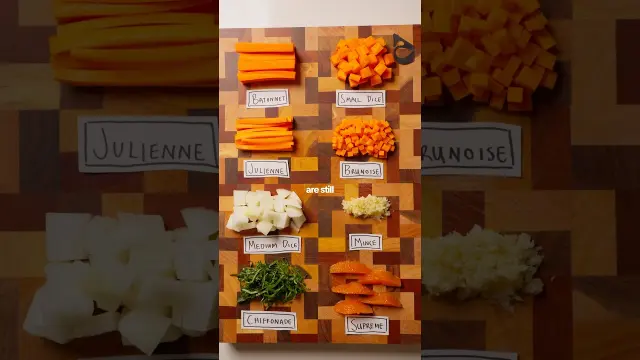
 Practicing the Eight Fundamental Knife Cuts
#Knife Cuts
1 ideas
Practicing the Eight Fundamental Knife Cuts
Get new #Knife Cuts ideas by email
Every Thursday: the week's best ideas, with the newest from #Knife Cuts.
Related tags
Knife Cuts: A Guide to Chopping with Confidence
Every ingredient passes through a knife before it reaches a pan. The shape you give it there is not a detail: it decides how quickly it cooks, how it feels in the mouth, and how evenly it shares the pan with everything else. This is what cooks mean by knife cuts — not simply chopping, but cutting with intent.
The vocabulary most kitchens use comes from the French professional tradition, where cuts were named, taught and tested because consistency let a brigade of cooks work from the same recipe and get the same result. Home cooking has inherited that vocabulary and loosened it. You do not need to measure anything to benefit from it; you only need to understand why the shapes exist.
Why evenness comes first
Two pieces of carrot of different sizes will not cook at the same rate. The small one softens to mush while the large one is still firm, and no amount of stirring fixes it. Cutting everything to roughly the same size means it all finishes together, which is the single most useful habit a cook can build.
Read more
Evenness also changes texture. A fine dice disappears into a sauce and thickens it; a rough chunk stays a distinct mouthful. Neither is better. The right one is the one the dish is asking for.
The cuts worth knowing
- Slice: a flat cut across the ingredient, from a thin coin to a thick slab. The workhorse.
- Julienne: thin matchstick strips, good for quick stir-fries, salads and garnishes that cook in moments.
- Batonnet: the same idea, but thicker — roughly pencil-sized, good for dipping and roasting.
- Dice: cubes, small, medium or large. The smaller the dice, the more it melts into the dish.
- Brunoise: a very fine dice, usually used for aromatics or a neat finish.
- Chiffonade: herbs or leafy greens rolled tightly and cut into fine ribbons.
- Mince and crush: the smallest and most informal cuts, for garlic, ginger and anything that should spread through a dish.
Hands, board and blade
The guiding hand that holds the food curls its fingertips under, knuckles forward, so the blade rests against them and the fingertips stay out of reach. The knife hand keeps a firm, relaxed grip and lets the blade do the work rather than pressing down.
A sharp knife is a safer knife: a dull edge skids off skins and peels instead of biting in. Keep the blade honed, use a board that does not slide, and lay round vegetables on a flat side first so they cannot roll.
Beginners should slow down and choose one cut per week to practice. Speed is the last thing to arrive, and it arrives on its own.
#Knife Cuts: frequently asked questions
How do I start learning knife cuts at home?
Pick a single cut and practice only that one for a while, on something cheap and forgiving like an onion or a carrot. Slowing down matters more than looking fast: speed is the last thing to come, and it comes on its own once the motion feels natural. Working on the guiding hand and the grip first makes everything else easier later.
What do I actually need to begin?
A sharp knife, a board that will not slide around under it, and something to cut is really all it takes. You do not need a set of different blades or any measuring gadget, because the shapes are about consistency rather than exact dimensions. Keeping the edge honed matters, since a dull blade skids off skins and peels instead of biting in.
Which cut should I use for a given ingredient?
Ask what the dish needs the piece to do: thin matchsticks cook in moments and suit stir-fries and garnishes, while thicker pencil-sized sticks hold up to roasting and dipping. A fine dice melts into a sauce and thickens it, whereas a rough chunk stays a distinct mouthful. Rolled leafy things and herbs cut into fine ribbons give you a delicate finish rather than bulk.
How should I hold the food and the knife?
Curl the fingertips of the guiding hand under and keep the knuckles forward, so the flat of the blade rests against them and your fingertips stay out of the way. On the knife hand, use a firm but relaxed grip and let the blade travel through the ingredient instead of pushing down. Round vegetables should be laid on a flat side first so they cannot roll.
What mistakes do beginners make most often?
Cutting pieces of uneven size is the big one, because small bits soften to mush while the large ones are still firm, and no amount of stirring fixes it. Rushing toward speed before the motion is settled, and working with a dull edge on a sliding board, are the other usual culprits. Slow down, aim for roughly the same size every time, and the rest follows.
Can you suggest ideas for an occasion or a themed meal?
Use the cuts as a way to vary texture across a menu rather than as decoration: fine dice for aromatics that should disappear, thick batons for a platter meant to be picked up, and ribbons for a light garnish. Practising the fundamental cuts one at a time is a good theme for an evening with friends, since everyone ends up with something to cook. The shapes are there to serve the dish, so choose the one each plate is asking for.
Videos come from YouTube and posts from Instagram; titles and summaries are our own. All rights belong to their creators.