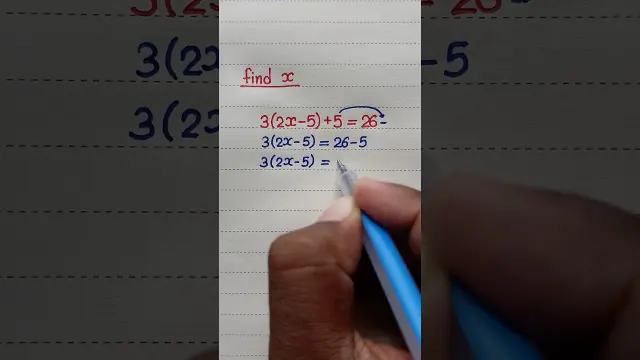
 Quick Shortcut Trick For Linear Equations
#Linear Algebra
1 ideas
Quick Shortcut Trick For Linear Equations
Get new #Linear Algebra ideas by email
Every Thursday: the week's best ideas, with the newest from #Linear Algebra.
Related tags
Linear Algebra Basics and Ideas
What linear algebra is
Linear algebra is the branch of mathematics that studies vectors, matrices, and linear relationships. At its heart, it helps you describe and solve problems where quantities change in a structured, predictable way. Instead of working only with single numbers, you work with lists of numbers and with rules for combining them.
You meet linear algebra in many places: geometry, computer graphics, engineering, data analysis, physics, and many other fields. It is especially useful when you want to organize information, transform shapes, or solve several equations at once.
The main ideas
Read more
The basic objects in linear algebra are vectors and matrices.
A vector is a collection of numbers that can represent a point, a direction, a quantity with several parts, or any data arranged in order. You can add vectors and scale them by multiplying by a number.
A matrix is a rectangular table of numbers. Matrices are used to represent systems of equations and transformations. They can multiply vectors and other matrices, following specific rules.
Other important ideas include:
- Systems of linear equations
- Linear combinations
- Span and basis
- Dimension
- Determinants
- Inverse matrices
- Eigenvalues and eigenvectors
These ideas help you understand how spaces are built and how linear transformations act on them.
What linear algebra is used for
Linear algebra is a practical tool for solving many kinds of problems.
It can help you:
- Solve systems of equations with several unknowns
- Describe lines, planes, and higher-dimensional spaces
- Rotate, scale, or reflect shapes
- Organize and process data
- Model relationships in science and engineering
- Work with signals, images, and networks
Even when the applications look very different, the same core ideas often appear underneath them.
Common ways to think about it
There are several useful viewpoints in linear algebra. One focuses on equations, another on geometry, and another on transformations. Learning to move between these viewpoints is one of the most helpful skills you can develop.
For example, a system of equations can be viewed as:
- A search for values that satisfy all the equations
- An intersection of geometric objects
- A matrix problem with a structured method of solution
These different perspectives make the subject richer and often easier to understand.
Tips for beginners
If you are new to linear algebra, it helps to take it step by step.
- Make sure you are comfortable with algebraic manipulation first
- Pay attention to notation, since symbols carry a lot of meaning
- Draw pictures when possible, especially for vectors and geometric ideas
- Practice small examples by hand before moving to larger ones
- Learn the meaning of each concept, not just the procedure
- Notice how ideas connect, such as how matrices relate to transformations
It is normal to feel that the subject is abstract at first. With practice, the patterns become much clearer.
A good way to study it
Linear algebra becomes much easier when you combine calculation with intuition. Work through examples, but also ask what the numbers represent. Try to see how changing a vector or matrix changes the outcome. Over time, you will start to recognize the same structures appearing in different problems, and that is when the subject really begins to open up.
Videos come from YouTube and posts from Instagram; titles and summaries are our own. All rights belong to their creators.