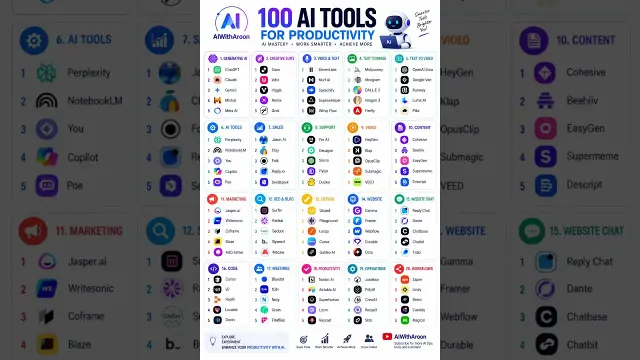
 A Tour of 100 AI Tools for Productivity, Split by Category
#Marketing Tools
1 ideas
A Tour of 100 AI Tools for Productivity, Split by Category
Get new #Marketing Tools ideas by email
Every Thursday: the week's best ideas, with the newest from #Marketing Tools.
Related tags
Marketing Tools: A Practical Guide to the Software Stack
Marketing has always involved tools — a mailing list, a printed catalogue, a calendar of promotions. What changed is that most of that work now happens through software. "Marketing tools" is the loose name for the programs and platforms that help plan, produce, publish, measure and improve marketing activity. They don't create a strategy by themselves; they remove friction from a strategy you already have.
The main families of tools
It helps to think in categories rather than in products, because the categories are stable even when individual products come and go.
- Customer relationship management: a single record of who your customers are, what they bought and when you last spoke to them. For many businesses this is the foundation everything else connects to.
- Email and messaging: newsletters, automated sequences, transactional notices and the subscriber list itself.
- Content and publishing: writing, editing, image preparation and scheduling posts across websites and social channels.
- Analytics: traffic, conversion, campaign attribution and reporting. The tool you need least at the start and most once you have volume.
- Advertising platforms: the interfaces for buying and managing paid placements.
- Automation and integration: the connective tissue that moves data between the other tools so you aren't copying and pasting.
- Analytics for the business side: pricing, forecasting and inventory, which marketing depends on more than people expect.
Read more
Where beginners usually get stuck
The common mistake is buying tools before defining the job. A calendar of content, a domain name, a place to store contacts and a way to read basic numbers will carry a small business a long way. Add a new tool only when a specific, repeated task has become painful enough to justify the cost and the learning time.
Second mistake: too many overlapping tools. Every subscription adds a place for data to go stale and a login to forget. Fewer tools, better used, almost always outperforms a crowded stack.
Third: ignoring the export. Before committing to a platform, check that you can get your contacts and content out in a usable format. Your list is an asset; the tool is only the current custodian.
Practical habits
Name things consistently — campaigns, files, tags, audience segments — so that reports mean something months later. Write down what each automated sequence is supposed to achieve and who owns it. Review the stack periodically and cancel what you no longer open. Keep one source of truth for customer data and make sure everything else points at it.
Choosing well
Ask what problem the tool solves, who will actually use it, how it connects to what you already run, and what it costs at the size you expect to be. Trial periods are for testing your own workflow, not for admiring the interface. A tool that a colleague will genuinely use beats a more powerful one that sits idle.
Good marketing tools are quiet. They should make the ordinary work — reaching the right people with something worth their attention, then learning from the result — faster and more measurable, and then get out of the way.
#Marketing Tools: frequently asked questions
How do I get started with marketing tools when I'm running a small business on my own?
Start from the work you already do rather than from the software: write down one routine task you repeat every week, such as emailing customers or posting content, and pick a single tool that shortens it. Get comfortable with that one before adding anything else, because each new platform costs learning time as well as money. A simple place to keep contacts plus a way to publish and a way to read results is usually enough to begin.
Do I need every category of marketing tool from the start?
No — the categories become useful at different stages, and analytics in particular rarely pays off until there is enough activity to measure. Most small operations get furthest with a customer record, a mailing list and a way to prepare and schedule content. Add advertising, automation or deeper reporting only when a specific repeated job has genuinely become painful.
How do I choose between two marketing tools that seem to do the same thing?
Test them against your own workflow during the trial rather than judging the interface, and try the exact task you need to do most often. Check how each one connects to what you already use and whether you can export your contacts and content in a format you can actually reuse elsewhere. The tool a colleague will open every week beats a more capable one that sits unused.
What are the most common mistakes people make with marketing tools?
Buying software before defining the job is the big one, followed by signing up for several overlapping tools that each hold a slightly different copy of the same customer data. Another frequent slip is committing to a platform without checking that your list and content can be taken out again. Fewer tools used properly tends to outperform a crowded, half-used stack.
How should I look after my marketing tools once they're set up?
Name campaigns, files, tags and audience segments consistently so that reports still make sense when you return to them later, and keep one authoritative record of customer data that everything else points at. Write down what each automated sequence is meant to achieve and who is responsible for it. Review the stack now and then and cancel whatever you no longer open.
Videos come from YouTube and posts from Instagram; titles and summaries are our own. All rights belong to their creators.