 A poised moment in Marrakech, Morocco, at La Mamounia
#Marrakech
2 ideas
A poised moment in Marrakech, Morocco, at La Mamounia
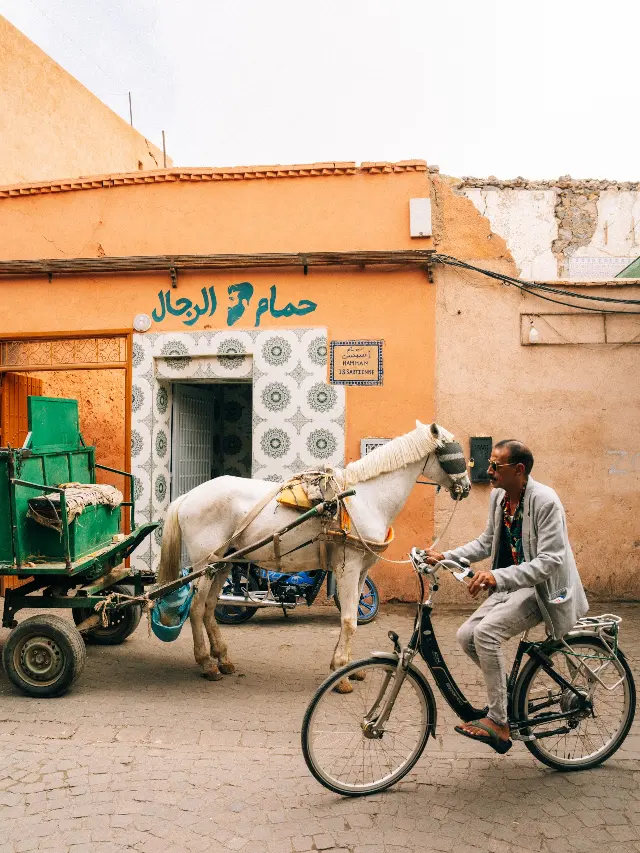 Capturing the Vibrant Streets of Marrakech Medina
Get new #Marrakech ideas by email
Every Thursday: the week's best ideas, with the newest from #Marrakech.
Related tags
Marrakech: A Guide to the Red City
Marrakech sits at the foot of the Atlas Mountains in the south of Morocco, and it is one of the country's four imperial cities. Founded in the eleventh century as a stop on the caravan routes that crossed the Sahara, it grew wealthy on trade in gold, salt, leather and spices. That history still shapes the place: the medina, the old walled town, is a maze of alleys where the same crafts have been practised for centuries, and the rammed-earth walls that surround it are the reason the city is nicknamed "the red city" — the ochre colour comes from the local clay.
The heart of the city
The centre of old Marrakech is the Jemaa el-Fna, a vast square that shifts character through the day: quiet and dusty in the morning, crowded with storytellers, musicians and food stalls by evening. From it, the souks spiral north. These are not a single market but a series of them, each with its own trade — dyers, metalworkers, slipper makers, spice sellers, lantern makers. Getting lost is part of the experience, and the most rewarding approach is to accept it rather than fight it. If you do want to orientate yourself, look up: the minaret of the Koutoubia mosque rises above almost everything and serves as a reliable compass.
Gardens and calm
Read more
Marrakech is also a city of hidden gardens, and they offer a necessary contrast to the noise of the medina. The Majorelle Garden, planted around a vivid blue villa, and the Menara gardens, with their long reflecting pool and olive groves, are the best known. Beyond the walls, the newer districts — Gueliz and Hivernage — are wider, greener and more modern, and worth a wander if only to see how differently the city builds outside its historic core.
Courtyards and rooftops
Much of Marrakech's architecture turns inward. Traditional houses, called riads, are built around a central courtyard, often with a fountain, orange trees and shaded arcades. Many have been restored as guesthouses, and staying in one gives a sense of how the city has always lived: private and cool inside, busy and bright outside. Rooftops are the other great vantage point, and a glass of mint tea at sunset is one of the simplest pleasures the city offers.
Practicalities for a first visit
Dress with a little modesty — shoulders and knees covered — especially away from the tourist centre. Learn a few words of French or Arabic; it is appreciated and makes bargaining friendlier. When shopping in the souks, prices are usually negotiable, so ask with good humour and be willing to walk away. Photography deserves care: ask before photographing people, and expect that some will decline or ask for payment. Finally, pace yourself. Marrakech is intense — the heat, the noise, the constant invitations to look and buy — and the pleasure of it comes from slowing down, sitting in the shade, and letting the city come to you.
#Marrakech: frequently asked questions
Why is Marrakech called the red city?
The nickname comes from the ochre colour of the rammed-earth walls that ring the old town — the hue is drawn from the local clay. Those walls and the medina inside them still give the city its warm, dusty glow, especially at sunset.
How do you find your way around the medina and the souks?
You mostly don't, and that's fine — the souks are a series of small markets each devoted to a different trade, and wandering is part of the pleasure. If you want a bearing, look up: the tall minaret of the Koutoubia mosque rises above the rooftops and works as a compass.
What is a riad, and is it worth staying in one?
A riad is a traditional house built around a central courtyard, often with a fountain, orange trees and shaded arcades that keep the inside cool and quiet. Many have been restored as guesthouses, so staying in one lets you experience the city the way it has always been lived — private inside, bustling outside.
What should a first-time visitor wear and how should they behave?
Dress with a little modesty, keeping shoulders and knees covered, especially once you're away from the busiest tourist areas. A few words of French or Arabic go a long way, and asking before you photograph people is expected — some will decline or ask for payment.
How do you shop in the souks without getting overwhelmed?
Prices are usually negotiable, so treat bargaining as a friendly exchange rather than a contest, and be ready to walk away if the price isn't right. Buying less but better — a lantern, a pair of slippers, some spices — is usually more satisfying than trying to see everything.
Where do you go for calm and quiet in Marrakech?
The city is full of hidden gardens that offer a real contrast to the noise of the medina, and the newer districts outside the walls are wider, greener and far more relaxed. A rooftop with a glass of mint tea at sunset is the simplest way to slow down.
Videos come from YouTube and posts from Instagram; titles and summaries are our own. All rights belong to their creators.