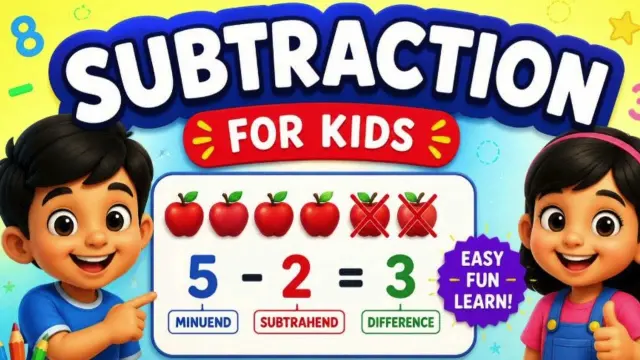
 Quick and Easy Subtraction Lesson for Beginners
#Math Lessons
2 ideas
Quick and Easy Subtraction Lesson for Beginners
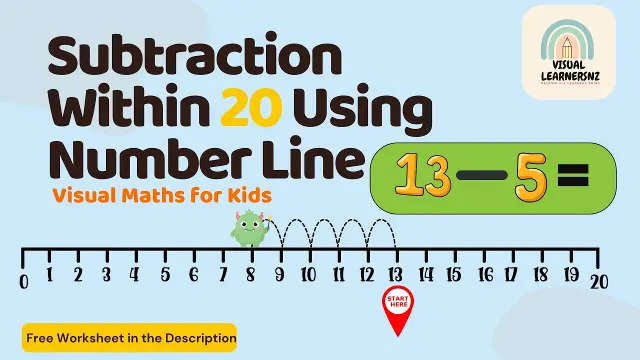 How to Subtract Within Twenty Using a Number Line
Get new #Math Lessons ideas by email
Every Thursday: the week's best ideas, with the newest from #Math Lessons.
Related tags
Math Lessons for Clear, Confident Learning
Math lessons are structured ways of learning numbers, shapes, patterns, measurement, and problem-solving. At first, they often focus on basic skills such as counting, recognizing numerals, and understanding addition and subtraction. As you move forward, lessons may include multiplication, division, fractions, geometry, data, and algebraic thinking. The aim is not only to get the right answer, but also to understand how numbers work and how to explain your thinking.
What math lessons usually cover
Early math lessons often begin with concrete ideas: matching objects, comparing quantities, and seeing how one number relates to another. This helps build number sense, which is the foundation for later work. Once that feels familiar, lessons usually introduce written symbols and more formal methods.
Later lessons often explore:
- Number operations such as addition, subtraction, multiplication, and division
- Place value and the idea that digits change meaning depending on position
- Fractions, decimals, and percentages
- Shapes, angles, symmetry, area, and perimeter
- Measurement, time, money, and units
- Word problems that connect math to real situations
Read more
Good math teaching moves between seeing, doing, saying, and writing. For many learners, it helps to use objects, pictures, and simple examples before moving to abstract sums.
Main approaches and styles
There is no single correct way to learn math. Some lessons are very direct and step-by-step, while others use games, puzzles, drawings, or real-life examples. A balanced lesson often includes both practice and understanding.
Common styles include:
- Guided practice, where you work through examples with support
- Independent practice, where you try a few problems on your own
- Visual learning, using number lines, blocks, diagrams, or charts
- Real-world tasks, such as measuring ingredients or comparing prices
- Mental math, which builds speed and number flexibility
The best lessons usually mix these methods. If one approach feels confusing, another may make the idea clearer.
What beginners should know
If you are just starting, it helps to go slowly and build a strong base. Many difficulties in math come from skipping over early ideas. Make sure you are comfortable with counting, comparing numbers, and simple addition and subtraction before moving ahead.
A few useful habits:
- Learn one idea well before adding the next
- Practice a little often rather than doing too much at once
- Say your steps out loud to help you think clearly
- Check your work carefully, especially in word problems
- Ask yourself what the question is really asking
Mistakes are part of learning math. They often show exactly where more practice is needed.
Practical tips for better progress
Try to keep math lessons calm and regular. A quiet space, pencil, paper, and enough time can make a big difference. It also helps to use examples that feel familiar, such as sharing snacks, telling time, or measuring everyday objects.
If a problem feels hard, break it into smaller parts. Read it carefully, underline important information, and solve one step at a time. When you finish, check whether your answer makes sense.
Over time, math becomes easier when you notice patterns and understand why methods work. With steady practice and patient guidance, you can build confidence and improve at every level.
Videos come from YouTube and posts from Instagram; titles and summaries are our own. All rights belong to their creators.