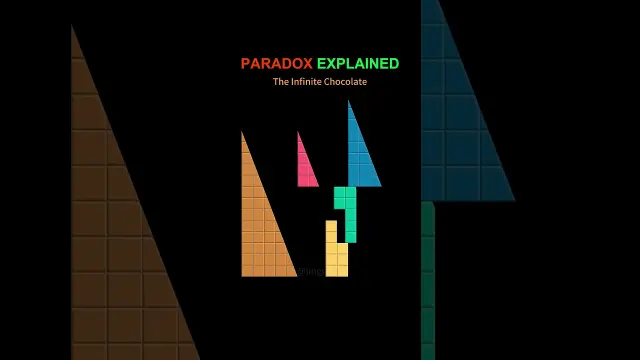
 The infinite chocolate paradox explained with geometry
#Math Shorts
1 ideas
The infinite chocolate paradox explained with geometry
Get new #Math Shorts ideas by email
Every Thursday: the week's best ideas, with the newest from #Math Shorts.
Related tags
Math Shorts: Short, Clear Ways to Explore Mathematics
Math shorts are short, focused pieces of mathematical content designed to explain one idea quickly. They may be a puzzle, a visual trick, a small proof, a clever calculation, or a surprising result that can be understood in just a few minutes. Because they are brief, they work well for sharing mathematical ideas in an accessible way, especially when the goal is to spark curiosity rather than cover a full lesson.
Mathematics itself has many branches, from arithmetic and algebra to geometry, probability, and logic. Math shorts usually draw from these areas by taking one small concept and presenting it in a clear, memorable form. A well-made math short does not try to do everything at once. Instead, it focuses on a single question, such as why a pattern works, how a shape behaves, or how a problem can be solved more elegantly than expected.
What math shorts are used for
Math shorts are often used to introduce a topic, refresh old knowledge, or make a difficult idea feel approachable. They can be helpful for learners who prefer visual explanations or who want to see how mathematics connects to everyday reasoning. They are also popular for curiosity-driven learning, because they often highlight the surprising side of math: symmetry, infinity, proportions, probability, and logical shortcuts.
Read more
Common styles
- Visual explanations: diagrams, shapes, and movements that make the idea easier to see
- Puzzle-based shorts: a question is posed first, then solved step by step
- Proof sketches: a short, simple version of a mathematical argument
- Number tricks: playful calculations that reveal patterns
- Word problems: everyday situations translated into math
- Geometry and logic examples: topics that work well in a compact format
What makes a good math short
A good math short is clear, accurate, and limited to one main idea. It should build from what the reader already understands and avoid rushing through important steps. If there is a surprising answer, the explanation should show why it happens instead of leaving it as a trick. Good math writing is not about sounding complicated; it is about making a difficult idea easier to follow.
Tips for beginners
If you are new to making or following math shorts, start with simple topics and familiar numbers. Use plain language and a clean structure. It helps to show the problem first, then the reasoning, then the conclusion. Diagrams can be especially useful for geometry, fractions, and patterns. If a result seems strange, check each step carefully, since short explanations can sometimes hide assumptions.
You may also find it helpful to think of a math short as a small lesson with a beginning, middle, and end. First, set up the idea. Then, guide the reader through the reasoning. Finally, show the result in a way that feels complete.
Math shorts can be playful, elegant, and genuinely useful. They offer a way to enjoy mathematics without needing a long explanation every time, and they can make even a small idea feel sharp, memorable, and worth thinking about.
Videos come from YouTube and posts from Instagram; titles and summaries are our own. All rights belong to their creators.