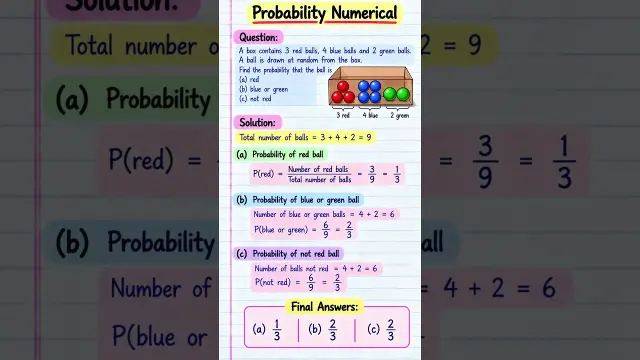
 Can You Solve This School Level Probability Numerical Question
#Maths Revision
1 ideas
Can You Solve This School Level Probability Numerical Question
Get new #Maths Revision ideas by email
Every Thursday: the week's best ideas, with the newest from #Maths Revision.
Related tags
Maths Revision Guide
Maths revision is the process of going back over the ideas, methods, and problem types you have already learned so that they become clearer, faster, and easier to use. Unlike subjects where remembering facts is enough, mathematics asks you to understand patterns, steps, and the reasons behind each method. Good revision helps you build confidence, spot gaps in your knowledge, and solve problems more accurately under pressure.
What maths revision involves
At its heart, maths revision is about three things: understanding, practice, and recall. You need to know what a method means, when to use it, and how to carry it out correctly. This applies across many areas of maths, including number, algebra, geometry, statistics, ratio, and probability. Each topic has its own language and standard techniques, but the best revision habits are similar for all of them.
A useful starting point is to separate topics into smaller parts. For example, algebra may include simplifying expressions, solving equations, and working with formulas. Geometry may include angle facts, area, perimeter, and transformations. Breaking work into sections makes revision feel more manageable and helps you see exactly where you need more practice.
Read more
How to revise effectively
Start by checking what you already know. Try a few questions without notes and notice where you hesitate or make mistakes. Those weak spots should guide your revision. It is usually more helpful to do a smaller amount of focused practice than to read through lots of material without actively working.
Make sure you revise both the method and the meaning. If you learn a formula, understand what the symbols represent and why the formula works in that situation. If you are solving a problem, ask yourself which clues show you what kind of question it is. This habit makes it easier to recognise similar questions later.
Working through past questions, textbook exercises, or mixed practice sets can be very effective. Mixed practice is especially useful because it trains you to choose the right method instead of simply repeating the same type of question. After each exercise, check your working carefully and correct any errors. In maths, a wrong answer often comes from a small step that went unnoticed.
Helpful study habits
- Write out full working, even for questions that seem easy.
- Keep a formula list, but also learn when each formula is used.
- Revisit weak topics regularly instead of leaving them to the end.
- Practise explaining a method in your own words.
- Use neat layouts, especially in multi-step problems.
- Check answers by substituting back, estimating, or using a second method when possible.
What beginners should keep in mind
If you feel stuck, remember that progress in maths usually comes from repetition and clear thinking, not from trying to memorise everything at once. It is normal to make mistakes while revising. Treat them as clues. Each mistake shows you something specific to fix, whether it is a calculation error, a misunderstanding of a rule, or a problem with timing.
The most effective maths revision is steady, active, and honest. Focus on understanding the method, practise until it feels familiar, and return often to the topics that still need work.
Videos come from YouTube and posts from Instagram; titles and summaries are our own. All rights belong to their creators.