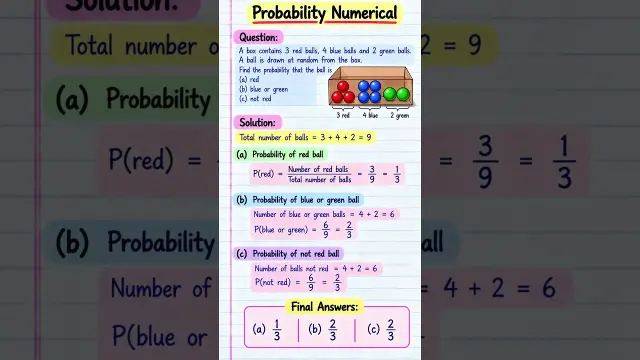
 Can You Solve This School Level Probability Numerical Question
#Numerical
1 ideas
Can You Solve This School Level Probability Numerical Question
Get new #Numerical ideas by email
Every Thursday: the week's best ideas, with the newest from #Numerical.
Related tags
Numerical Problems and Number Sense
What numerical means
A numerical problem is any question answered with numbers, calculation, or logical reasoning based on quantities. It may ask you to add, subtract, multiply, divide, compare, estimate, interpret data, or work out a missing value from given information. Numerical thinking appears in school mathematics, everyday budgeting, measurements, statistics, and many practical decisions.
At its heart, numerical work is about making sense of quantities. You may be working with whole numbers, fractions, decimals, percentages, ratios, or simple probability. Some questions are direct, while others ask you to read a situation carefully and choose the right operation. That is why numerical skill is not only about arithmetic; it is also about understanding the problem itself.
Where numerical questions come from
Read more
Numerical questions are used in many settings: classrooms, exams, interviews, forms, charts, and everyday life. You see them when checking a receipt, adjusting a recipe, measuring fabric, or comparing prices. In more formal settings, numerical reasoning helps you interpret tables, graphs, and word problems.
There are many kinds of numerical tasks:
- Basic arithmetic: addition, subtraction, multiplication, and division
- Fractions and decimals: converting, simplifying, and comparing
- Percentages: discounts, increases, and proportions
- Ratios and rates: recipes, scale, speed, and sharing
- Probability and statistics: chance, averages, and data interpretation
- Mental maths and estimation: quick, practical approximations
How to approach a numerical problem
The best first step is to read slowly and identify what is being asked. Underline the important numbers and words such as total, difference, each, remaining, per, or percent. These clues often show the operation you need.
A simple method is:
- Read the question twice
- Write down the known values
- Decide what is missing
- Choose the operation or formula
- Check your answer against the question
If the problem is longer, break it into smaller parts. Many numerical questions become easier when you solve them step by step rather than trying to do everything at once.
What beginners should know
If you are starting out, focus on accuracy before speed. A careful understanding of place value, fraction basics, and multiplication tables makes later work much easier. Learn to estimate answers too, because estimation helps you spot mistakes and see whether a result makes sense.
It also helps to practice with different formats. A number can appear as a fraction, decimal, percent, or ratio, and the same idea may be expressed in words, symbols, or a chart. The more familiar you become with these forms, the faster you can recognise what a question is really asking.
Practical tips
- Always check units, especially in measurement problems
- Watch for words that signal subtraction or division
- Estimate first if the exact answer is not obvious
- Re-read word problems to avoid missing hidden information
- Show your working so you can check each step
Numerical skill grows with practice. The aim is not only to get the right answer, but to understand how numbers behave and how to use them confidently in real situations.
Videos come from YouTube and posts from Instagram; titles and summaries are our own. All rights belong to their creators.