 The Six Levels of Thinking in Bloom's Taxonomy Explained
#Metacognition
2 ideas
The Six Levels of Thinking in Bloom's Taxonomy Explained
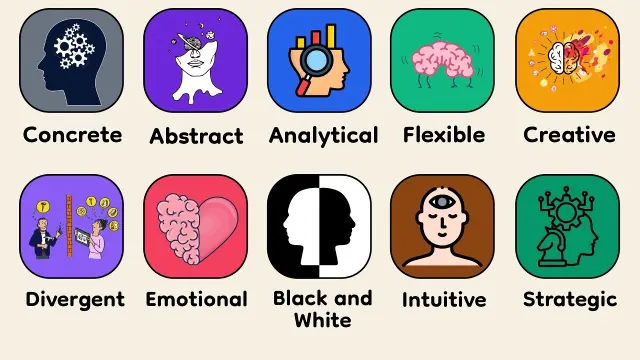 Every Type of Thinking Explained, From Concrete to Reflective
Get new #Metacognition ideas by email
Every Thursday: the week's best ideas, with the newest from #Metacognition.
Related tags
Metacognition: A Guide to Thinking About Your Thinking
Most of the time you think without noticing that you are thinking. You answer a question, make a decision, learn a new skill, and the mental machinery runs quietly in the background. Metacognition is what happens when you turn around and look at that machinery: it is the awareness of your own mind at work, and the ability to steer it. The word combines the Greek meta, meaning beyond or about, with the Latin cognoscere, to know. In plain terms, it is knowing about knowing.
Two sides of the same coin
Researchers usually split metacognition into two related parts. The first is metacognitive knowledge: what you understand about your own mind and about thinking in general. That includes knowing how well you have learned something, recognising that one task is harder than another, and being aware that some strategies suit you better than others.
The second is metacognitive regulation: what you actually do with that knowledge. It shows up as planning before you begin, checking your understanding while you work, noticing when you have drifted off course, and reviewing afterwards whether your approach was any good. Knowledge without regulation stays theoretical; regulation without knowledge tends to be guesswork.
Read more
Where the idea comes from
The concept has deep roots in philosophy, which has asked for centuries how the mind can examine itself. As a named area of psychology it took shape in the 1970s, when the developmental psychologist John Flavell and others began studying how people monitor their own memory and comprehension. Since then it has become central to research on learning, and it sits close to what educators mean by reflective thinking and to the higher levels of Bloom's taxonomy, where evaluation and creation depend on being able to judge your own work.
Why it matters
Metacognition is one of the quiet dividers between people who improve and people who plateau. Strong learners are not simply smarter; they are better at noticing what they do not yet understand and adjusting accordingly. The same skill supports decision making, since it lets you ask whether you are reasoning carefully or merely reasoning confidently, and it supports emotional life, because recognising a thought as a thought creates a little space between a feeling and an action.
The cycle in practice
Metacognition is easiest to learn as a three-step loop.
- Before: predict. Ask what the task requires, what you already know, how long it will take, and which approach is likely to work.
- During: monitor. Pause occasionally and ask whether this is making sense, whether you are stuck, and whether your strategy is still the right one.
- After: evaluate. Judge the result honestly and ask what you would do differently next time.
A key idea here is calibration, the match between how well you think you know something and how well you actually do. Familiarity is a poor guide: rereading feels productive while adding little. Testing yourself, explaining a concept aloud, or trying to solve a problem without notes gives far more honest feedback.
Traps worth knowing
Overconfidence is the common one, but there are others. Rumination can masquerade as reflection, circling the same worry without producing insight. And a fixed story about yourself, such as deciding you are simply bad at a subject, shuts down the curiosity that metacognition depends on.
Starting out
Begin small. Pick one task a day and spend thirty seconds before it predicting how it will go, then a minute afterwards asking what happened. Keep a short note of what surprised you. Say your thinking out loud when you are learning something difficult, and invite someone to check your reasoning. Over time the questions become automatic, and you gain something valuable: a working relationship with your own mind.
#Metacognition: frequently asked questions
What does metacognition actually mean in everyday terms?
It is thinking about your own thinking — noticing how you are approaching a task while you are doing it, rather than just doing it on autopilot. In practice it means you can tell whether you truly understand something or only feel familiar with it, and you can change course when the answer is not what you hoped.
How do I get started with metacognition without turning it into a big project?
Pick a single ordinary task each day: spend a moment beforehand predicting how it will go and roughly what it will demand of you, then a moment afterwards asking what actually happened and what surprised you. Jotting down the surprises in a line or two is enough, and saying your reasoning out loud while learning something difficult makes the process far more visible. The habit becomes automatic sooner than people expect.
What is the difference between knowing about your thinking and actually managing it?
One is the understanding you carry around — that a certain subject is hard for you, or that a particular method suits you better than another. The other is what you do with it: planning before you begin, checking mid-way whether things make sense, and reviewing honestly at the end. Understanding without action stays theoretical, while action without understanding is mostly guesswork, so the two work best together.
How can I tell whether I have really learned something or just feel like I have?
Familiarity is misleading — rereading and highlighting feel productive but mostly build a sense of comfort rather than recall. A more honest signal comes from closing the material and trying to explain the idea aloud, solve a problem without notes, or quiz yourself. If the gap between how confident you felt and how you performed is large, that gap is the useful information.
What mistakes stop people from thinking about their thinking well?
Overconfidence is the usual one, where the feeling of knowing replaces any real check. Rumination is another: replaying the same worry feels like reflection but never produces insight, and a fixed story about yourself — deciding you are simply bad at something — closes off the curiosity the whole process depends on. Naming which of these you tend toward is often the quickest way past it.
Does metacognition relate to reflection and higher-order thinking?
Yes, it overlaps closely with what educators call reflective thinking, and it underpins the more demanding levels of any thinking framework, where judging and creating depend on being able to assess your own work. It also reaches beyond study: asking whether you are reasoning carefully or merely confidently improves decisions, and recognising a thought as a thought puts a little space between a feeling and what you do next.
Videos come from YouTube and posts from Instagram; titles and summaries are our own. All rights belong to their creators.