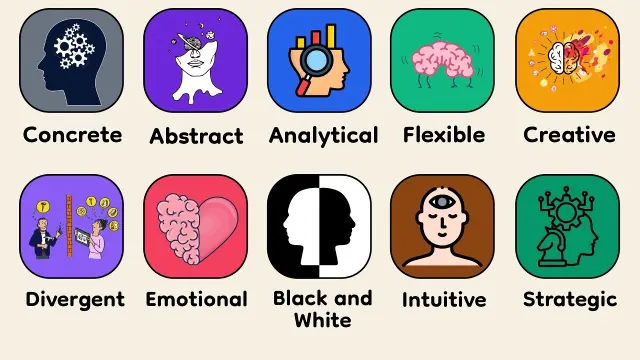
 Every Type of Thinking Explained, From Concrete to Reflective
#Thinking Styles
1 ideas
Every Type of Thinking Explained, From Concrete to Reflective
Get new #Thinking Styles ideas by email
Every Thursday: the week's best ideas, with the newest from #Thinking Styles.
Related tags
Thinking Styles: A Guide to How Minds Approach Problems
Thinking styles are the patterns your mind settles into when it meets a question, a task or a decision. The idea comes from psychology and education, where teachers and researchers noticed that two people of equal intelligence could approach the same problem in completely different ways: one reaching for numbers, another for images, one moving step by step, another jumping straight to the whole picture. A style is not a measure of ability. It is a preference, a default setting, and like any default it can be useful in one situation and limiting in another.
The main families of style
Most descriptions of thinking sort into a few broad contrasts.
- Analytical thinking breaks a problem into parts, tests them one at a time and looks for causes and consequences. It suits anything that can be measured or checked.
- Creative thinking works by association, recombination and play. It generates options rather than narrowing them.
- Critical thinking is the evaluating counterpart: questioning what you are told, weighing evidence, spotting the gap between a claim and its support.
- Concrete thinking stays close to what can be seen, touched and demonstrated. It is practical and grounded.
- Abstract thinking moves into ideas, models and possibilities that have no immediate physical form.
- Convergent thinking aims at one right answer; divergent thinking spreads outward into many possible answers.
- Linear thinking proceeds in sequence; holistic thinking looks at the whole system and how its parts interact.
- Reflective thinking turns back on itself, asking not only "what is true?" but "how did I arrive at that, and could I be wrong?"
Read more
What beginners should know
The most common mistake is treating a style as an identity. "I'm a creative person, not a numbers person" closes doors that were never locked. Styles are learnable habits of attention, and most people can shift between them with practice.
A second mistake is confusing speed with style. Some thinking is genuinely fast and intuitive, some is slow and deliberate, and both are appropriate at different moments. The useful skill is recognising which one a situation is asking for: a routine decision usually wants speed, an unfamiliar one usually wants patience.
Practical habits
Try naming the style you are using. Simply saying to yourself "I am analysing this" or "I am brainstorming now" tends to keep you in the right mode and stop you from criticising ideas while you are still generating them.
Deliberately switch modes when you get stuck. If analysis has stalled, sketch. If a brainstorm has produced nothing usable, list the constraints and test them one by one. Moving between styles is often what unblocks a problem, more than pushing harder inside a single one.
Finally, leave room for reflection. Thinking styles describe how you think; reflection is how you notice whether it is working. A few minutes spent asking what you assumed, what you skipped and what you would do differently is often worth more than another hour of effort.
#Thinking Styles: frequently asked questions
What are thinking styles, in simple terms?
They are the habits of attention your mind falls into when it meets a question, a task or a decision — reaching for pictures versus words, or working step by step versus grasping the whole shape at once. They come from psychology and education, where it became clear that equally capable people can approach the same problem in completely different ways. A style describes preference, not ability.
Is a thinking style something you are born with, or something you can change?
It is a default setting rather than a fixed identity, and defaults can be redrawn with practice. Most people can move between analytical, creative, concrete and abstract modes once they notice which one they have slipped into. The trap is deciding you are simply 'not a numbers person' and closing a door that was never locked.
Which thinking style should I choose for a given task?
Match the style to what the task actually demands: anything measurable or checkable rewards an analytical, step-by-step approach, while an open-ended problem rewards association, play and many possible answers. Routine decisions usually want speed and intuition, unfamiliar ones want patience and deliberation. The skill is recognising which situation you are in before you start.
How do I get better at switching between styles?
Start by naming the mode you are in, even silently — telling yourself 'I am analysing this' or 'I am brainstorming now' keeps you from criticising ideas while you are still producing them. When you stall, change mode deliberately: if analysis has run dry, sketch it; if a brainstorm yields nothing usable, list the constraints and test them. Switching unblocks more problems than pushing harder inside a single style.
What is the most common mistake beginners make?
Confusing thinking style with identity, so a preference hardens into a limit on what you believe you can do. The other frequent slip is mistaking speed for style — treating fast intuition as shallow and slow deliberation as thorough, when each fits different moments. Neither is a measure of how well you think.
How do I know whether my thinking is actually working?
Leave room for reflection, which is the mode that turns back on the process itself rather than the problem. Ask what you assumed, what you skipped and what you would do differently next time. A short pause for that kind of review usually pays off more than another long stretch of effort in the same groove.
Videos come from YouTube and posts from Instagram; titles and summaries are our own. All rights belong to their creators.