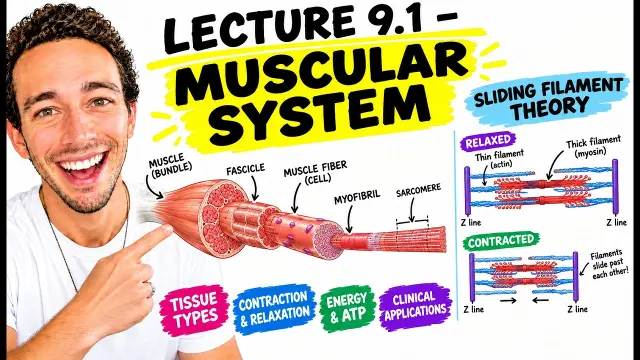
 Anatomy and Physiology Lecture on the Muscular System
#Muscular System
1 ideas
Anatomy and Physiology Lecture on the Muscular System
Get new #Muscular System ideas by email
Every Thursday: the week's best ideas, with the newest from #Muscular System.
Related tags
The Muscular System: How Your Body Moves
Every movement you make, from lifting a kettle to blinking at a bright light, happens because muscle tissue contracted. The muscular system is the body's engine of motion: a collection of tissues that shorten and relax in response to signals from the nervous system, pulling on bones, squeezing blood vessels, and pushing food along its way. It is also part of why you feel warm after climbing stairs, and part of why your posture holds together when you sit at a desk for hours.
Three kinds of muscle
Muscles are usually grouped by how they are built and how much say you have over them.
- Skeletal muscle is the kind you can see and name at the gym. It attaches to bone, often through tendons, and it moves the skeleton at the joints. It is striped under a microscope, works in pairs across a joint, and answers to your will.
- Smooth muscle lines hollow organs such as the stomach, intestines and blood vessels. It is not striped, works slowly and steadily, and carries on without your attention.
- Cardiac muscle is found only in the heart. It is striped like skeletal muscle but, like smooth muscle, it does not wait for instructions. It contracts in a rhythm of its own for your whole life.
Read more
How a movement actually happens
Muscles can only pull; they cannot push. So they work in opposing pairs, one contracting while the other lengthens and gives way. The muscle doing the work is the agonist, the one yielding is the antagonist, and stabilising muscles hold the joint steady while it happens. A signal travels from the brain down a nerve, reaches the muscle, and sets off a sliding action inside the fibres that shortens them.
What beginners should know
You do not need to memorise every muscle to train sensibly, but a few principles carry most of the weight.
- Muscles respond to progressive demand. Lifting or resisting a little more than before, gradually, is what leads to change.
- Rest is part of the work. Muscle tissue adapts between sessions, not during them.
- Warm up gently and build up load slowly; sudden jumps are where strain tends to happen.
- Variety matters. Pushing movements and pulling movements, upper body and lower body, all deserve a place.
- Daily movement counts too. Walking, carrying, climbing stairs and stretching all keep the system doing what it was built for.
Caring for the system as a whole
Muscles like to be used, fed and rested. Regular activity of any kind keeps them responsive, and eating enough overall, including protein, gives them the material to repair. Water and sleep matter more than most people expect. If something hurts sharply, swells, or stops you moving normally, that is a moment to stop and seek proper advice rather than push through.
The muscular system rarely asks for much: move often, build up slowly, and let it rest.
Videos come from YouTube and posts from Instagram; titles and summaries are our own. All rights belong to their creators.