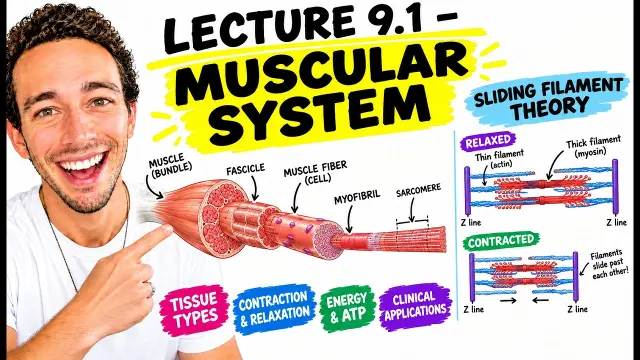
 Anatomy and Physiology Lecture on the Muscular System
#Physiology
1 ideas
Anatomy and Physiology Lecture on the Muscular System
Get new #Physiology ideas by email
Every Thursday: the week's best ideas, with the newest from #Physiology.
Related tags
Physiology: How Your Body Works, System by System
Physiology is the study of how living things work. Where anatomy asks what the body is made of, physiology asks what those parts do and how they cooperate. It looks at the way a muscle contracts, how a nerve carries a signal, how the kidneys decide what to keep and what to release, and how all of it happens at the same time without anyone giving instructions.
The word comes from the Greek roots for "nature" and "study" — a study of the way things naturally are. For centuries it sat close to medicine: understanding how the body normally behaves is what makes it possible to recognise when something has gone wrong. Today it is a science in its own right, taught to students of biology, medicine, sport and animal science.
What it covers
Physiology works at several scales. Cell physiology looks at the processes inside a single cell — how it takes in nutrients, moves water, and responds to a signal. Systemic physiology takes one organ system at a time: the circulatory, respiratory, digestive, nervous, endocrine, muscular and other systems, and the role each plays. Human physiology is the most widely studied, but comparative physiology considers how animals solve the same problems in different ways, exercise physiology looks at the body under effort, and plant physiology does much the same work for green things.
Read more
The organising idea: balance
If you learn one concept, learn this one. Living systems hold their internal conditions within a workable range, adjusting continuously as things shift. This steady-upkeep is what makes complex life possible, and almost every topic in physiology is a story about it. Temperature, water, blood sugar, oxygen levels, acidity — each is managed through feedback, where a change triggers a correction that pulls things back toward the middle.
That is also why physiology is so full of loops, trade-offs and "it depends" answers. The body is rarely doing one thing; it is balancing several at once.
Getting started
A few habits make the subject far easier.
- Always link a structure to its job. Ask what a shape or a position makes possible.
- Study one system at a time, then ask how it talks to the others. Systems are not independent; that is the interesting part.
- Draw instead of highlighting. Tracing a pathway from memory shows you what you actually know.
- Follow the "why" questions. Why does the body do it this way, what breaks if it doesn't, and what does that protect?
- Keep the scale in mind. The same process looks different inside a cell and inside a whole organ.
You do not need to memorise everything at once. Physiology rewards curiosity more than cramming: the more you ask how something works, the more the rest of it starts to fit together.
Videos come from YouTube and posts from Instagram; titles and summaries are our own. All rights belong to their creators.