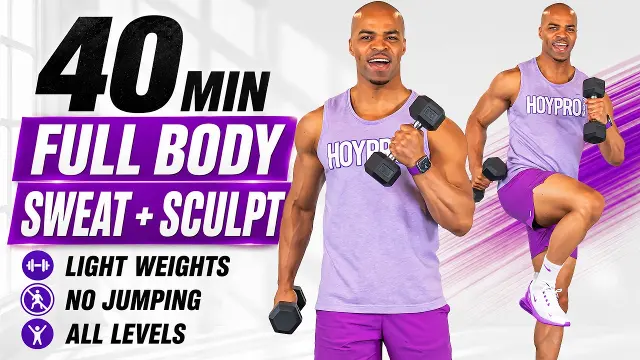
 Forty-Minute Standing Sweat and Sculpt with Light Dumbbells
#No Jumping
1 ideas
Forty-Minute Standing Sweat and Sculpt with Light Dumbbells
Get new #No Jumping ideas by email
Every Thursday: the week's best ideas, with the newest from #No Jumping.
Related tags
No Jumping: Low-Impact Workouts That Still Work Hard
No jumping is a way of training that leaves out hops, bounds and plyometric moves, keeping at least one foot on the floor at all times. Nothing about it is soft. Removing the impact simply means the effort has to come from somewhere else: from tempo, from range of motion, from resistance, from balance, or from holding a position longer than is comfortable.
The approach sits inside what trainers call low-impact training, and it has a long history in physiotherapy and rehabilitation, where protecting joints matters more than spectacle. It has become popular far beyond that world because it makes exercise possible in flats with thin floors, in small rooms, early in the morning or late at night, and for people returning to movement after a long break.
What it looks like in practice
The simplest no-jumping session is a steady circuit of large movements done with control:
Read more
- Squats, split squats and lunges at a pace you can actually own.
- Step-ups onto a stair or a low box.
- Glute bridges and hip hinges, with or without weight.
- Push-ups against a wall, a bench or the floor.
- Rows with a band or a pair of dumbbells.
- Carries: walking while holding weight at your sides.
Cardio without the bounce comes from marching in place, brisk walking, step-touch patterns, shadow boxing, low-impact dance, cycling on a stationary bike, rowing, or swimming. Intervals work here just as well as anywhere: a minute of harder effort, a minute easier, repeated.
Making it demanding
If a session feels too easy, the answer is rarely to add jumping. It is usually to slow down the lowering phase of each movement, pause at the hardest point, increase the weight slightly, shorten the rest, or add a balance challenge such as standing on one leg. These adjustments raise the effort without a single landing.
What beginners should know
Start with movements you can perform with steady breathing and clean form. Two or three sessions a week is plenty at the beginning, with a rest day between them. Warm up for a few minutes with gentle marching and arm circles, and finish with slow stretches. Expect muscle soreness in the first weeks; it fades as the body adapts.
Shoes matter less than people assume, but a firm, flat surface helps, and bare feet on a rug can be fine for strength work. Keep water nearby and stop if something hurts sharply rather than aching.
Who it suits
No-jumping training is a sensible default for anyone in an apartment, anyone who dislikes the jarring feeling of landings, and anyone building back from a period of inactivity. If you are pregnant, recovering from an injury or managing a condition that affects your joints, bones or heart, talk to a doctor or a qualified instructor before starting, and let them adapt the plan to you.
The quietness is the point, not a compromise. Done with attention, a no-jumping routine can be the most consistent training you have ever kept.
#No Jumping: frequently asked questions
What exactly is no-jumping training?
It is a style of workout that removes hops, bounds and plyometric moves so that at least one foot stays on the floor the whole time. The effort still has to come from somewhere, so it is built through tempo, range of motion, added resistance and balance instead. Think squats, lunges, step-ups, bridges, pushes, rows and weighted carries done with control.
What do I need to start a no-jumping routine?
Very little — your own bodyweight, a bit of floor space and something to step onto, like a stair or a low sturdy box, cover most of it. A band or a pair of light dumbbells opens up rows and carries, but they are not required on day one. A firm, flat surface helps more than special shoes, and bare feet on a rug are fine for strength work.
How do I make a no-jumping workout hard enough to feel worthwhile?
The usual fix is not to add jumping but to change the tempo: lower more slowly, pause briefly at the hardest point of the movement, or shorten your rest between rounds. Adding a little resistance, or a balance challenge such as standing on one leg, raises the demand without a single landing. Done with attention, the session ends up feeling far from gentle.
What mistakes do beginners usually make?
The most common one is rushing the movements, which turns controlled work into sloppy work and makes breathing ragged. Others are skipping the warm-up, ignoring sharp pain, and assuming that a quiet session must be an easy one, so they quit before the effort builds. Start with movements you can do with clean form and steady breathing, and add difficulty gradually.
How sore will I be, and how should I recover?
Expect some muscle soreness in the first weeks; it fades as the body adapts, and a rest day between sessions helps that along. Finish each session with slow stretches, keep water nearby, and stop on sharp pain rather than working through it. Soreness that lingers is a signal to ease off rather than push harder.
Is no-jumping a good choice for an apartment or for getting back into exercise?
Yes — the quietness is the point, not a compromise, which makes it workable on thin floors, in small rooms, and at odd hours. It also suits anyone who dislikes the jarring feeling of landings or is rebuilding after time away from movement. If you are pregnant, recovering from an injury, or managing a condition affecting joints, bones or heart, check with a doctor or qualified instructor first and let them adapt the plan.
Videos come from YouTube and posts from Instagram; titles and summaries are our own. All rights belong to their creators.