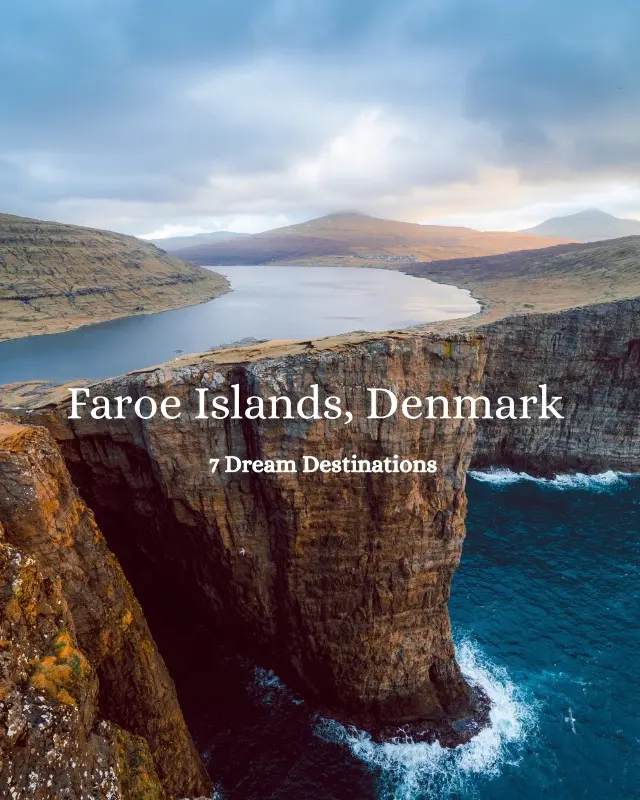
 Faroe Islands Travel Guide for Your Next Trip
#Nordic Destinations
1 ideas
Faroe Islands Travel Guide for Your Next Trip
Get new #Nordic Destinations ideas by email
Every Thursday: the week's best ideas, with the newest from #Nordic Destinations.
Related tags
Nordic Destinations: A Traveller's Guide to the North
The Nordic region stretches across the top of Europe and takes in five countries — Denmark, Finland, Iceland, Norway and Sweden — along with the self-governing islands of Greenland, the Faroe Islands and Åland. "Nordic" and "Scandinavian" are often used interchangeably, but they are not the same: Scandinavia refers only to Denmark, Norway and Sweden, while the Nordic grouping is broader and includes Finnish, Icelandic and Sami cultures. Keeping the distinction in mind is a good first step towards understanding how varied the region really is.
A landscape of contrasts
What draws most travellers is the geography. Norway is known for fjords — deep sea inlets cut between steep mountains — and for a long, fragmented coastline. Iceland has volcanic terrain, glaciers, geysers and lava fields. Sweden and Finland are dominated by pine forest, lakes and archipelagos; Denmark is flatter and more agricultural, with long sandy beaches. Greenland and the Faroe Islands offer some of the most dramatic and least visited scenery in the north.
Distances are considerable and population is sparse. A common beginner's mistake is planning too much for the time available. Two or three well-chosen bases will usually give you more than a hurried tour of six.
Read more
Seasons and light
The northern position shapes everything. In summer the days are extremely long, and above the Arctic Circle the sun does not set for weeks. In winter the opposite happens: the far north has a period of polar night, when the sun stays below the horizon. The aurora borealis is most likely to be seen in the darker months, in clear skies, away from town lights — but it is a natural phenomenon and never guaranteed.
Spring and autumn are quieter and often beautiful, with autumn colour in the forests and a softer quality of light. Whatever the season, weather changes quickly and layering is the practical approach: a warm base layer, an insulating middle and a wind- and waterproof outer shell.
Culture and everyday life
Nordic societies tend to be informal and quietly efficient. The Swedish habit of fika — a daily pause for coffee and something to eat — and the Danish idea of hygge, a word for cosy contentment, both describe a preference for unhurried time with others. The sauna is central to Finnish life and is best approached simply: follow the customs you are shown, and remember that it is a calm, social space rather than a performance.
Outdoor access is unusually generous. Across much of the region there is a shared right to walk, ski and camp on open land, and to pick berries and mushrooms, provided you keep your distance from homes, leave no trace and respect farmland and protected areas.
Before you go
Learn a few words of the local language — English is widely spoken, but the attempt is appreciated. Book accommodation early in the far north, where supply is limited. Carry cash only as a backup, as cards are accepted almost everywhere. And accept that the weather may cancel a plan: in the Nordic countries, flexibility is not a compromise, it is part of the pleasure.
#Nordic Destinations: frequently asked questions
How do I start planning a trip to the Nordic region?
Begin with the distinction between the Nordic countries and Scandinavia, since the wider group includes Finnish, Icelandic and Sami cultures as well as the Atlantic islands. From there, pick a season and two or three bases rather than trying to cover everything. Reading a little about local customs before you go makes the everyday side of the trip much easier to enjoy.
Which kind of Nordic destination should I choose?
Choose by landscape: fjords suit travellers who want dramatic coastal scenery, volcanic terrain and glaciers suit those drawn to raw geology, and forests and lakes suit anyone wanting quiet inland walks and boat trips. The flatter areas with long beaches are a gentler option, particularly with children. If you want remoteness, the smaller Atlantic islands deliver it in abundance.
What should I pack and prepare for a Nordic trip?
Think in layers — a warm base, an insulating middle and a wind- and waterproof outer layer — because conditions shift quickly whatever the season. Good footwear and a relaxed attitude to changing plans matter more than a long packing list. Book your accommodation early if you are heading far north, and treat cards as your default with a little cash as backup.
What are the most common mistakes visitors make?
The classic one is over-scheduling: distances are long and populations sparse, so a packed itinerary turns into time in a vehicle rather than time outdoors. Another is assuming the aurora is a certainty; it is a natural event and clear, dark skies away from town lights only improve your chances. A third is ignoring local rules on open land — enjoy the freedom to roam, but keep your distance from homes, leave no trace and respect farmland.
Is the Nordic region a good choice for a special occasion?
Yes, and the occasion usually shapes the plan — a quiet coastal escape, a winter trip built around dark skies, or a summer journey with almost endless daylight all work well. The everyday rituals of the region, such as a slow coffee break, a sauna or a long outdoor meal, give celebrations an unhurried feel. Just build in slack, since weather can rearrange a carefully arranged day.
How can I travel respectfully in the Nordic countries?
Learn a few words of the local language, follow the customs you are shown, and treat shared outdoor access as a privilege that comes with obligations. That means keeping clear of private ground, carrying out what you bring in, and not disturbing wildlife or working farmland. Slowing down and accepting the weather as part of the experience is, in practice, the most respectful approach of all.
Videos come from YouTube and posts from Instagram; titles and summaries are our own. All rights belong to their creators.