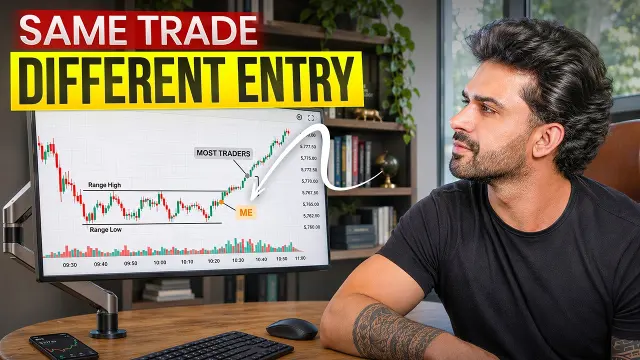
 Opening Range Breakout Strategy: Entering Before the Break
#Opening Range Breakout
1 ideas
Opening Range Breakout Strategy: Entering Before the Break
Get new #Opening Range Breakout ideas by email
Every Thursday: the week's best ideas, with the newest from #Opening Range Breakout.
Related tags
Opening Range Breakout: A Guide to Early-Session Trading
Every trading session begins with a burst of activity. Orders that built up overnight meet the first wave of fresh interest, and prices often swing sharply before settling into a direction. Traders have long watched that early window for clues, and the opening range breakout is one of the simplest ways of turning the observation into a repeatable plan.
What the opening range is
The opening range is simply the high and the low price reached during a chosen stretch of time right after a market opens. That stretch might be the first fifteen minutes, the first half hour, or the first hour, depending on the market and the temperament of the trader. Once the window closes, those two prices become fixed reference points: the top and bottom of the box that price action starts inside.
An opening range breakout happens when price leaves that box — climbing above the high or falling below the low — and a trader treats the exit as a signal that the early balance has been decided in one direction.
Read more
Where the idea comes from
The concept grew out of open-outcry futures and commodity pits, where the first minutes of the day carried the heaviest order flow and the widest spreads, and where floor traders needed a quick, mechanical way to decide which side of the market was in control. It travelled into screen-based intraday trading because it needs almost nothing to define: no indicator, no complex formula, just a clock and two prices.
How traders apply it
A typical framework has four parts:
- Marking the range using a fixed, pre-chosen time window, applied the same way every session.
- Waiting for a close beyond the boundary rather than reacting to a single tick that pokes through it.
- Looking for confirmation, such as expanding volume or a sustained move rather than an immediate snap back.
- Deciding in advance where the idea is wrong, so the exit is defined before entry rather than after.
Variations exist. Some traders only take breakouts in the direction of the broader trend, some require the range to be unusually narrow first, and some fade the breakout instead of following it, betting that the first push beyond the box will fail.
What beginners should know
False breakouts are common. Price frequently pierces the boundary, gathers the orders resting there, and returns inside the range — a behaviour often called a fakeout. Losing streaks of exactly this kind are normal, which is why position size and a predefined exit matter more than any entry trigger.
Choose one liquid market and one time window, then study many sessions before risking money. Keep a record of each setup, including the ones you skip, so you can see whether the pattern actually suits the market you are watching. Remember that intraday trading carries real risk of loss and is not suitable for everyone; treat any strategy as a hypothesis to test, never as a promise.
#Opening Range Breakout: frequently asked questions
What exactly is an opening range breakout, in plain terms?
It describes price leaving the high–low box formed during a chosen window right after a market opens, with the exit treated as a signal that the early balance has tipped one way. The range itself is nothing more than those two prices, marked once the window closes. No formula or indicator is involved — just a clock and the boundary lines.
What do I need before I start watching for one?
A liquid market, a fixed time window applied identically every session, and a written record of what happens. The record matters more than any add-on tool, because it shows whether the pattern actually behaves consistently in the market you are following. Keeping notes on the setups you skip is as useful as noting the ones you take.
Which variation suits someone starting out?
The plain version — mark the range, wait for price to close and hold beyond the boundary, then follow the direction it chose — is the easiest to observe and repeat. Trend filters, unusually narrow ranges and fading the break are refinements that only become meaningful once the basic behaviour has been watched across many sessions. Trying several variants at once makes it impossible to tell which one is helping.
What mistakes do people make most often?
Jumping on a single tick that pokes through the line rather than waiting for price to hold beyond it, and entering without having decided beforehand where the idea is wrong. Another common one is changing the time window or the market after a losing stretch, which discards the sample the trader was building.
Why do these breakouts fail so often?
Price frequently pierces the boundary, gathers the orders resting there, and slips back inside the range — the fakeout. That is ordinary behaviour for these early ranges rather than something going wrong, which is why the exit and the position size are settled before entry rather than after.
Videos come from YouTube and posts from Instagram; titles and summaries are our own. All rights belong to their creators.