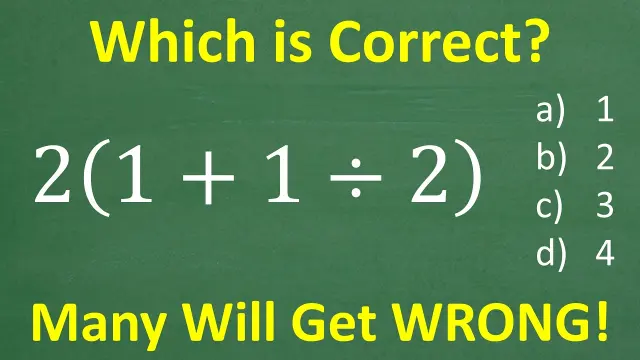
 Solving Numeric Expressions Using the Order of Operations
#Order of Operations
1 ideas
Solving Numeric Expressions Using the Order of Operations
Get new #Order of Operations ideas by email
Every Thursday: the week's best ideas, with the newest from #Order of Operations.
Related tags
Order of Operations
What the order of operations means
The order of operations is the rule set that tells you which parts of a math expression to work out first. It matters because the same numbers can lead to different answers depending on the order in which you calculate them. By following the same sequence every time, you make expressions clear, consistent, and easier to solve.
This idea is used in arithmetic, algebra, and many everyday calculations. It helps when you are working with sums, differences, products, quotients, powers, and grouped terms. Once you learn the pattern, you can read an expression with confidence instead of guessing where to begin.
The usual sequence
Read more
The basic idea is to handle expressions in a standard order:
- Grouping symbols first, such as parentheses, brackets, and braces
- Exponents and roots
- Multiplication and division, from left to right
- Addition and subtraction, from left to right
You may hear this summarized in different ways, but the important point is that multiplication does not always come before division, and addition does not always come before subtraction. At the same level, you work from left to right.
Grouping symbols are especially important because they show that certain parts belong together. If there are nested groups, you work from the inside outward.
Why it is useful
Without a shared rule, the same expression could be interpreted in several ways. The order of operations gives you one clear method. It is especially helpful when expressions include more than one operation, such as a number multiplied by a sum, or a fraction inside parentheses.
It also prepares you for more advanced math. In algebra, for example, the same rules apply whether you are working with numbers, letters, or both. If you understand the order of operations well, you will find it easier to simplify expressions, solve equations, and check your work.
Helpful habits for beginners
A careful, step-by-step approach is the best way to start.
- Look for grouping symbols first
- If a power or root appears, do that next
- Work through multiplication and division in the order they appear
- Then finish with addition and subtraction in the order they appear
- Write each step clearly so you do not skip anything
If you feel unsure, rewrite the expression with each step separated. This makes it easier to see what changes and helps prevent small mistakes. It can also help to compare your answer by doing the calculation in a different way, when that is possible.
Common mistakes to avoid
One common mistake is doing all multiplication before division, or all addition before subtraction. These operations share the same level, so you move from left to right. Another common mistake is ignoring parentheses and treating every part of an expression as if it were separate. Grouping symbols change the meaning of the whole expression, so give them priority.
The order of operations is less about memorizing a slogan and more about reading math carefully. Once you get used to the pattern, it becomes a natural part of solving expressions accurately.
Videos come from YouTube and posts from Instagram; titles and summaries are our own. All rights belong to their creators.