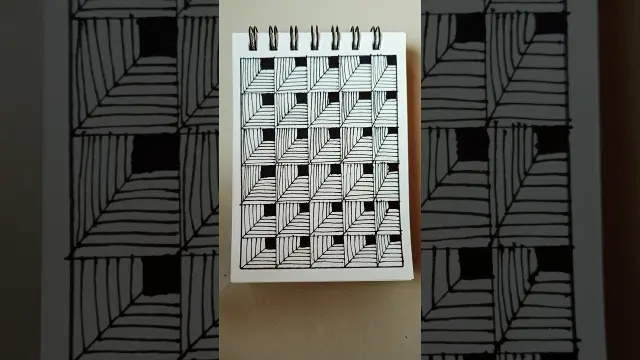
 Easy Zentangle Pattern Art Tutorial for Beginners
#Pattern Drawing
1 ideas
Easy Zentangle Pattern Art Tutorial for Beginners
Get new #Pattern Drawing ideas by email
Every Thursday: the week's best ideas, with the newest from #Pattern Drawing.
Related tags
Pattern Drawing Ideas and Techniques
Pattern drawing is the art of creating repeated marks, shapes, and motifs in a planned or improvised way. It appears in many places: textiles, wallpaper, tiles, illustration, stationery, decorative art, and even in sketchbooks as a relaxing creative practice. At its core, pattern drawing is about rhythm, repetition, and variation. A pattern may be perfectly regular, or it may feel organic and free-flowing, but it usually keeps some visual logic that ties the design together.
What pattern drawing is
A pattern can be as simple as a row of dots, stripes, or leaves, or as detailed as a fully filled surface made from interlocking shapes. Some patterns repeat the same unit over and over. Others use a group of elements that change slightly each time. This makes pattern drawing useful both for structured design work and for more expressive, hand-drawn artwork.
Pattern drawing has a long history in many cultures, especially in textiles, ceramics, manuscripts, architecture, and ornament. You can see pattern used to decorate objects, guide the eye, or create a sense of balance and movement.
Read more
Common kinds of patterns
There are many ways to approach pattern drawing, and it helps to know the basic families of pattern:
- Geometric patterns use circles, triangles, squares, lines, and grids.
- Floral patterns include flowers, leaves, vines, and other natural forms.
- Organic patterns are looser and may be inspired by shells, water, clouds, or stones.
- Abstract patterns use repeated marks, shapes, or visual textures without representing anything literal.
- Decorative line patterns often combine stripes, waves, curls, dots, and borders.
You can also mix styles. A pattern might begin with a geometric structure and then soften with hand-drawn details.
How to begin
If you are new to pattern drawing, start small. One motif is enough: a leaf, a star, a loop, or even a simple dot arrangement. Repeat it several times and notice how spacing changes the feeling of the design. Tight spacing can feel dense and energetic, while wider spacing can feel calmer and more open.
A good beginner approach is to choose:
- one main shape
- one or two supporting shapes
- a limited number of line styles
This keeps the drawing clear and helps you avoid overcrowding.
Helpful techniques
You do not need advanced skills to make a strong pattern. Simple habits make a big difference:
- Sketch lightly first, especially if you want even spacing.
- Use guides, grids, or basic guidelines when you want symmetry.
- Vary line weight to add depth and emphasis.
- Repeat elements consistently so the pattern feels intentional.
- Leave some negative space so the design can breathe.
- Test your pattern at a small scale and from a distance to check balance.
Hand-drawn patterns often look best when they keep a little imperfection. Small changes in line or shape can make the work feel lively and personal.
Practical tips
If you want your pattern to feel cohesive, decide early whether it should be busy, simple, formal, playful, or organic. Then keep that feeling in mind while you draw. If the composition starts to look crowded, remove a few elements instead of adding more.
You can build pattern drawing into your sketching routine by filling borders, pages, or small rectangles with repeating motifs. Over time, you will develop a personal library of shapes and arrangements you can reuse in new ways. The more you practice, the easier it becomes to see how repetition, spacing, and contrast work together.
#Pattern Drawing: frequently asked questions
Do I need to be good at drawing to start pattern drawing?
No. Patterns are built from simple repeatable units like dots, loops, leaves, or stripes, so accuracy matters far less than consistency and rhythm. Keeping to one main motif, a small set of supporting shapes, and a couple of line styles is enough to make a design read clearly.
What supplies should I have on hand for pattern drawing?
A pencil for light sketching, a fine liner or pen for the final lines, and smooth paper are really all you need. A ruler, a grid pad, or a compass helps when you want even symmetry or regular spacing, while an eraser keeps the structure hidden under your ink work.
Which type of pattern should I pick first?
Start with whichever family matches the feeling you want — geometric for order and structure, floral or organic for a softer, freer look, abstract for texture and mark-making. Choosing early whether the result should feel busy, calm, formal, or playful keeps the whole drawing coherent.
How do I keep my spacing and repetition even?
Sketch lightly before committing to ink, and use faint guidelines, a grid, or a folded strip of paper as a measuring guide so units land in the same places. Stepping back or viewing the sheet from a distance quickly shows where the rhythm drifts or where gaps get cramped.
How do I stop a pattern from looking overcrowded or messy?
Crowding usually comes from adding elements rather than fixing the ones already there. If the surface feels tight, remove a shape or open up the negative space between motifs, and let slight variations in line weight and hand-drawn imperfection do the work of keeping it lively.
What are common beginner mistakes in pattern drawing?
The usual ones are mixing too many shapes and line styles at once, pressing too hard before the layout is settled, and filling every bit of space so the design has nowhere to breathe. Another is judging the pattern close up — small scale and slight irregularity often look intentional in the finished piece but alarming while you draw.
Videos come from YouTube and posts from Instagram; titles and summaries are our own. All rights belong to their creators.