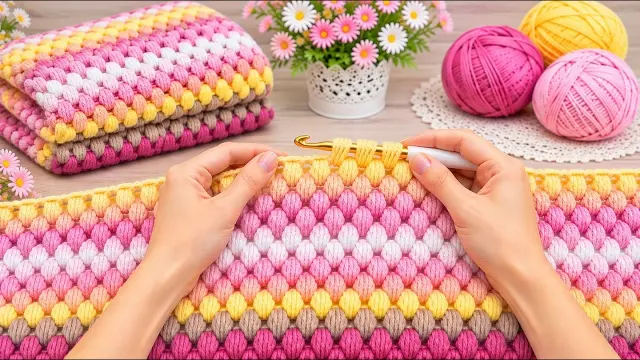
 Tunisian Crochet Blanket With Raised Puff Stitch Texture
#Puff Stitch
1 ideas
Tunisian Crochet Blanket With Raised Puff Stitch Texture
Get new #Puff Stitch ideas by email
Every Thursday: the week's best ideas, with the newest from #Puff Stitch.
Related tags
Puff Stitch Crochet: A Guide to Texture and Loops
The puff stitch is one of crochet's most loved ways of adding depth to a flat fabric. Rather than building height with a single loop, it gathers several loops onto the hook and closes them together, so a soft rounded bump rises from the surface beneath. The result is texture you can feel with your fingertips as much as see: dense, slightly squashy, and generous with shadow.
It belongs to the wider family of cluster stitches, which collect several partly finished stitches and join them into one. Crocheters have used this idea across many traditions and in every weight of yarn, from fine thread lace to chunky blankets, which is why the puff appears in so many different guises once you start looking for it.
How the stitch works
Most versions follow the same rhythm. You draw up a loop in the usual way, then repeat that motion several times into the same space, each time keeping the loops live on the hook instead of finishing the stitch. When you have as many loops as your pattern asks for, you pull the yarn through all of them at once and usually secure the bundle with a chain. A single puff can hold two loops or a dozen; the more loops, the fatter and rounder the bump.
Read more
Common variations
- The classic puff, worked into one stitch or space and closed with a chain.
- Puff clusters grouped in threes or fours, which read as a star or a flower motif.
- Puffs worked between stitches rather than into them, which gives a looser, more open fabric.
- Raised or textured puffs, where the stitch is worked around the post of a stitch below so the bump stands proud of the surface.
- Tunisian crochet puffs, worked on a longer hook and often used to build a dense, quilted texture.
What beginners should know
Evenness matters more than speed. Keep the loops you lift roughly the same height, and try to snug them together on the hook so the finished puff is neat rather than lopsided. Tension on that final pull-through is the usual culprit when puffs look loose: work it slowly and let the yarn settle before you chain.
Count as you go. It is easy to lose track of how many loops are waiting on the hook, and a puff with one loop too few or too many changes the whole texture of a row.
Practical tips
Choose a hook a size or so larger than the yarn label suggests if your puffs feel tight and hard to work. Softer, rounder yarns show the stitch best, while very slippery or splitty yarns make the loops harder to control. Puffs use more yarn than plain stitches, so buy generously for a large project, and always work a swatch — the fabric can pull in noticeably and behave differently after washing.
#Puff Stitch: frequently asked questions
How do you start a puff stitch?
Draw up a loop as you normally would, then repeat that motion into the same stitch or space, keeping each loop live on the hook instead of finishing it. When you have as many loops as your pattern asks for, pull the yarn through all of them at once and secure the bundle with a chain.
What do I need to work puff stitches?
Only yarn and a hook are required, though a hook a size larger than the yarn label suggests helps if the loops feel tight and hard to work. Softer, rounder yarns show the bump best, while very slippery or splitty yarns make the waiting loops harder to control.
Which puff stitch variation should I choose?
The classic single puff worked into a stitch or space is the easiest starting point because it teaches the basic rhythm. From there, grouped puffs create flower or star motifs, puffs worked between stitches give a looser and more open fabric, and raised or Tunisian versions suit dense, quilted textures.
How should I care for a puff stitch project?
Because this fabric can pull in and behave differently once it is washed, work a swatch first and treat that swatch the way you plan to treat the finished piece. Gentle handling and drying flat generally help the bumps keep their rounded shape instead of flattening.
What can I make with puff stitches?
Puffs suit anything that benefits from touchable depth without colourwork, such as blankets, scarves, cushion covers, hats and bags. Grouped puffs also work well as decorative motifs on smaller accessories.
What mistakes do beginners usually make with puff stitches?
Losing track of how many loops are waiting on the hook is the most common slip, so count as you go, since one loop too few or too many changes the whole texture of a row. Uneven loop heights and rushing the final pull-through are what leave puffs looking loose or lopsided.
Videos come from YouTube and posts from Instagram; titles and summaries are our own. All rights belong to their creators.