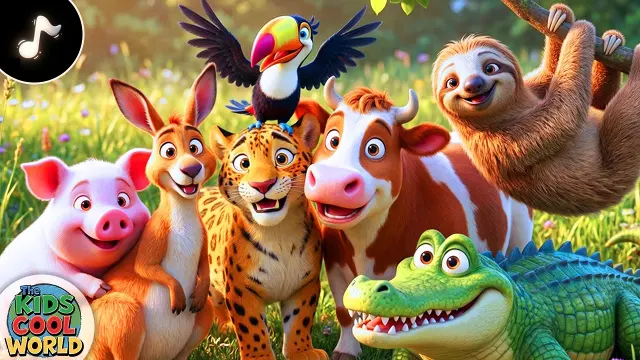
 Global Animal Sounds And Habitats Musical Adventure
#Rainforest Animals
1 ideas
Global Animal Sounds And Habitats Musical Adventure
Get new #Rainforest Animals ideas by email
Every Thursday: the week's best ideas, with the newest from #Rainforest Animals.
Related tags
Rainforest Animals: A Guide to Life in the Trees
What rainforest animals are
Rainforest animals are the birds, mammals, reptiles, amphibians, fish, insects, and other creatures that live in tropical forests. These forests are warm, wet, and full of layered plant life, so animals often live high in the canopy, near the forest floor, or in the rivers and streams that run through the trees. Because the rainforest is so dense, many species are skilled at climbing, gliding, hiding, or moving quietly through leaves and branches.
Rainforests are found near the equator, where the climate stays humid and rainfall is frequent. Over time, animals there have adapted to a world of shade, constant moisture, and rich but crowded habitats. Many are brightly colored, while others blend in so well that they can be hard to see.
Common kinds and adaptations
Read more
You may think first of monkeys, parrots, jaguars, frogs, or snakes, but rainforest life is much broader than that. There are tiny tree-dwelling insects, leaf-eating mammals, nectar-feeding birds, and amphibians that depend on damp surroundings. Some animals spend most of their lives in the treetops, while others move along the forest floor or in the water.
Many rainforest animals have special features that help them survive. Some use camouflage to avoid predators. Some have grasping feet or tails for climbing. Others are built for gliding between trees, leaping from branch to branch, or catching insects in the air. No single body shape suits every rainforest animal, because the forest offers many different ways of living.
The main layers of the rainforest
A helpful way to understand rainforest animals is by the layer they live in.
- The canopy is the thick upper layer of leaves and branches. Many birds, monkeys, and insects live here because it offers food and shelter.
- The understory is shaded and humid, with smaller trees and vines. Animals here often rely on camouflage and quiet movement.
- The forest floor is darker and richer in fallen leaves. Larger ground-dwelling animals, fungi, and decomposers are important here.
- Streams and rivers support fish, frogs, reptiles, and animals that come to drink or hunt along the edges.
Each layer has its own conditions, so animals often specialize in one part of the forest rather than moving everywhere.
What to know if you are learning about them
If you are new to rainforest animals, start by noticing how closely each species is tied to its habitat. Food, shelter, and moisture all shape how it lives. A bird with a long beak may feed on nectar. A frog may need wet leaves or water nearby. A predator may depend on cover to hunt successfully.
It also helps to remember that rainforests are connected ecosystems. Animals are not isolated; they interact through pollination, seed dispersal, hunting, and decomposition. Many plants and animals depend on each other in quiet but essential ways.
Practical ways to explore the topic
When you study rainforest animals, look at where each creature lives, what it eats, and how it moves. Grouping animals by layer, body type, or diet can make the forest easier to understand. You can also compare animals from different rainforest regions, since forests in different parts of the world hold different species, even if they share similar roles.
Above all, rainforest animals show how varied life can be in one habitat. The more you look, the more you notice that the forest is not just one place, but many living spaces stacked together.
Videos come from YouTube and posts from Instagram; titles and summaries are our own. All rights belong to their creators.