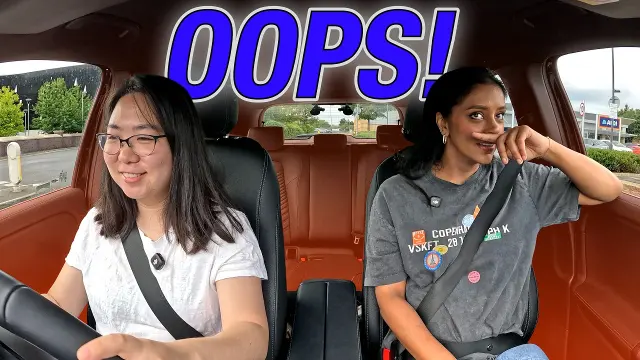
 Reversing Goes Wrong in an Automatic Car Mock Test
#Reversing
1 ideas
Reversing Goes Wrong in an Automatic Car Mock Test
Get new #Reversing ideas by email
Every Thursday: the week's best ideas, with the newest from #Reversing.
Related tags
Reversing a Car: A Complete Guide for New Drivers
Reversing is the art of moving a vehicle backwards under control, and it is one of the few everyday driving skills that almost everyone finds difficult at first. It feels unnatural because the driver's reference points change: the steering behaves differently, the view ahead disappears, and the sense of speed and distance is distorted. Yet it is a skill built almost entirely on observation, patience and repetition rather than on talent.
Why reversing is harder than driving forwards
When you drive forward, the front wheels steer and the rear of the car follows, tracing a tighter path than the front. In reverse, the geometry flips: the rear of the car swings in the direction you turn the wheel, and the front end sweeps out to the opposite side. That swing is what catches people out, especially in a tight space where a front corner can approach a wall, a pillar or a parked car without the driver noticing. Reversing also compresses the field of view — the mirrors show a narrow slice of the world, and blind spots grow larger the closer you get to an obstacle.
Setting up before you move
Read more
Good reversing starts while the car is still stationary. Adjust the seat so you can reach the pedals comfortably and still turn to look over your shoulder. Set the mirrors so that a sliver of your own car is visible at the edge, which gives you a reference for judging distance. Know where your blind spots are and check them physically rather than trusting the mirrors alone. Then, before moving, look all around: behind, both sides and ahead. Reversing into a road or a car park means other people are moving too.
The basic technique
Move slowly and steer deliberately. At walking pace you have time to correct, and small steering inputs produce predictable results. Reverse with the wheel straight until the car is clear of obstacles, then turn. Keep both hands on the wheel where you can, and choose one method of looking — over your shoulder, or through the mirrors — and stay consistent with it, glancing at the other view regularly. If you are unsure of the space behind you, stop, get out and look, or ask someone to guide you. Nobody reverses well by guessing.
Main manoeuvres and how they differ
Parallel parking, bay parking, reversing around a corner and a simple straight-line reverse each demand a different sequence of reference points. Driving schools teach specific markers — a certain point on the kerb aligning with a mirror, for instance — and these are useful while learning, but they vary between cars and drivers. What matters is understanding the principle underneath: where the rear wheels are going, and how much room the front needs to swing.
Practical tips
- Reverse into spaces rather than out of them, so you leave forwards with a clear view.
- If in doubt, take another attempt. A second manoeuvre is cheaper than a repair.
- Practise in an empty car park on a quiet day until the movements feel familiar.
- Automated aids such as sensors and cameras help, but they supplement observation rather than replace it.
- In an automatic car, control your speed with the brake pedal alone and keep your foot off the accelerator while manoeuvring.
Reversing becomes ordinary with practice. Start somewhere quiet, go slowly, and treat every check as a habit rather than a chore.
#Reversing: frequently asked questions
How do I start learning to reverse if it feels unnatural?
Begin somewhere quiet and open, such as an empty car park, so there is nothing to hit while the movements become familiar. Set your seat and mirrors before you move off, then practise reversing slowly in a straight line before adding any steering. The awkwardness fades with repetition far more than with talent, so short, frequent practice beats one long session.
Why does the car seem to steer differently when going backwards?
Going forwards, the rear wheels follow the front ones and cut a tighter path, but in reverse that geometry flips: the back of the car swings the way you turn the wheel while the front end sweeps out the other way. That wide front swing is what surprises people in tight spaces, since a front corner can drift toward a wall or a parked car without being noticed. Understanding where the rear wheels are heading, and how much room the front needs, matters more than memorising markers.
Should I look over my shoulder or use the mirrors when reversing?
Either works as long as you pick one as your main view and stay consistent with it, glancing at the other regularly. Mirrors show only a narrow slice of what is behind you, and blind spots grow the closer you get to an obstacle, so a physical check is still needed. If you genuinely cannot tell what is behind you, stop and look, or ask someone to guide you in.
Is it better to reverse into a parking space or drive in nose first?
Reversing in usually leaves you driving out forwards with a clear view, which is the safer way to rejoin traffic. It also means the manoeuvre happens while you have the most information about the space and the least pressure. If the space is awkward, take another attempt rather than forcing it.
Do parking sensors and cameras mean I can stop checking myself?
They are useful aids, but they supplement your own observation rather than replace it, and they can miss things at the edges of their range. Keep the habit of looking all around before you move and checking blind spots physically. In an automatic, keeping your foot off the accelerator and controlling speed with the brake alone gives you more time to react.
What are the most common reversing mistakes?
Moving too fast and turning the wheel too early are the usual culprits, because both remove the time you need to correct. Another is trusting the mirrors alone and forgetting the front corners, which swing out further than expected. Guessing when you are unsure of the space behind is the mistake worth avoiding most — stopping to look costs far less than a repair.
Videos come from YouTube and posts from Instagram; titles and summaries are our own. All rights belong to their creators.