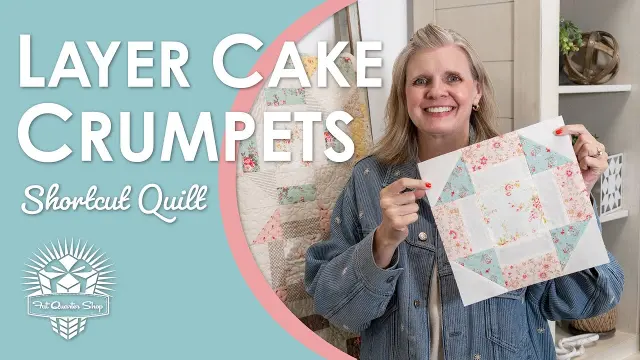
 Easy Layer Cake Crumpets Quilt Tutorial
#Shortcut Quilt
1 ideas
Easy Layer Cake Crumpets Quilt Tutorial
Get new #Shortcut Quilt ideas by email
Every Thursday: the week's best ideas, with the newest from #Shortcut Quilt.
Related tags
Shortcut Quilting: Fast, Simple Ways to Piece a Quilt
Shortcut quilting is the practice of piecing a quilt with methods that cut down the number of steps, rather than the quality of the result. Instead of tracing templates and cutting every shape individually from yardage, quiltmakers lean on pre-cut fabric bundles, the rotary cutter and a few repeatable techniques that produce many identical units at once. The approach grew naturally out of modern cutting tools and the way fabric shops began selling cloth already squared and sized, but the idea itself is old: quilters have always looked for ways to make a useful object without wasting effort.
What counts as a shortcut
The shortcuts are not one technique but a family of habits that share a single goal: fewer cuts, fewer seams, fewer chances to go wrong.
- Precuts. Fabric sold in coordinated bundles of ready-cut squares, strips or small squares. Because the pieces are already sized, a whole quilt can be assembled from a few bundles with very little measuring.
- Strip piecing. Long strips are sewn together, pressed, then cross-cut into segments. Several identical blocks appear from a single seam.
- Chain piecing. You feed one unit after another through the machine without lifting the presser foot or snipping threads between them, then clip them apart at the end.
- Quick triangle methods. Two squares sewn along a drawn diagonal, then cut apart, yield two half-square triangles at once; the same idea scales to larger squares for bigger blocks.
Read more
Where beginners should start
Choose one shortcut and let it be the whole project. A quilt made only of simple squares from a pre-cut bundle teaches straight seams, pressing and layout without demanding any other skill. Once seam accuracy feels steady, strip piecing is the natural next step, because it rewards consistency and forgives very little.
Practical points worth knowing
A true quarter-inch seam matters more in shortcut work than anywhere else, since errors repeat across every block made the same way. Sew a test pair of strips and measure before committing a whole bundle.
Press seams as you go rather than ironing them open and forth; a small amount of starch or sizing helps pre-cut fabric hold its shape.
Read a pattern all the way through before the first cut. Many shortcut designs depend on the order of steps, and resewing a seam is quicker than replacing fabric.
Keep a notebook of the size of the unit you get from each method. Shortcut quilting is arithmetic as much as sewing, and knowing your own finished measurements is more useful than any chart.
Expect the fabric to have a direction. Stripes, plaids and one-way prints look quite different when rotated, so lay pieces out before you sew.
Finally, embrace repetition. The pleasure of a shortcut quilt lies in the rhythm of the same motion repeated, and in a finished quilt that arrives sooner than you expected.
#Shortcut Quilt: frequently asked questions
How do I get started with shortcut quilting if I have never made a quilt?
Pick a single shortcut and let it carry the whole project — a quilt of plain squares from a pre-cut bundle is the usual starting point, because it teaches straight seams, pressing and layout without asking for anything else. Make a small practice piece first so you can see how your machine behaves before you commit your good fabric. Keep the project simple enough that finishing it feels likely.
What do I actually need before I begin a shortcut quilt?
A sewing machine with a reliable seam allowance, a rotary cutter and mat, a ruler, an iron and a pile of pre-cut fabric will take you a long way. Add a few pins or clips, thread that matches, and something to jot measurements in. The tools matter less than the consistency of how you use them.
Which shortcut method should I choose?
Start with whichever one matches how confident your seams are: simple squares ask the least of you, strip piecing rewards steady accuracy, and the quick triangle methods suit anyone happy to sew on a drawn line. If a design appeals to you, choose the technique it depends on rather than the one that sounds fastest. It is easier to learn one habit well than to juggle several at once.
What mistakes do people make most often with shortcut quilting?
The big one is a seam allowance that drifts, because every block made the same way repeats the same small error until the whole top is off. Skipping the pressing, or ironing seams back and forth instead of setting them, is another common slip that shows up much later. And reading the pattern only after the first cut — order of steps often carries the design.
How should I care for a shortcut quilt once it is finished?
Wash it gently and sparingly, in cool water with a mild soap, and let it dry flat or on a line rather than tumbling it hard, since quilting softens with every wash. Check for loose threads and any seam that has opened before it goes in, and mend small problems early. Store it folded loosely and out of direct sun so the folds and colours do not set.
What are good occasions or gifts for a shortcut quilt?
Because shortcut methods get you to a finished top faster, they suit the gifts that come with a deadline — a baby quilt, a wedding throw, a housewarming lap quilt. Pre-cut bundles in a coordinated palette make it easy to match someone's colours without hunting through yardage. Small quilts for a chair back or a pram are also a good way to try a new technique without committing to a large piece.
Videos come from YouTube and posts from Instagram; titles and summaries are our own. All rights belong to their creators.