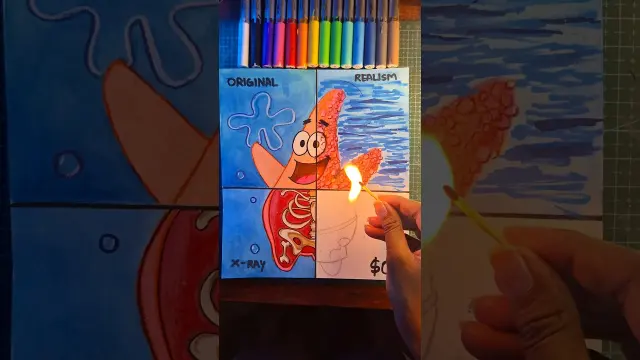
 Drawing Patrick Star From Spongebob Into a Masterpiece
#Spongebob
1 ideas
Drawing Patrick Star From Spongebob Into a Masterpiece
Get new #Spongebob ideas by email
Every Thursday: the week's best ideas, with the newest from #Spongebob.
Related tags
SpongeBob SquarePants: Drawing, Craft and Fan Art Ideas
SpongeBob SquarePants is an animated comedy about a cheerful, square yellow sea sponge who lives in an underwater town, works as a fry cook, and meets nearly everything with unstoppable optimism. Its visual language is loud, flat and playful, and that is exactly why the character keeps turning up in sketchbooks, craft rooms and costume parades: he is bright, forgiving to draw and instantly recognisable.
Why it works so well as a subject
The design rests on basic geometry. The body is a softened rectangle, the arms and legs are thin tubes, the eyes are circles, the cheeks are dots. Shapes that simple are easy to place, easy to correct, and easy to exaggerate, which makes the character a genuinely good confidence builder for someone learning to draw. The palette is small as well: yellow, white, red, brown and a little blue.
Getting the features right
Read more
Most of the likeness lives in the face and in a few clothing details, so it pays to sketch those first.
- Body: a tall rectangle with gently wavy edges, dotted with round pores
- Face: large round eyes, a long narrow nose, a wide grin with two front teeth, freckled cheeks
- Outfit: a white collared shirt, a red tie, brown square shorts, striped socks and dark shoes
- Pose: he is usually drawn standing straight with feet turned slightly out, which reads as earnest
Styles and techniques worth trying
The character adapts to a surprising range of media, because the shapes survive simplification so well.
- Pencil and ink, for practising line confidence and clean outlines
- Marker or flat digital colour, which suits the original bold look
- Watercolour or gouache, for a looser, softer take on the same design
- Pixel art and cross-stitch, where a grid pattern makes the geometry almost automatic
- Polymer clay, air-dry clay or crochet, for three-dimensional figures and keychains
- Paper crafts, cakes and pumpkin carving, where the silhouette alone carries the joke
Practical tips for beginners
Work from a clear reference rather than memory, and build the drawing in layers: a light construction sketch first, details second, colour last. Keep the yellow area flat and even, and let the line work do the characterisation. Sketching the face alone, several times and with different expressions, teaches more than a single full-body attempt. If you are making a costume or a clay figure, start with the head, since it is the part people read first, and get the proportions of eyes to nose right before adding anything else.
Beyond the character
The show is also an invitation to draw places. An underwater street, a pineapple-shaped house, a fast-food restaurant with a boat-shaped counter: these give you practice in perspective and background design while keeping the mood light. Adding a second character beside the first introduces scale, contrast and a bit of storytelling, which is usually what turns a copy into a picture of your own.
Work slowly, let the shapes be simple, and enjoy the fact that a drawing this cheerful rarely needs to be perfect.
#Spongebob: frequently asked questions
How do I start drawing Spongebob if I'm a beginner?
Begin with a light construction sketch built from simple shapes, then add the details and colour last — that layering keeps the proportions under control. Sketch the face on its own a few times in different expressions before attempting a full body, since the face carries most of the likeness. Working from a clear reference rather than memory makes the early attempts far less frustrating.
What supplies do I need to make Spongebob crafts?
For drawing, a pencil for the construction sketch, an eraser and a fine liner or marker for clean outlines will cover most of it, with flat colour added in marker, digital or paint. If you would rather work in three dimensions, polymer or air-dry clay, or a crochet hook and yarn, gives you figures and keychains. A grid-based craft such as cross-stitch or pixel art needs almost nothing beyond the pattern and the base.
Which style or medium works best for a Spongebob project?
Because the design is built from basic geometry, it survives simplification well in almost any medium, so pick the one you actually enjoy using. Pencil and ink suit practising line confidence, marker or flat digital colour matches the bold original look, and watercolour or gouache gives a looser, softer version. Paper crafts, cakes and pumpkin carving work too, since the silhouette alone is enough to make the joke read.
What are the most common mistakes when drawing Spongebob?
The usual slip is drawing from memory and rushing to colour before the structure is right, which throws off the eyes-to-nose relationship. Keep the yellow area flat and even and let the line work do the characterisation instead of over-shading. It also helps to exaggerate the shapes on purpose — the design is forgiving of distortion, and stiff, timid lines read as more wrong than a bold one.
What can I make for a party or costume with a Spongebob theme?
Costumes, cake toppers and pumpkin carving all lean on the same silhouette, so you can keep the character simple and let the shapes carry it. If you are building a costume or a clay figure, start with the head, because that is the part people read first, and get the facial proportions right before adding anything else. Party props and paper decorations are a low-pressure way to try the design in a larger size.
How do I look after a clay or crocheted Spongebob figure?
Air-dry clay figures are best kept somewhere dry and out of direct sun, and dusted gently rather than washed. Crocheted or fabric pieces should be spot-cleaned carefully and reshaped while slightly damp so they hold their form. If the figure is a keychain or gets handled often, choose a sturdier material from the start so the details don't wear away.
Videos come from YouTube and posts from Instagram; titles and summaries are our own. All rights belong to their creators.