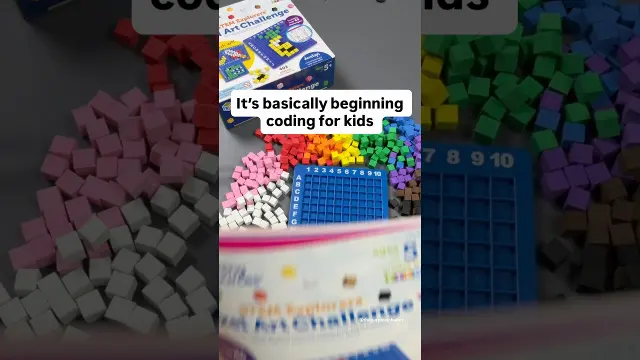
 Early Math and Coding Through STEM Pixel Art Activities
#STEM Activities
1 ideas
Early Math and Coding Through STEM Pixel Art Activities
Get new #STEM Activities ideas by email
Every Thursday: the week's best ideas, with the newest from #STEM Activities.
Related tags
STEM Activities for Curious Kids
What STEM activities are
STEM activities are hands-on projects that bring together science, technology, engineering, and mathematics in a practical, playful way. They can be simple experiments, building challenges, observation tasks, measuring games, or creative coding exercises. The goal is not only to teach facts, but to help you think, test, solve problems, and make connections between ideas.
STEM stands for four broad fields that are closely linked in everyday life. Science helps you ask questions about how things work. Technology involves tools and systems used to solve problems. Engineering is about designing and building. Math gives you the language for patterns, shapes, quantities, and logic. When these areas are mixed in a single activity, learning often feels more natural and memorable.
Why they are useful
Read more
STEM activities are useful because they encourage curiosity and persistence. A child who builds a tower, tests what makes it stronger, and then tries again is learning much more than how to stack blocks. They are learning to observe, compare, predict, and improve. These are valuable skills at any age.
They also support creativity. STEM is not only about getting the right answer. It often involves trying different approaches, noticing what happens, and adjusting along the way. That makes it a good fit for children who like making, moving, drawing, sorting, or experimenting.
Common kinds of STEM activities
There are many ways to explore STEM at home or in a classroom:
- Simple science experiments, such as mixing materials, exploring water, light, magnets, or plants
- Engineering challenges, such as building bridges, towers, shelters, or ramps
- Math-based games, such as pattern making, counting, measuring, or shape sorting
- Technology activities, such as basic coding, sequencing, or using simple digital tools
- Design and construction projects, such as paper structures, recycled models, or art combined with logic
You can also combine STEM with everyday play. Cooking involves measuring and timing. Gardening involves science and observation. Crafts can include planning, symmetry, and structure. Even a walk outside can become a STEM activity if you notice leaves, shadows, textures, or insect habitats.
Tips for beginners
If you are just getting started, keep the activity simple. A good STEM project does not need special equipment. Often, the best materials are things you already have: paper, cups, tape, cardboard, string, blocks, or household objects.
A few helpful ideas:
- Start with one clear question or challenge
- Let the child try before offering answers
- Ask open questions like “What do you notice?” or “What could you change?”
- Focus on the process, not perfection
- Keep instructions short and age-appropriate
It also helps to choose activities that match the child’s interests. If they like art, try patterns, pixel designs, or building from shapes. If they enjoy movement, try ramps, pulleys, or balancing games. If they like stories, connect STEM to a problem that needs solving.
A simple way to think about STEM
The most effective STEM activities usually follow a gentle cycle: wonder, test, notice, and try again. That simple rhythm helps children build confidence and learn that mistakes are part of discovery. Over time, STEM becomes less about a subject and more about a way of thinking.
Videos come from YouTube and posts from Instagram; titles and summaries are our own. All rights belong to their creators.