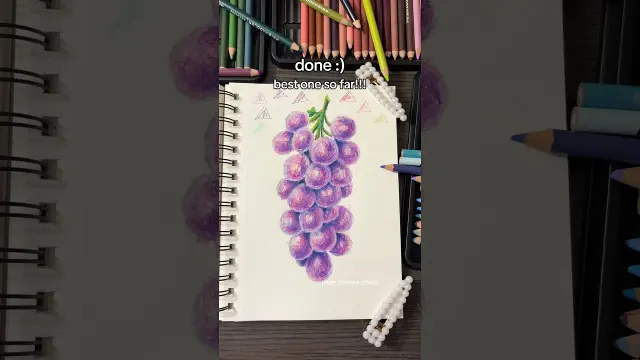
 Drawing grapes with colored pencils using only triangle shapes
#Still Life
1 ideas
Drawing grapes with colored pencils using only triangle shapes
Get new #Still Life ideas by email
Every Thursday: the week's best ideas, with the newest from #Still Life.
Related tags
Still Life: An Evergreen Guide to a Timeless Genre
Still life is the art of depicting objects that do not move: fruit, flowers, vessels, food, books, cloth, and the small things found on a table. Because the subject stays put, the painter or photographer can return to it again and again, which is why it has long served as a place to learn observation, light, and craft. The genre is often called by its French name, nature morte, literally "dead nature," though the English term better captures the quiet attention the subject asks for.
Where it comes from
Objects have appeared in art since antiquity, in wall paintings and mosaics where food and vessels decorate scenes of daily life. Still life became a subject in its own right in Europe during the sixteenth and seventeenth centuries, when growing trade brought rare flowers, imported fruit, silver and porcelain into ordinary homes, and artists began to celebrate them. In the Dutch tradition, flower pieces, laid tables and reminders of passing time all flourished as separate specialities. Later centuries used the genre as a laboratory: arranged apples and folded cloth became a way of testing colour, shape and brushwork rather than simply recording objects.
The main kinds
Read more
Some still lifes are celebrations of abundance, heaped with fruit and poured wine. Others carry a quieter message: a skull, a burnt candle or an hourglass signals that beauty fades. Flower pieces follow the seasons of the garden rather than a single moment. Trompe-l'œil paintings try to fool the eye into seeing real objects on a flat surface. Kitchen pieces dwell on pots, game and vegetables, while modern arrangements often reduce objects to simple geometric forms.
Mediums and approaches
Still life suits almost any medium: graphite and coloured pencil for careful study, watercolour for light and transparency, oil and acrylic for depth and texture, pastel for softness, and photography for framing and light. Many artists work from life rather than a photograph, because the eye catches subtle shifts of colour and shadow that a picture flattens.
Practical starting points
Begin with three to five objects rather than a crowd, and choose things that differ in size, shape and surface: something round, something tall, something matte next to something shiny. Give the group a clear structure, with one object as the focal point and the others supporting it, and let some shapes overlap so the arrangement reads as a whole.
Set your light to one side so shadows describe form. Notice where objects touch: the small dark contact shadows anchor them to the surface. Look at negative space between forms as carefully as at the forms themselves. Work from large shapes to small details, and build tone gradually instead of pressing hard at the start.
Finally, keep a simple setup near your desk. A few familiar objects under a steady lamp will teach you more than any ambitious composition, and they will still be there tomorrow.
#Still Life: frequently asked questions
How do I start a still life if I've never set one up before?
Pick just a few everyday objects — a cup, a piece of fruit, a folded cloth — and group them so that one clearly leads and the rest support it. Put the light to one side so the shadows explain the shapes, then look for the small dark shadow where each object touches the table, since that is what makes things feel grounded. Keep the whole setup small and close to where you work, so you can return to it.
What objects should I choose for a still life arrangement?
Choose things that differ from one another: something round next to something tall, something matte next to something glossy, something soft next to something hard. Variety in shape and surface gives you more to observe and makes the composition more interesting to look at. Familiar objects are often the best teachers, because you already know how they behave.
How do I decide which kind of still life to make?
Let the mood you want decide. If you want warmth and plenty, heap fruit and pour a drink; if you want something quieter and more thoughtful, include a single fading flower or a worn object that speaks of time passing. Some people prefer to arrange flowers by the season, and others like to reduce everything to simple shapes and test colour and form instead of recording detail.
Do I need a lot of equipment to do still life work?
No — a steady lamp, a plain surface and a few objects are enough to begin, whatever medium you use. Pencil and paper suit careful study, watercolour rewards you for light and transparency, and oil or acrylic gives depth if you want to build texture. Photography works too, and lets you experiment with framing and light without any drawing materials at all.
What are the most common mistakes beginners make with still life?
The usual one is crowding the table with too many objects, which leaves the eye nowhere to rest. Others are lighting the group from the front so everything flattens, pressing hard from the first mark instead of building tone gradually, and ignoring the empty spaces between objects. Work from large shapes down to small details, and check the negative space as carefully as the objects themselves.
How should I look after a flower still life so it lasts while I work?
Cut and condition the stems before arranging, keep the water fresh, and place the setup out of direct sun and draughts so blooms hold their shape longer. Since flowers keep changing, treat the arrangement as something to be observed rather than frozen — noticing how a petal opens or droops is part of the study. If you need more time, work from a photograph alongside the real thing rather than instead of it.
Videos come from YouTube and posts from Instagram; titles and summaries are our own. All rights belong to their creators.