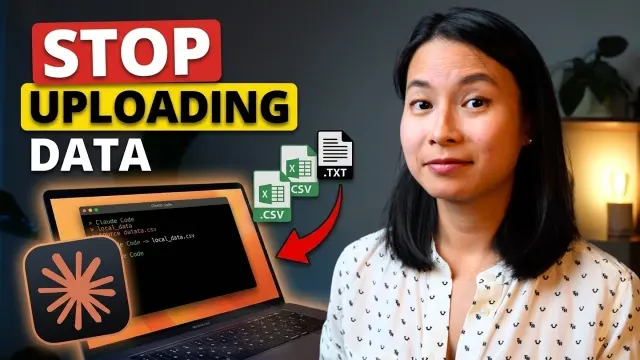
 Using AI for Data Analysis Without Uploading Real Data
#Synthetic Data
1 ideas
Using AI for Data Analysis Without Uploading Real Data
Get new #Synthetic Data ideas by email
Every Thursday: the week's best ideas, with the newest from #Synthetic Data.
Related tags
Synthetic Data: A Beginner's Guide to Artificial Datasets
Synthetic data is information that has been generated rather than collected. Instead of recording real events, real people or real objects, you produce new records that imitate the patterns, structure and statistical behaviour of an original dataset. The result looks and behaves like real data in most respects, but no individual row corresponds to anyone or anything that actually exists.
The idea is not new. Statisticians have long used simulated values to test methods and explore scenarios, and simple imitation has been part of computing from its early days. What has changed is the sophistication of the tools: modern generative models can learn the shape of complex material — images, text, sensor readings, tabular records, sound — and then produce endless variations that share its characteristics without copying it.
Why people use it
The most common reason is scarcity. Real data can be expensive to collect, slow to label, unevenly distributed or simply unavailable for the case you care about. Rare conditions, unusual failures and edge cases are, by definition, hard to find in the wild. Synthetic data lets you manufacture them deliberately, so a system can be tested against situations that might otherwise never appear in a sample.
Read more
A second reason is privacy. Personal records carry obligations, and sharing or reusing them is often restricted. Synthetic records aim to carry the same useful patterns while breaking the link to any individual, which makes them easier to circulate, publish or hand to a collaborator. That protection is a goal, not a guarantee — more on that below.
A third reason is control. When you generate data, you know exactly what is in it. You can introduce a known amount of noise, create balanced groups, or vary one factor at a time to see how a model responds.
The main approaches
Simple methods draw from statistical descriptions: you estimate distributions and correlations, then sample new values from them. These are transparent and fast, and they work well for tidy tabular data.
Model-based methods train a generative model on real examples and use it to produce new ones. These handle images, text and audio far better, and they are the reason synthetic data has become so prominent.
Simulation is a third route. Rather than learning from examples, you build a model of how a system works — physics, traffic, a supply chain, a household budget — and let it run. Simulation is often the most reliable option when you understand the underlying rules.
What to watch for
Synthetic data is only as good as what it imitates. If the original sample was biased or incomplete, the generated data will inherit and sometimes amplify those flaws, while looking convincingly clean.
Privacy deserves particular care. Generative models can memorise details of their training examples, and a synthetic record may end up uncomfortably close to a real one. If anonymity matters, the output needs to be checked, not assumed safe.
Finally, remember what it is for. Synthetic data is excellent for testing, prototyping, teaching and protecting privacy. It is a stand-in, not evidence. Before you trust a conclusion drawn from it, ask whether the imitation captured the things that actually matter in the real world — and test against genuine data wherever you can.
#Synthetic Data: frequently asked questions
What exactly is synthetic data, in plain terms?
It is information produced by a process rather than recorded from real events, people or objects. The generated records copy the patterns and structure of an original dataset, but no single row describes anyone or anything that truly exists. Think of it as a stand-in that behaves like the real thing without being a copy of it.
Do I need a technical background or special software to get started?
It depends on the route you take. Simple statistical sampling is approachable with ordinary spreadsheet or scripting skills, while training a generative model or building a simulation asks for more technical comfort. A reasonable start is to describe your data clearly, note the patterns that matter, and begin with the simplest method that captures them.
How do I choose between statistical sampling, a generative model and simulation?
Pick based on what your data looks like and how well you understand it. Tidy tables are usually served well by sampling from estimated distributions, while images, text and sound need a trained generative model. If you know the rules governing the system — physics, traffic, a budget — a simulation is often the most dependable option.
Is synthetic data safe to share, since it isn't about real people?
Not automatically. Generative models can memorise fragments of their training examples, so an output may land uncomfortably close to a genuine record. Treat anonymity as something to verify by checking the output, rather than something the label guarantees.
What are the most common mistakes people make with it?
The biggest is forgetting that the imitation inherits the flaws of its source, so a biased sample produces biased output that still looks clean. Another is treating synthetic results as evidence rather than as a testing tool. Whenever you can, check your conclusions against genuine data before relying on them.
Can I explore or analyse a dataset without exposing the real records?
Yes, that is one of the practical reasons people generate data in the first place. You can build a synthetic version that preserves the useful patterns and work with that for prototyping, teaching or sharing with a collaborator. Keep in mind it is a stand-in, so confirm the important findings against the original where access allows.
Videos come from YouTube and posts from Instagram; titles and summaries are our own. All rights belong to their creators.