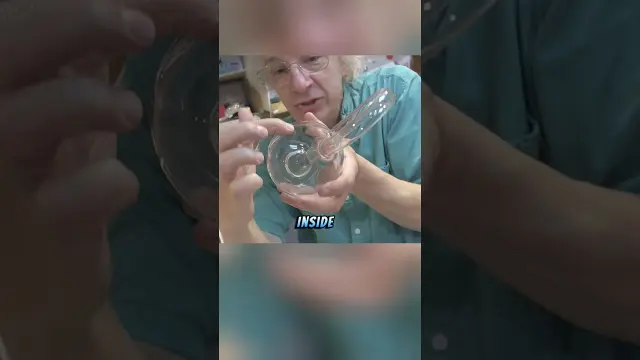
 A Klein bottle with no inside or outside
#Topology
1 ideas
A Klein bottle with no inside or outside
Get new #Topology ideas by email
Every Thursday: the week's best ideas, with the newest from #Topology.
Related tags
Topology: the Study of Shape and Continuity
Topology is a branch of mathematics that explores the properties of shape that stay the same when an object is stretched, bent, twisted, or smoothly deformed. It asks a different question from geometry: not “How big is it?” or “What are the exact angles?” but “What remains unchanged if the shape is continuously altered?” That makes topology useful for understanding surfaces, spaces, and connections in a very flexible way.
A classic idea in topology is that some objects are considered equivalent if one can be transformed into the other without cutting or gluing. A coffee cup and a doughnut are a familiar example, because each has one hole. In topology, the number of holes, the way parts are connected, and whether a space has an inside and an outside are often more important than precise measurements.
Topology comes from mathematical research into space, continuity, and deformation. It grew out of geometry and analysis, but it developed its own language and methods. Today it appears in many areas of mathematics and is also useful in physics, computer science, data analysis, and other fields where structure and connectivity matter.
Main ideas in topology
Read more
- Continuity: a function or transformation is continuous when it changes smoothly, without sudden jumps.
- Neighbourhoods: instead of focusing on exact distances, topology often studies what counts as “near” a point.
- Open and closed sets: these are basic building blocks used to describe topological spaces.
- Homeomorphism: two spaces are topologically equivalent if one can be continuously transformed into the other.
- Invariants: features such as connectedness, holes, and boundaries help classify shapes.
Common kinds of topological objects
- Surfaces: two-dimensional spaces like spheres, tori, and other curved surfaces.
- Knots: loops embedded in three-dimensional space that cannot be untangled without cutting.
- Manifolds: spaces that may look flat locally, even if their overall shape is curved or complex.
- Networks and graphs: connected structures that help describe relationships and pathways.
If you are new to topology, it helps to think visually. Imagine a shape made of flexible material that can be bent but not torn. Ask what features survive those changes. This way of thinking is at the heart of the subject.
What beginners should know
Topology can feel abstract at first because it replaces measurement with structure. A useful starting point is to get comfortable with simple examples: circles, spheres, tori, and surfaces with holes. Try to notice whether a space is connected, whether it has a boundary, and how many holes it contains. These basic features often tell you more than length or curvature.
It also helps to distinguish between local and global properties. Locally, a surface may look simple and flat. Globally, it may wrap around in surprising ways. That contrast is one of the most interesting parts of topology.
Practical ways to think about topology
- Use models and sketches to compare shapes by their essential features.
- Look for properties that do not change under smooth deformation.
- Focus on connections, holes, and boundaries rather than exact dimensions.
- Start with familiar objects before moving to more abstract spaces.
Topology is, at its core, a way of seeing shape differently. It reveals that some of the most important qualities of a space are not about appearance, but about how it is put together.
Videos come from YouTube and posts from Instagram; titles and summaries are our own. All rights belong to their creators.