 A Simple Chess Thinking Loop: Opponent, Plan, Two Moves, Decide
#Chess Improvement
2 ideas
A Simple Chess Thinking Loop: Opponent, Plan, Two Moves, Decide
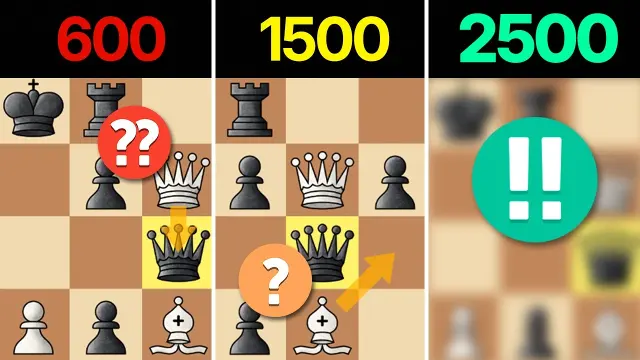 How Beginner, Intermediate and Grandmaster Players Think in Chess
Get new #Chess Improvement ideas by email
Every Thursday: the week's best ideas, with the newest from #Chess Improvement.
Related tags
Chess Improvement: How to Get Better at Chess
Chess improvement is the deliberate work of becoming a stronger player over time. It is different from simply playing a lot. Games give you experience, but progress usually comes from what you do around those games: studying patterns, solving positions, reviewing your mistakes and building habits of thought that hold up under pressure. The good news is that improvement follows a fairly predictable path, and the methods that work are well established.
What improvement actually means
Strength at chess rests on a few broad pillars. Tactical vision lets you see short forcing sequences. Positional understanding helps you judge where pieces belong and which weaknesses matter. Endgame knowledge turns small advantages into wins instead of draws. Opening knowledge gives you playable positions without spending too much time. Time management and emotional steadiness decide how much of that knowledge shows up on the board. Most players are uneven across these pillars, and improvement begins with noticing which one is holding you back.
Building tactical sharpness
Read more
Tactics are the fastest return on effort for most improving players. Regular puzzle solving trains you to notice the patterns that recur constantly in real games: forks, pins, discovered attacks, back-rank weaknesses, overloaded defenders. Solve puzzles slowly enough to calculate the whole line rather than guessing the first idea that appears, and check your answer before moving on. A modest number of carefully solved positions is worth more than a large number rushed through.
Studying strategy and endings
Strategy is about plans: improving your worst piece, fighting for open files, creating and attacking weaknesses, deciding when to trade. Good books and annotated games teach this language, but it only sticks when you apply it to your own positions. Endgames deserve early attention too. Knowing basic pawn endings, rook endings and typical drawing and winning techniques prevents many painful losses and gives you confidence to simplify when ahead.
The habit of review
Reviewing your games is where the real learning happens. After each game, go back through it without an engine and try to find the moment you stopped understanding the position, then note what you should have considered. Only afterwards check with an engine or a stronger player. Keep a short written record of recurring mistakes; themes emerge quickly, and they tell you what to study next.
Playing well and playing often enough
Choose opponents slightly stronger than you and slower time controls, where you have room to think. Fast games are useful for opening practice and for fun, but they rarely teach calculation. Play with a plan rather than moving on instinct, and after each move ask what your opponent is threatening.
Practical approach
Aim for steady, sustainable habits: a few puzzles most days, one longer study session each week, and a review after every serious game. Progress in chess is rarely linear; plateaus are normal and usually mean a weakness is waiting to be found. Patience, curiosity about your own errors and a willingness to lose instructive games will take you further than any single shortcut.
#Chess Improvement: frequently asked questions
How do I start improving at chess if I already play a lot?
Playing gives you experience, but progress comes from what you do around the games. Begin by adding a short puzzle routine, a review of your own games, and a little study of strategy and endings to your playing time. Then look honestly at which area is weakest — tactics, positional judgement, endings, openings or time management — and put your effort there first.
What should I focus on first: tactics, openings or endgames?
Tactics usually give the fastest return, because the same patterns keep appearing in real games, so regular slow puzzle solving pays off quickly. Endgames deserve attention earlier than most players give them, since basic winning and drawing techniques turn small advantages into results. Openings only need enough knowledge to reach playable positions without burning your thinking time.
How should I review a game so that I actually learn from it?
Go back through the game on your own first, without an engine, and find the point where you stopped understanding the position. Note what you missed and what you should have considered, then check with an engine or a stronger player afterwards. Keeping a short written list of recurring mistakes shows you quickly what to study next.
Which opponents and time controls are best for getting stronger?
Slower time controls give you room to calculate and to play with a plan instead of moving on instinct. Choose opponents a little stronger than you, so the games expose gaps in your understanding. Fast games are enjoyable and fine for practising openings, but they rarely teach calculation.
What are the most common mistakes that hold players back?
One is playing many games without ever reviewing them, which repeats the same errors indefinitely. Another is rushing puzzles and accepting the first idea that appears instead of calculating the whole line, and a third is spending study time on openings while basic tactics and endings stay shaky. Moving too fast and never asking what the opponent is threatening is another habit worth breaking.
What should I do when my progress stalls?
Plateaus are normal and rarely mean you have stopped being able to improve; they usually point to a weakness you have not noticed yet. Change your routine slightly — different kinds of puzzles, a new study theme, or opponents of a different style — and keep the habits steady rather than chasing a shortcut. Patience and curiosity about your own errors matter more than any single method.
Videos come from YouTube and posts from Instagram; titles and summaries are our own. All rights belong to their creators.