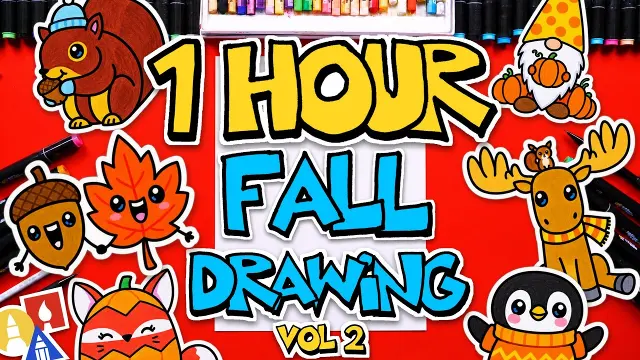
 One hour of fall drawing lessons: squirrel, pumpkin fox and puppy
#Drawing For Kids
1 ideas
One hour of fall drawing lessons: squirrel, pumpkin fox and puppy
Get new #Drawing For Kids ideas by email
Every Thursday: the week's best ideas, with the newest from #Drawing For Kids.
Related tags
Drawing for Kids: A Gentle Guide to Getting Started
Drawing is one of the first ways children make marks on the world, and one of the last creative habits many of us keep. Give a small child a crayon and a scrap of paper and something appears: a sun with rays, a house with a smiling door, a dog that is mostly ears. Drawing for kids is not a subject to be mastered so much as a language they already speak, and the adult's job is mostly to keep the conversation going.
What drawing gives a child
Long before children can write words, they can draw them. Drawing lets a child put an idea somewhere outside their head, where it can be looked at, changed and shown to someone else. It supports fine motor control, hand-eye coordination and the slow discovery that a mark can be repeated on purpose. It also gives shape to feelings that are hard to say out loud. None of this needs to be measured or graded; the value is in the doing.
Materials that get out of the way
Read more
Children draw best with tools that do not demand care. Thick crayons are easier for small hands than thin ones, and washable markers spare both the tablecloth and the child's confidence. A large sheet of plain paper invites bigger, freer movement than a small one. Coloured pencils reward a lighter touch and suit older children who want detail. Chalk on a pavement or a finger in sand counts just as much as paper, and it costs nothing to begin again.
The stages children move through
Very young children scribble, and the scribble is the point: it teaches the hand what a mark feels like. Later, shapes appear and get named, so that the same circle becomes a sun, a face, a balloon. Then come the first figures, usually people drawn as a head with legs, and eventually a base line appears, with sky above and ground below. Knowing these stages helps adults stop expecting a seven-year-old to draw like a twelve-year-old, and stop correcting a four-year-old who is exactly where they should be.
Simple things to draw together
Start with what the child can see and touch: a favourite toy, a bowl of fruit, a shoe, a sleeping pet. Shapes can be built from simple parts, so a bird is an oval with a triangle beak, and a house is a square with a triangle roof. Drawing from imagination is just as worthwhile, and often more so. Try drawing the same object twice, once from memory and once with it in front of you, and let the child notice the difference without judging either version.
Tips for the adult nearby
- Draw alongside them rather than over them; children copy attitude long before technique.
- Ask what is happening in the picture instead of what it is.
- Avoid the word "wrong". A purple dog is a decision, not a mistake.
- Keep a folder of finished work so the child can see their own progress over months.
- Let a drawing be finished when the child says so, even if the page is half empty.
The most useful thing you can offer is time, materials within reach and the quiet assumption that making pictures is a normal thing to do.
#Drawing For Kids: frequently asked questions
How do I get started with drawing at home?
Put a thick crayon and a large sheet of plain paper within easy reach, then sit down and draw something yourself rather than announcing a lesson. Children copy the attitude around them long before they copy technique, so a relaxed adult sketching nearby teaches more than any instruction. Keep the first sessions short and let them end when the child loses interest.
What materials does a child actually need to begin drawing?
Tools that don't demand careful handling work best: chunky crayons suit small hands, washable markers protect both the tablecloth and the child's confidence, and big paper invites bigger, freer movement. Older children who want detail tend to prefer coloured pencils, which reward a lighter touch. Nothing needs to be bought at all — chalk on pavement or a finger in sand counts just as much.
My child only scribbles. Is something wrong?
Nothing is wrong — scribbling is a stage, and the scribble itself is the point, because it teaches the hand what a mark feels like. Shapes come next and get named, so the same circle turns into a sun, a face or a balloon, and simple figures follow after that. Knowing the sequence helps you stop expecting a child to draw like someone several years older.
Should I correct my child's drawing or demonstrate the proper way?
It helps to drop the word "wrong" entirely, since a purple dog is a decision rather than a mistake. Draw beside your child instead of over their picture, and ask what is happening in the scene rather than what the object is supposed to be. Suggestions land better when the child asks for them than when they arrive uninvited.
What can we draw together when my child says they don't know what to draw?
Start with what is already in the room: a favourite toy, a bowl of fruit, a shoe, a pet asleep on the sofa. Shapes can be assembled from simple parts, so a bird becomes an oval with a triangle beak and a house is a square under a triangle roof. Drawing from imagination is just as worthwhile, and often more so — try the same subject twice, once from memory and once with it in front of you, and let the child spot the difference without judging either version.
How do I keep a child's drawings and encourage them to carry on?
Keep a folder of finished pictures so the child can flip back through months of work and see their own progress. Let a drawing be finished when the child says it is, even if most of the page is still empty, and pay attention to how long they worked rather than how the result looks. Time, materials within reach and the quiet assumption that making pictures is normal will do more than praise.
Videos come from YouTube and posts from Instagram; titles and summaries are our own. All rights belong to their creators.