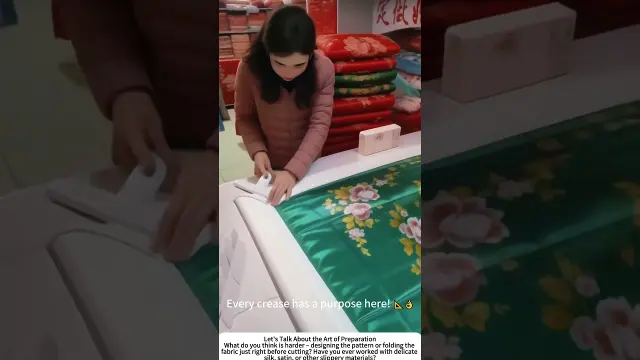
 Folding Patterned Silk Neatly in a Traditional Workshop
#Fabric Handling
1 ideas
Folding Patterned Silk Neatly in a Traditional Workshop
Get new #Fabric Handling ideas by email
Every Thursday: the week's best ideas, with the newest from #Fabric Handling.
Related tags
Fabric Handling: How to Hold, Cut and Care for Cloth
Fabric handling is the craft of knowing how a piece of cloth wants to be held, moved, cut, folded and kept. It sits underneath almost every textile skill: sewing, quilting, upholstery, embroidery, tailoring, even wrapping a gift or packing a suitcase. Two people with the same machine and the same material can produce very different results, because one of them understands how the fabric behaves in the hand and the other is fighting it.
What it covers
The phrase gathers together a set of small, practical judgements: how much to support a length of cloth so it does not stretch under its own weight, which way to lay a pattern piece, how to keep a slippery surface from sliding, how to press a seam without flattening the texture around it, and how to store a finished piece so it still looks the same years later. None of it is complicated on its own. What makes it a skill is that every fabric answers these questions differently.
Grain, drape and hand
Three ideas explain most of it. Grain is the direction of the threads: the lengthwise grain runs parallel to the selvedge and is the most stable, the crosswise grain has a little more give, and the bias — a diagonal — stretches considerably. Cutting or pressing against the grain changes how a garment hangs and can leave it permanently distorted.
Drape is how cloth falls under its own weight, from the crispness of a tightly woven linen to the fluid collapse of a fine silk or a crepe. Hand is the word for how it feels and moves: soft or firm, cool or warm, springy or limp. Before you cut anything, let the fabric hang or be held loose for a moment and watch what it does. It will tell you whether it needs firm support, gentle handling or almost none at all.
Read more
Materials behave differently
Woven cloths are generally more stable than knits, which stretch and can curl at the edges. Fabrics with a pile, such as velvet, corduroy or terry, have a direction and show every change of pressure, so they are usually cut in one direction and never pressed flat with force. Slippery weaves want to be pinned or weighted more generously. Delicate and loose structures need lighter handling and less handling overall.
Cutting, pressing and keeping
Wash or pre-shrink cloth before cutting when the finished item will be washed, and let it dry completely flat. Lay fabric on a surface large enough to support it, smooth rather than pull it into place, and cut with the cloth flat rather than letting it hang off an edge. Press by lifting and lowering the iron rather than sliding it, and test on a scrap first. Fold along seams and grain lines where you can, pad folds in delicate pieces with acid-free tissue, and store textiles away from direct light and damp, rolled rather than folded where the fabric is heavy or fragile.
Starting out
Beginners usually learn fastest by handling a scrap of every new fabric before committing to it: stretch it gently, press a corner, see how it frays. Patience at that stage saves hours later, and it turns an unfamiliar material into something you can read.
#Fabric Handling: frequently asked questions
How do I get started with fabric handling if I've never worked with cloth before?
Start with scraps rather than a project. Take a sample of any new material, give it a gentle pull in both directions, press a corner, and watch how the raw edge behaves, since that handful of small tests teaches you more about a cloth than reading about it. Doing this before you commit to a cut turns an unfamiliar fabric into something you can predict.
What should I have ready before I cut into a piece of fabric?
You want a flat surface big enough to hold the whole piece, sharp shears or a rotary cutter, and some weights or pins for anything slippery. If the finished item will be washed, pre-shrink the cloth first and dry it completely flat before laying it out. Give the fabric a few moments to hang loose as well, because how it falls will tell you how much support it needs while you work.
How do I decide which handling approach a particular fabric needs?
Read three things: grain, drape and hand. Check which way the threads run so you can place pattern pieces on the stable lengthwise direction, then watch how the cloth collapses under its own weight, and finally feel whether it is springy, limp, crisp or fluid. Crisp and heavy cloths want firm support, while loose or delicate ones reward light, minimal handling.
Which fabrics are hardest to handle, and how do I deal with them?
Piled cloths such as velvet or corduroy, slippery weaves, and loose knits cause the most trouble, each for a different reason. Pile shows every change in pressure and has a direction, so cut it all one way and press it without force; slippery surfaces need generous weighting or pinning; knits stretch and curl, so handle them with support rather than letting them dangle. Test on a scrap before you commit.
What are the most common mistakes people make when working with fabric?
Pulling cloth into place instead of smoothing it, letting a length hang off the table edge while cutting, and sliding a hot iron across the surface rather than lifting and setting it down. All three distort the cloth, and the damage often only shows up once the piece is finished. Pressing a scrap first and keeping everything supported prevents most of it.
How should I fold and store a finished textile so it still looks right later?
Fold along seams and grain lines wherever you can, and pad the creases of delicate pieces with acid-free tissue so the fold itself does not become a permanent mark. Heavy or fragile items are better rolled than folded. Keep everything out of direct light and away from damp, and check stored pieces occasionally rather than leaving them undisturbed for a long stretch.
Videos come from YouTube and posts from Instagram; titles and summaries are our own. All rights belong to their creators.