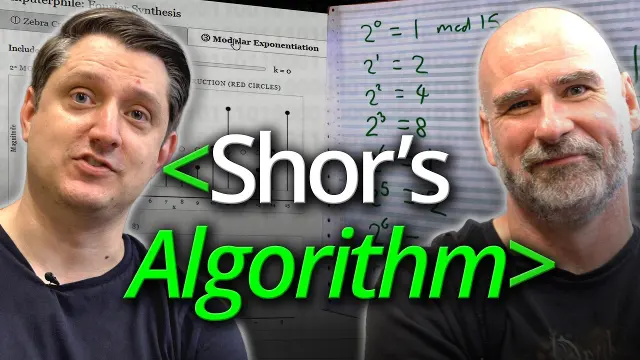
 Shor's Algorithm Explained by a Computer Scientist and Physicist
#Factoring
2 ideas
Shor's Algorithm Explained by a Computer Scientist and Physicist
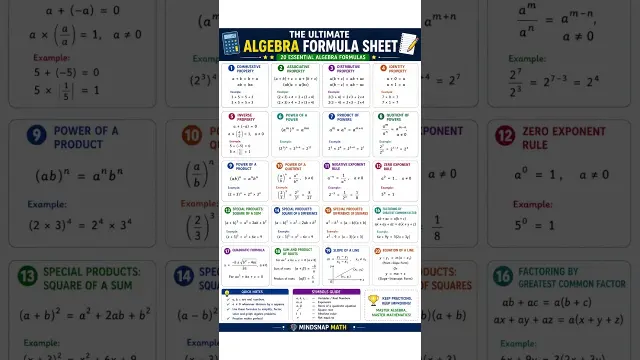 Twenty essential algebra formulas for quick exam revision
Get new #Factoring ideas by email
Every Thursday: the week's best ideas, with the newest from #Factoring.
Related tags
Factoring: Splitting Numbers and Expressions Apart
Factoring is the art of taking something whole and writing it as a product of smaller pieces. Multiply two numbers together and you get a result; factoring runs the process backwards, asking which numbers were multiplied to produce it. The word itself comes from the Latin factor, meaning a maker or doer — the parts that "make" the whole.
In arithmetic, the idea is simple: 12 is 3 times 4, and 4 is 2 times 2, so 12 is 2 times 2 times 3. Stop when every piece can no longer be broken into smaller whole factors, and you have a prime factorisation. Every whole number greater than one has exactly one of these, no matter which path you took to find it. That guarantee is one of the quiet pillars of number theory, and it is what makes factorisation useful for finding common denominators, simplifying fractions, and working out lowest common multiples.
Why factoring is worth the effort
Factoring turns hard problems into easy ones. A fraction like 42 over 56 looks awkward until you notice both share a factor of 14 and reduce to three quarters. In algebra, rewriting an expression as a product reveals its structure: where it equals zero, where it peaks, which values make it undefined. Solving equations usually means factoring one side and setting each piece to zero, because a product is zero only when at least one of its factors is.
Read more
The main techniques for expressions
- Take out the common factor first. It is the fastest move and often the only one you need.
- Look for a difference of two squares: something of the form a squared minus b squared, which splits into two matching brackets with opposite signs.
- For three-term expressions, find two numbers that multiply to the constant term and add to the middle coefficient.
- With four terms, group them in pairs and factor each pair, hoping a shared bracket appears.
- Cubes have their own patterns, worth learning once and recognising forever.
Try these in order. Beginners often jump to the clever pattern when a common factor would have simplified everything in one line.
Practical advice
Always expand your answer back out to check it. Factorisation is easy to verify and hard to get right first time, which is a rare gift — use it. Learn a handful of squares and cubes by heart so patterns leap out. If an expression refuses to crack, ask whether it factors at all: many do not, and recognising that is a skill rather than a failure.
Beyond the classroom, the difficulty of factoring very large numbers underpins a great deal of modern digital security, which is why the topic keeps drawing mathematicians and computer scientists alike.
#Factoring: frequently asked questions
What does factoring actually mean?
Factoring runs multiplication backwards: instead of combining pieces into a result, you look at the result and work out which pieces produced it. You keep breaking those pieces down until nothing further can be split, and what remains are the factors. The idea is the same whether you are dealing with plain numbers or with algebraic expressions.
Where should I start when factoring an expression?
Scan every term first for something they all share, and pull that common factor out before anything else. It is the fastest step and frequently the only one you need. Reaching straight for a clever pattern while a shared factor is still sitting there is the mistake beginners make most often.
How do I know when I have finished factoring?
You are done when none of the remaining pieces can be broken into smaller whole factors. For ordinary numbers that endpoint is unique, so different routes all arrive at the same place. With algebraic expressions, you are finished when no bracket shares a factor with another and no known pattern still applies.
How can I check that my factorisation is correct?
Multiply everything back out and compare the result with what you started from. This is the quiet advantage of the topic: the answer is quick to verify even when it was slow to find, so there is no reason to leave it unchecked. If the expansion does not match, look for a dropped sign or a common factor you only partly removed.
What should I do if an expression refuses to factor?
Many expressions genuinely do not factor at all over the numbers you are working with, and spotting that is a skill rather than a failure. Work through the methods in order — shared factor first, then the standard patterns — and if none of them bites, question whether you have misread the expression. Knowing when to stop saves you from chasing something that is not there.
Which technique suits which kind of expression?
The structure points to the method: a factor shared by every term, a square subtracted from another square, a three-part expression, or one that splits neatly when you group the terms. Match the technique to the shape rather than trying them at random. Whatever route you take, expand the result at the end to confirm it.
Videos come from YouTube and posts from Instagram; titles and summaries are our own. All rights belong to their creators.